The Bonanzaville open air pioneer village museum in Fargo is one of North Dakota’s most important historical attractions.
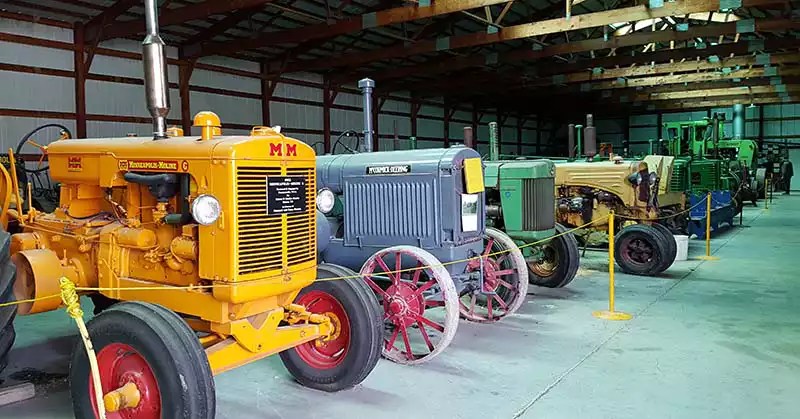
This open air museum is the work of the Cass Country, North Dakota, Historical Society. It was organized in 1954 to preserve the area’s pioneer history.
What’s in the Bonanzaville Museum?
Bonanzaville has 40+ historic buildings on site to create its pioneer village (see the village map). Overall, 400,000+ artifacts are displayed on the 12 acres that belong to the museum.
Well organized into village streets, the museum is easy to navigate. The buildings take visitors through the typical pioneer community and agricultural exhibits with lots of extras thrown in.
Some of the buildings and exhibits include:
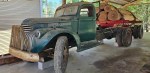
- Eugene Dahl Car Museum
- Ellingsberg Carriage House
- Cass County District Courthouse
- Brass Rail Saloon and Hotel
- Blacksmith Shop
- Embden Depot
- Hunter Times newspaper
- Law Enforcement Museum
- Pioneer Fire Company
- Moum Agricultural Building

The museum gets its name from the Bonana Farms of the mid-1800s. Thus, a lot of its focus is on the history of North Dakota agriculture.
According to the State Historical Society of North Dakota, the Great Dakota Boom of 1878-1887 was the busiest period of Euro-American settlement on the Northern Plains.
How did North Dakota Bonanza Farms get their name?
Many of us think of gold when we hear the word Bonanza. In fact, the term came from the Spanish, and meant “a rich lode,” according to the online etymology dictionary. The first use of bonanza with this definition is documented as 1844, which coincidentally is the start of the gold rush fever that consumed North Americans until the end of the 1800s.
Fast Fact: The wealth on Bonanza farms, however, didn’t come from minerals, although it did come from the ground and was “gold.” Indeed, Bonanza farms were enormous dirt farms that grew golden fields of wheat.
Most were situated along the Red River, which flows for 550 miles through North Dakota, Minnesota, and Manitoba. And yes, while Bonanza farms, like gold strikes, meant that someone hit it rich, there’s a lot more to the story.
Over the years, North Dakota has been home to 91 Bonanza farms, according to True West Magazine. While the farms were all supersized, some were much larger than others. In fact, they ranged from 3,000 to 200,000 acres each in an era when North American farms were around 160 to 320 acres.
[A version of this article was first published in the online publication, guide2travel.]
When I visit museums, I’m always looking for pieces a little out of the ordinary. In Bonanzaville, that turned out to be the commercial diary — the Cass-Clay Creamery reproduction from the 1920s.
Fast Fact: Did you know that butter was originally packed into square wooden boxes, chilled, then sliced with thin wires (like a cheese cutter) into long thin chunks to sell? I hadn’t!
Linda’s Pick of the Displays at Bonanzaville
Pioneer museums showcase an area’s history and its significant contributions.
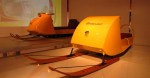
While I was less fascinated, David spent a lot of time going through the bobcat display (headquarters in West Fargo, ND) in the Melroe Tractor Building. They’re another important part of North Dakota history.

There were lots of machines and information about these skidsteers that didn’t start out quite as small and maneuverable as they are today.

Another favorite for both of us was the Moum Agricultural Building. It held the world’s largest bulldozer, and the first Steiger tractor ever built.
Fast Fact: The world's largest bulldozer, which is on display in Bonanzaville, once worked in the coal fields outside Estevan, Saskatchewan.
The first Steiger tractor was built on their farm by John Steiger and his sons, Douglass and Maurice. It was originally built in Minnesota, but headquarters moved to Fargo in 1969.
Eagles Air Museum
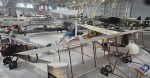
The Bonanzaville museum showcases more than agricultural and pioneer history. It also has 20+ airplanes in the Eagles Air Museum, dating from 1911 to 1975.
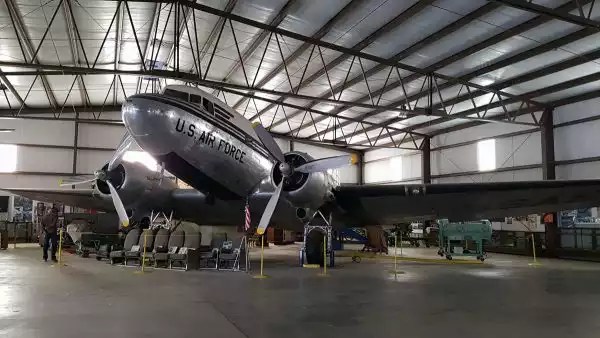
“The Governor’s Plane,” a C-47 that flew in the D-Day invasion, is its main attraction. Fargo has been home to an air force base, the 119th Wing (119 WG) squadron, for 60+ years.
Linda’s Road Trip Tips
If you find the idea of Bonanza farms intriguing, you can visit one just 50 miles away from Fargo — the Bagg Bonanza Farm in Mooreton, ND. This farming museum is right off I-29.
There’s also lots to do in the Fargo area. I enjoyed the Historical & Cultural Society of Clay County – Hjemkomst Center with its feature full-scale ship modeled after the Gokstad burial ship. And while it’s a model, the ship has sailed to Norway and back, so it’s no stranger to water.
We also really enjoyed the Fargo Air Museum, which is located near Hector International Airport.
How Do You Visit Bonanzaville?
The open air pioneer village museum, Bonanzaville, in Fargo, North Dakota, has 40+ historic buildings. It contains typical pioneer community & agricultural exhibits with lots of extras.
Street Location: Bonanzaville is a North Dakota attraction located just outside West Fargo at 1351 Main Avenue W.
Parking: There's lots of free parking available at the entrance to the pioneer village.
Fargo, along with its twin city of Moorhead, Minnesota, and the adjacent cities of West Fargo, North Dakota, and Dilworth, Minnesota, form the core of the Fargo–Moorhead, ND-MN Metropolitan Statistical Area (MSA).
The MSA is at the junction of the two Interstate highways, I-29 and I-94.
Learn more about visiting Fargo / Moorhead.
The open air pioneer village museum typically opens in May (limited hours) and closes after the summer season (full hours) at the end of September (limited hours). For information on operating hours and admission fees for this living history farm museum, as well as upcoming events at Bonanzaville, see:
Bonanzaville
Bonanzaville Facebook Page
Visit Bonanzaville virtually with the Valley News Live production, North Dakota Today – Bonanzaville, on Youtube.
Find More Museum Reviews for North Dakota
Check out more reviews of museum attractions in North Dakota on guide2museums.com.
Discover More History Museums
- Musée de la civilisation: Quebec’s Museum of Civilization
- Inside the Cattle Raisers Museum: Fort Worth, Texas

- Plains of Abraham Museum & Battlefield Park: Quebec City

- Royal Ontario Museum in Toronto Review
- Amazing Giant Bison, Beaver, Mammoths & More: Yukon Beringia Museum in Whitehorse

- Royal Saskatchewan Museum & World’s Largest T-Rex Dinosaur

- Fick Fossil & History Museum: Buffalo Bill to Prehistoric Fish in Oakley, Kansas
- Ronald Reagan Presidential Library & Museum: Simi Valley, California

- Morro Bay Maritime Museum: Morro Bay, California

- National Cowgirl Museum & Hall of Fame: Cowgirl history in Fort Worth, Texas
- Bell Barn Museum: Historic Round Barn in Indian Head, Saskatchewan

- Naranjo Museum: Dinosaurs & Fossils in Lufkin, Texas

- Texas Seaport Museum: Gulf Coast History in Galveston, Texas

- Levine Museum of the New South: Charlotte, North Carolina

- Jefferson Historical Museum in Big Cypress Bayou: Jefferson, Texas
- Museum of the Fur Trade: Chadron, Nebraska

- Mystic Seaport Museum: Historic Seafaring Village in Mystic, Connecticut

References
Bommersbach, J. (2014). The last Bonanza farm. TrueWest. Retrieved from https://truewestmagazine.com/the-last-bonanza-farm/
Farms in North Dakota: A historical context. (2014). Bismarck, ND: State Historical Society of North Dakota. Retrieved from https://www.history.nd.gov/hp/PDFinfo/Farms-in-North-Dakota-Part1.pdf
Goerger, V. V. (2016). A century of life on the Bagg Farm and Red River Valley. Fargo: Knight Printing.
National Historic Landmark Designation: BAGG, FREDERICK A. AND SOPHIA, BONANZA FARM. (2005). United States Department of the Interior, National Park Service. Retrieved from https://npgallery.nps.gov/GetAsset/ccaecbfb-b034-4985-b425-9ff38fa594fa


 guide2museums.com