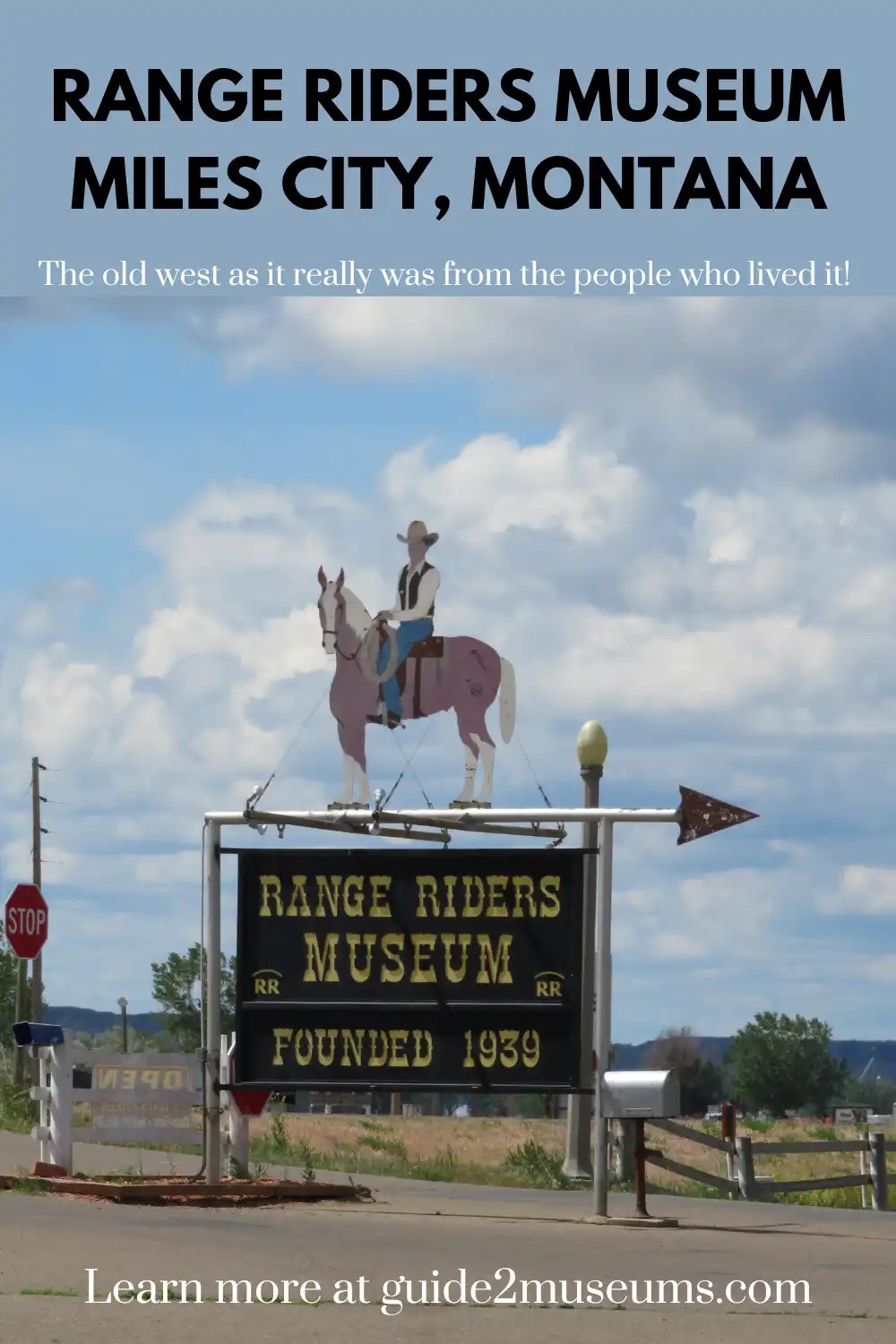
Roadtripping down I-94 in Montana, you’ll find the amazing western heritage museum, the Range Riders Museum.
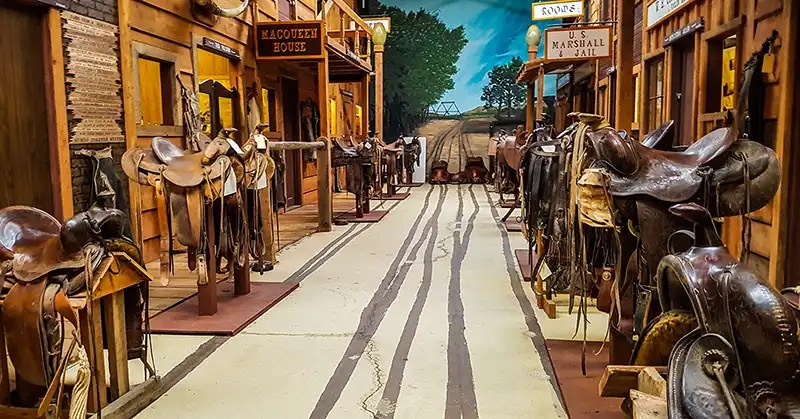
When it comes to authenticity, the Range Riders Museum attraction in Miles City, Montana, is unequaled. Established in 1939 by actual range riders, this museum preserves the artifacts and tells the stories.
Linda’s Pick of the Exhibits
My favorite exhibits revolved around the cowboy history — the cows — and the fences.
After growing up on a horse ranch with a steady diet of old westerns, some of the first YA novels I was inspired to write revolved around cattle drives and outlaws: Badlands & Outlaws and Kidnapped by Outlaws.
But back to the cowboy heritage museum!
Back in the ‘day, the range was wide open and cattle grazed wherever the cowboys could find water.
EASY READERS. Fairy tale and fable ebook retellings set in the old west pioneer days – BUY FOR $2.99 EACH on Amazon Kindle
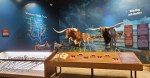
When did Texas longhorns reach Montana?
Around Miles City the water supply was the Yellowstone River. Texas longhorns had reached Montana by 1866 (Tusler, 2013), and small ranches popped up. Eventually these gave way to the short-lived 1880s era of cattle barons.
The era of cattle barons really got rolling in Miles City with the arrival of trains.
Indeed, the Northern Pacific Railroad came to town in 1881-82, making the city a key transportation crossroad. Main Street in Miles City, which is listed as a National Register historic district, was the town’s main business center until the late 20th century.
History of Barbed Wire
Fast Fact: Barbed wire is an American invention, having been patented in 1867. However, as with all things it didn't gain importance until a manufacturer stepped in. That happened in 1874, when Joseph Glidden of De Kalb, Ill., came up with a machine to build it.
Barbed wire marked the end of the open range of ranching. Fenceposts strung with wire made way for a different lifestyle where ranchers could contain their stock in one place.
What I didn’t know was how many kinds of barbed wire have been used! In fact, nearly 400 patents for barbed wire have been made.
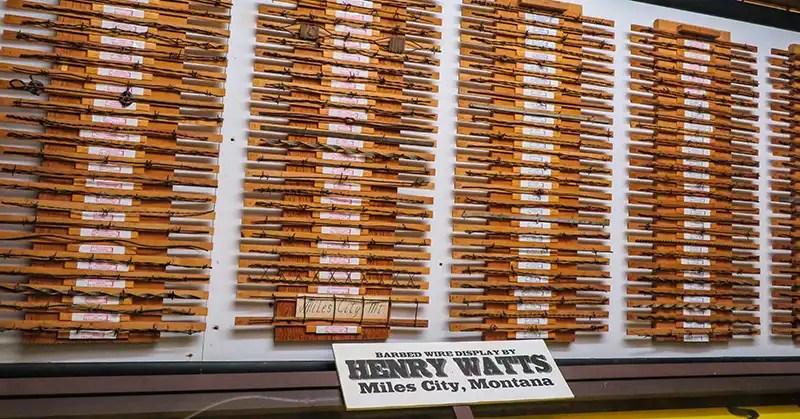
Once barbed wire was readily available, it didn’t take long for it to turn the wide open grasslands of the west into pastures.
Brands on the other hand, were the “signature” of ranchers on the open range. Each ranch’s mark was stamped into the hips of animals with red hot branding irons.
What books did Linda write about outlaws in the old west?
Linda has published three books about outlaws in the old west: 1 nonfiction and 2 fiction for teens and adults.
NONFICTION: Station No. 1 on the Outlaw Trail: Old West Outlaws
FICTION: Badlands and Outlaws
Kidnapped by Outlaws (Sequel to Badlands and Outlaws)
What’s in the Range Riders Open Air Museum
The Range Rider Museum is a sprawling open air museum that includes the original 2800 square foot log building dedicated in 1942.
Today, the museum has 13 buildings. Some of them have been relocated from nearby places and are spread out like an old west town.
Inside the buildings, there’s an impressive 38,000 feet of display area filled with everything from antique tools to fine china!
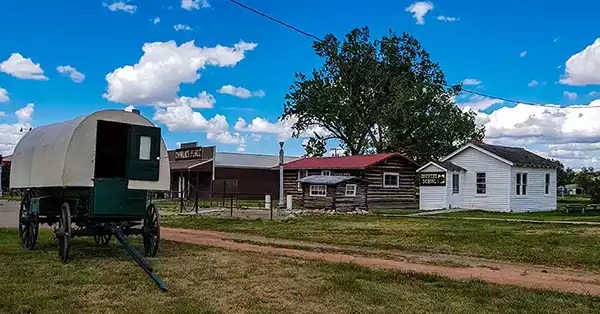
Specialized areas include:
- Fort Keogh Officers’ Quaraters
- Coach House
- Homestead House
- One-Room School
- Indian artifacts from the Sioux, Cheyenne, and Crow peoples
- Charley Russell Gallery
- Carol’s Hattery
- Lame Deer & L.O. Ranch Replicas
Main Street: Old Miles Town
We started our tour on Main Street, Old Miles Town, after leaving the reception area. The log building fronts all sport signs identifying their purpose.
What’s in the Bert Clark Gun Collection?
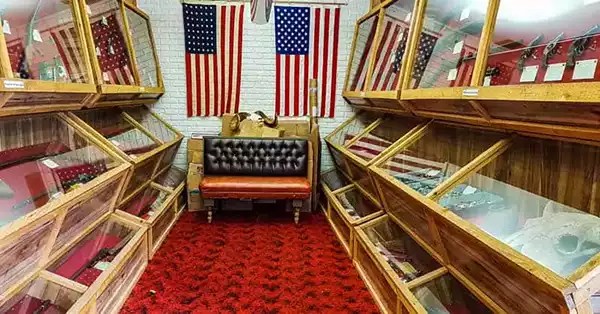
The collection of guns is one of the museum’s premier displays. Bert Clark, or BJ, was the youngest of seven children born to a Wisconsin family. He was an accomplished boxer, even teaching it for a decade. In 1940, he, along with his wife, Alta, moved to Miles City, until they eventually retired in the 1960s. B.J. died August 19, 1964, with complications after surgery.
Clark spent forty-five years building his collection, which consists of many unique guns.
Fast Fact: Clark's collection includes: an 1852 .44 cal. double action pistol, an 1858 Remington .44 cal. pistol from the Civil War, and a pistol, which was still loaded and in its holster, found by Walt Quinlan near where Custer camped on the Rosebud.
There were also French Flintlock pistols circa 1770, a bayonet with extra long blade so it could be used as a sword used in the Philippines, and a late 1800s 12 gauge double barrel, open hammer, lever under the trigger shotgun from England.
You can wander through the U.S. Marshall & Jail to Rooms (both provide rooms, although the experience between the two was significantly different in the old days!).
Instead of horses tied to the hitching rails though, the poles hold saddles of every make and description.
And what else symbolizes the old west better than a saddle?
Saddles have been around for millennia. However, the saddles of the range riders, which are what we still use today, took centuries to evolve.

Types of Saddles
The initial design started with saddles built for war. They were brought by the Moors to the Spanish, who improved on them by adding more protection for horse and rider.
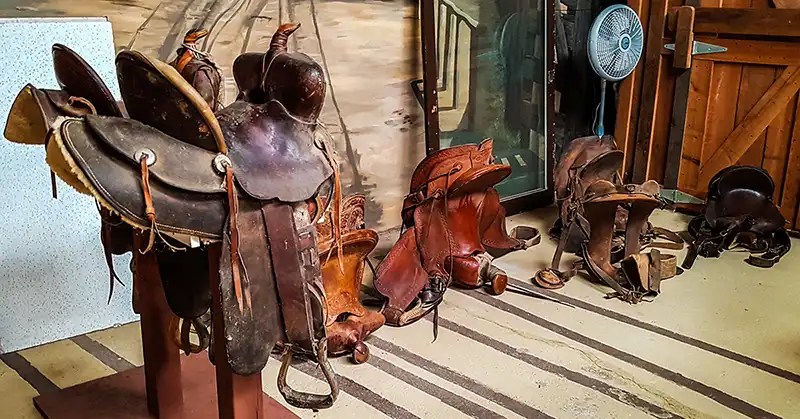
Eventually these became the stock saddles on display in the museum.
Fast Fact: What makes stock saddles different? The high pommels and saddle horns used when roping cattle or horses.
Mind you, I remember finding the horn most useful for hanging on when competing in barrel racing events!
Of course, each building on Main Street is set up according to its sign. We wandered through the Conservancy for Music, the Post Office, the Grey Mule Saloon, Bob’s Barber Shop, Macqueen House, the Drug Store, and more.
When was Miles City, Montana, established?
The museum recognizes the earliest Indigenous inhabitants of the area with an interactive display, the Lame Deer Camp. It tells the story of the conflict that played out during settlement and how the natural terrain was important.
The first visitors to this area used Mackinaw flat-bottomed boats on the Yellowstone river and its tributary, the Tongue River, which empties into the Yellowstone at Miles City. The Yellowstone rises just outside of Yellowstone National Park in Wyoming. It runs for nearly 700 miles across Montana until it joins the mighty Missouri River in North Dakota.
While the Yellowstone is the longest free-flowing river in the lower 48 states, the Missouri was much more important for moving people and cargo.
Miles City was founded in 1877 near Fort Keogh. The museum celebrates this history with a scale model of the Fort in an interactive room where you can explore its history. You can also walk through one of the original Officers’ Quarters buildings, which was moved to the museum grounds.
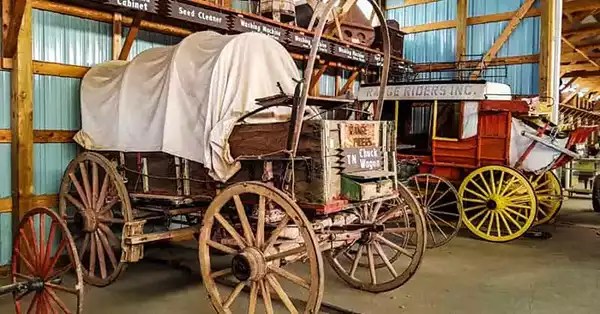
While there were earlier stages, the state’s first regular stagecoach lines ran from Salt Lake City, Utah, to Virginia City and Billings, Montana, starting in the 1860s.
A lot of Montana, though, wasn’t accessible via river, so stagecoach travel was important.
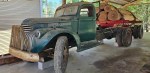
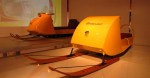
Mules, freight wagons, and bushwackers predominated in good weather, followed by sleds and sleighs when winter hit.
Home on the Range
The ranch houses of the west had little in common with the fancy parlors and fine china of the east. Indeed, the life of ranch wives was often a tough one with few luxuries available before the turn of the 20th century.
Furniture was often roughly made and focused on utility, rather than fine wood carvings and finishes.
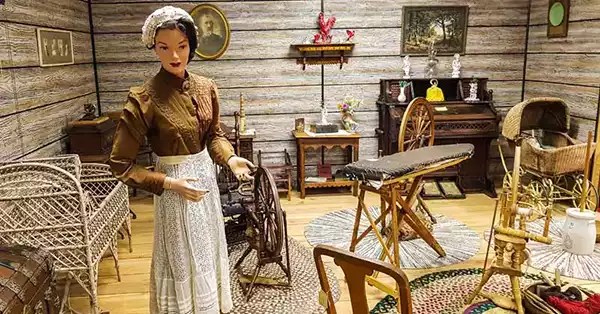
The Range Riders Museum attraction has an original pioneer home moved to the location from its original homestead.
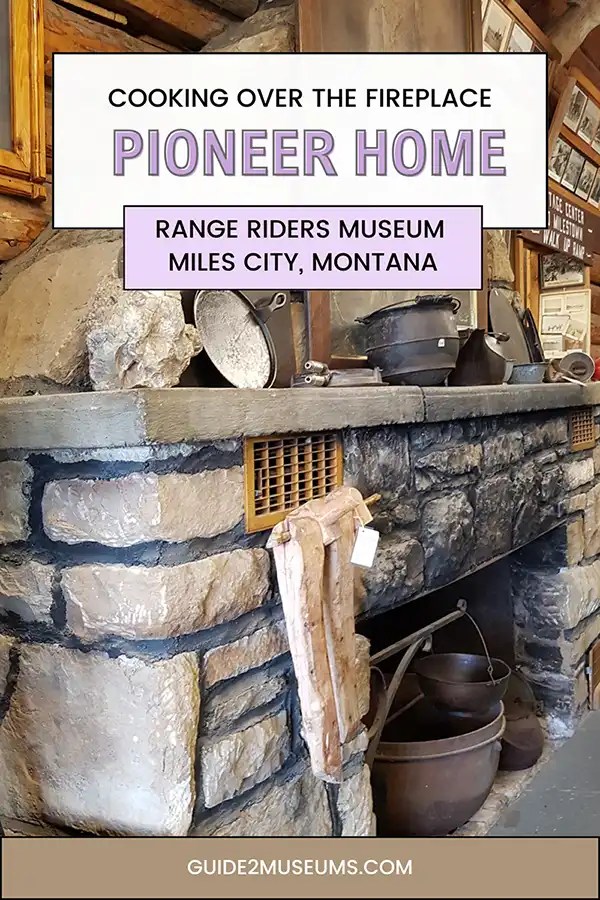
The house is complete with wood burning stove, a huge tin coffee pot, a chamber pail under the bed, so its owners didn’t need to make a midnight run to the outhouse, and a wooden cradle for baby.
When it comes to early western life, there are lots of other displays throughout the museum in addition to the pioneer home.
One display I really enjoyed was the original wedding outfits of the Jelinek Wedding display, complete with the retirement photos of the couple. Sylvia’s China and Carol’s Hattery were two more.
Linda’s Road Trip Tips
Miles City was a fun stop on our trek across Montana on I-94. I especially wanted to visit the historic Montana Bar and wasn’t disappointed with what I found!
The bar is considered one of the best preserved historic bars in Montana. So, it doesn’t take much to imagine cowboys (and a few outlaws) stepping over the original Italian tile floor and dropping into one of the booths with their solid cherry wood tables.

Throw in some steer heads, brown tin ceiling tiles, and statues of cowboys on bucking broncs, and you’ve got an historic western atmosphere.
And of course the food (a steak sandwich) was delicious. That night we stayed at the Econo Lodge, which was affordable and comfortable.
Who Should Visit the Range Riders Museum?
The Range Riders Museum for anyone interested in a cowboy and western heritage museum. Indeed, it’s one of the best cowboy museums we’ve ever visited.
Whether you’ve lived the cowboy life yourself, or want to know more about cowboy origins, this is a great Montana attraction.
We spent most of the morning going through the exhibits and could have been much longer. The museum uses excellent signage, so it identifies the artifacts, and in many cases, the ranch family that used and contributed it.
The main parts of the museum will be readily accessible to those with mobility issues.
If you’re traveling I-94, be sure to put this Montana attraction on your itinerary!
How Do You Visit the Range Riders Cowboy Heritage Museum?
The museum is open seasonally, typically from mid-April to mid-October. It’s located at: 435 W. I-94 Business Loop, Miles City, MT. The mailing address is 435 L P Anderson Rd, Miles City.
Check days open, hours, and admission costs on the Range Riders Museum website.
Check what’s happening on the Range Riders Facebook page.
Take a virtual tour of the Range Riders Museum with the Miles City Chamber of Commerce on YouTube.
Range Riders Museum on Google Maps.
Find More Museum Reviews for Montana
Check out more reviews for museum attractions in Montana on guide2museums.com.
Explore More History Museums
- Musée de la civilisation: Quebec’s Museum of Civilization
- Inside the Cattle Raisers Museum: Fort Worth, Texas
- Plains of Abraham Museum & Battlefield Park: Quebec City
- Royal Ontario Museum in Toronto Review
- Amazing Giant Bison, Beaver, Mammoths & More: Yukon Beringia Museum in Whitehorse

- Royal Saskatchewan Museum & World’s Largest T-Rex Dinosaur

- Fick Fossil & History Museum: Buffalo Bill to Prehistoric Fish in Oakley, Kansas
- Ronald Reagan Presidential Library & Museum: Simi Valley, California

- Morro Bay Maritime Museum: Morro Bay, California

- National Cowgirl Museum & Hall of Fame: Cowgirl history in Fort Worth, Texas
- Bell Barn Museum: Historic Round Barn in Indian Head, Saskatchewan

- Naranjo Museum: Dinosaurs & Fossils in Lufkin, Texas

- Texas Seaport Museum: Gulf Coast History in Galveston, Texas
- Levine Museum of the New South: Charlotte, North Carolina

- Jefferson Historical Museum in Big Cypress Bayou: Jefferson, Texas
- Museum of the Fur Trade: Chadron, Nebraska

- Mystic Seaport Museum: Historic Seafaring Village in Mystic, Connecticut

References
MacDonald, J.G. (1950). History of navigation on the Yellowstone River. Missoula: University of Montana. Retrieved from https://scholarworks.umt.edu/cgi/viewcontent.cgi?article=3584&context=etd
Tusler, K. (2013). The cattle barons rise and fall. Billings: Rocky Mountain College. Retrieved from https://www.rocky.edu/sites/default/files/tusler-honors-thesis.pdf
Schwantes, C.A. (n.d.). The steamboat and stagecoach era in Montana and the Northern West. Published in Montana the Magazine of Western History. Retrieved from https://go.gale.com/ps/i.do


 guide2museums.com