The Doukhobors left persecution in Russia and settled in Saskatchewan in 1899. The fascinating Doukhobor Museum in Veregin, opened in 1980, tells their story.

Linda’s Pick of the Exhibits
I have two favorites here, but I’ll start with the banya.
Fast Fact: A banya is a type of Russian steam-bath house. Water was typically heated with a stove.
It’s surprising to me that in an era when other settlers managed sporadic baths in folding wood or tin tubs, that there’d be a whole building set aside for cleaning purposes. In those days, it seemed only the wealthy could afford a space set aside just for bathing!
While you might expect the beautiful, big Prayer House to be my favorite, you’d be wrong. As lovely as it was, a lot of the floorspace was set aside for church services as well as management.

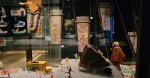
So, my favorite was the re-creation of a Doukhobor log house. It displayed the typical craft objects brought by the settlers to Canada, including clothing and floor coverings, as well as furniture they brought or made after arrival.
I loved the wall hangings with their bright colors, the woolen blankets (and spinning wheel!), and floor rugs.
The baby’s cradle, hung from poles over the parents’ bed, was beautifully draped with fabric, no doubt to keep the child from being pestered by insects!
What’s at the Saskatchewan Doukhobor Museum?
The museum is officially known as the National Doukhobor Heritage Village. As well, Saskatchewan’s Doukhobor Museum is also known as the Veregin National Historic Site of Canada, since it received Canadian national recognition in 2006. It’s also a Saskatchewan Historic site.
The Doukhobor Canadian story began in 1899, when about 7,500 people of the Doukhobor faith arrived, most settling in what was then the Northwest Territories. They had suffered religious persecution for two centuries in Russia.

On June 29, 1895, the Doukhobor Community made a final stand against military service and the Tsar in Russia.
They eventually fled the country.
Before settling in Canada, they were granted the freedom to practice their faith without military service.
Peter V. Verigin, originally exiled in Siberia, rejoined the group who had settled north of Yorkton, Saskatchewan, in 1902. With their leader once again part of the community, it began to thrive and grow.
Exhibits
Today, the Doukhobor village is an open air museum consisting of 13 original and reconstructed buildings all accessible to visitors. The largest is the (ca. 1917) Prayer Home. It was declared a Saskatchewan Provincial Heritage Building in 1982.
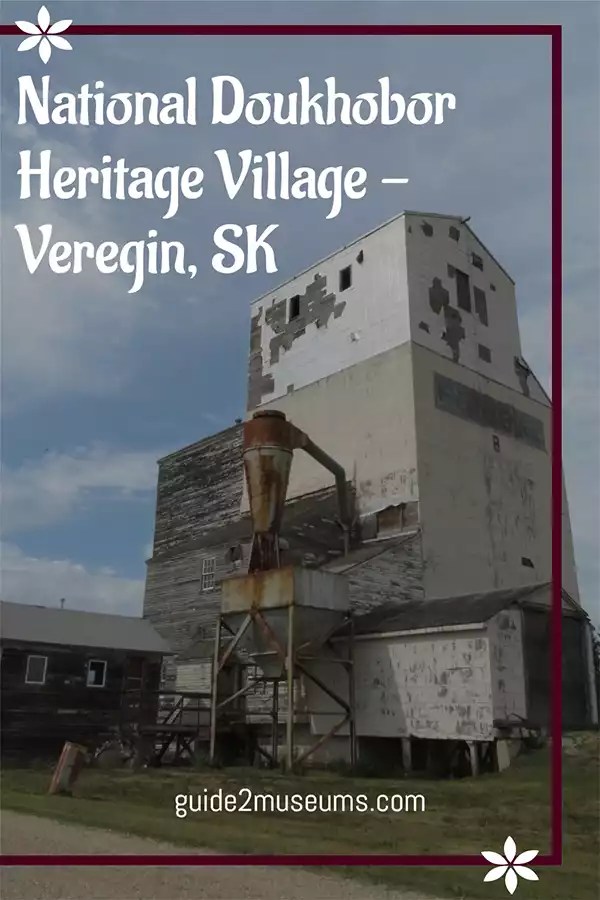
This building was, however, the second prayer home built there, as the original brick one was much smaller–it still stands today, opposite the larger one.
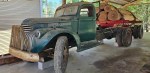
The machine shed, grain elevator, and foundations of the old store are also early constructions. In addition to various buildings, there are a number of pieces of vintage machinery and a stone oven.
Fast Fact: A statue of Leo Tolstoy honors him for all of his efforts in finding a new home for the Doukhobors. It was presented in 1987 by the Association of Canadians of Russian descent.
A Peace Grove monument celebrates Canada’s 125th birthday. It’s in honour of Canada’s international peace-keeping role, as well as their Doukhobor ancestors. On June 29, 1895, the Doukhobors destroyed all of their weapons, making a stand for peace.

Each item inside the many buildings is labelled (if required) and provides a history of its owners. Throughout, the story of the Doukhobor settlers and their communal ideals is provided through historic photos and artifacts.
Linda’s Road Trip Tips
This is a great area of Saskatchewan to visit to learn more about the cultures of various early settler groups.
- Kamsack Power Museum is just over 10 minutes east on Hwy 5, with its history of Russian, Ukrainian, and Chinese heritages.
- Canora Ukrainian Heritage Museum is just a half hour west on Hwy 5.
- Get a selfie with the 7.6 m statute of Lesia (a Ukrainian girl) in traditional dress holding a traditional welcome of bread and salt.
- Preeceville is just 45 minutes north of Veregin with its 22 room museum occupying an old Nurses’ Residence. Here, you’ll learn more about Ukrainian, Scandinavian, and British settlers from this area.
Who Should Visit the National Doukhobor Heritage Village?
The open air venue makes the museum a perfect stop for families, as there’s lots of area for children to explore outdoors.
That said, the level grassy lawns are manageable by most people with mobility issues. Inside the Prayer House, as you’d expect, there isn’t an elevator as the house maintains its original build.
Anyone interested in exploring turn of the 20th century lifestyles will find this a should-see stop.

The focus here is cultural. So, the museum will appeal to those curious about other cultures, particulary those from other religious denominations. Likewise, while there is some farming equipment, it’s a minimal display of well chosen artifacts.
Also, of course, anyone with an interest in the history of the Doukhobors in Canada will find it a must-see spot.
How Long Does It Take To Tour The National Doukhobor Heritage Village?
When you visit, allow 2 – 3 hours to go through the exhibits. Anyone with mobility issues will take longer as you have to move from building to building to see everything.
How To Visit the National Doukhobor Heritage Village
The National Doukhobor Heritage Village is located in East Central Saskatchewan on Highway #5 in Veregin, between the towns of Canora and Kamsack. It’s north of the city of Yorkton.
Typically the historic site is open from mid-May until mid-September, but check for specific days, times, and admission fees on the Doukhobor Heritage website.
Keep updated on what’s happening at the village, or when/how to attend a church service, with the National Doukhobor Heritage Village Facebook page.
Plan your visit now with Google maps. If you enjoyed this article, please pin it.
Discover More Museums in Saskatchewan
Exploring Saskatchewan? Here’s a list of guide2museum.com museum reviews for the Canadian province of Saskatchewan.
Discover More Heritage Museums
- Boot Hill Museum: Kansas Wild West Myth Meets Lived History
 The Boot Hill Museum in Dodge City, Kansas, provides an authentic–and exciting–look into the state’s past as Queen of the Cowtowns.
 - Maple Creek’s Intriguing Jasper Cultural & Historical Centre
 Learn more about “The Old Cowtown of Maple Creek,” Saskatchewan, with a visit to the Jasper Cultural & Historical Centre. From a Charlie Russell print collection to mounted policing history, you’ll find lots of intriguing stories.
 - Front Street Cowboy Museum: Ogallala, Nebraska
 Step into the wild, wild west in Ogallala, Nebraska. Its stories cover cowboys and lawmen to the Nebraska Sandhills Warrior Rabbit and undertakers.
 - Discover the Mormon Handcart Historic Site & Devil’s Gate in Wyoming
 Discover the history of pioneers who walked across the U.S. pulling hardcarts holding all of their belongings. The Mormon Handcart Historic Site consists of Martin’s Cove and the Sun Ranch.
 - See 100 Miles Across Nebraska From Scotts Bluff National Monument
 From hiking to museum exhibits about the Oregon Trail that ran through Gering, Nebraska, Scotts Bluff National Monument is a great summer stop. You’ll also see photos, sketches, and watercolors by William Henry Jackson.
 - Standout Ranching History at the MonDak Heritage Center: Sidney, Montana
 Check out the ranching displays and 1930s Main Street at the MonDak Heritage Center in Sidney, North Dakota. If you love Western art, see the collection from J.K. Ralston.
 - New Iceland Heritage Museum: Gimli, Manitoba, Canada
 From Icelandic Rocks! to life inside an Icelandic settlement, there’s lots to learn at the New Iceland Heritage Museum. It’s situated in Gimli on the shore of Lake Winnipeg 55 miles from Winnipeg, Manitoba.
 - Crazy Horse Memorial & Museums: South Dakota’s Black Hills
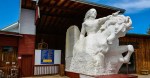 The Crazy Horse Memorial is a sculpture cut into Thunderhead Mountain in the Black Hills of South Dakota. There’s also a museum and cultural center with the memorial.
 - Myra Museum: Lustron House & More in Grand Forks, North Dakota
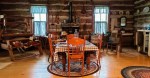 The Myra Museum in Grand Forks, North Dakota, is an open air heritage museum. It features the historic Campbell House and a Lustron metal prefabricated home, as well as several other furnished buildings and a main museum building.
 - Fort Cody Trading Post: Miniature Wild West Show in North Platte, Nebraska
 The key attraction at the Fort Cody Trading Post in North Platte, Nebraska, is a miniature wild west show. This amazing piece of art consists of 20,000 to-scale carvings of Buffalo Bill’s show.
 - Miracle of America Museum: 40+ Buildings in Polson, Montana
 The Miracle of America Museum is located in Polson, Montana, just outside Glacier National Park. It’s an eclectic collection of Americana from logging tow boat to toys and dolls.
 - Sukanen Ship Pioneer Village & Museum: Moose Jaw, Saskatchewan
 The Sukanen Ship Pioneer Village and Museum is just outside Moose Jaw, Saskatchewan. This open air museum features a huge Allis Chalmers & Case IH tractor collection, and much more!
 - Museum of Northern British Columbia: Indigenous Art & History in Prince Rupert, British Columbia
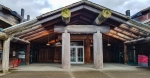 The Museum of Northern British Columbia is in Prince Rupert. Its collection focuses on the Indigenous art and history of the area’s First Nations.
 - Heritage Village: Museum in Weyburn, Saskatchewan
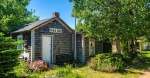 Heritage Village museum is located in Weyburn, Saskatchewan. It recreates a small town of the early 1900s in an open air collection of buildings and artifacts.
 - Vermilionville: Living History Open Air Village in Lafayette, Louisiana
 The Vermilionville Historic Village is an open air museum in Lafayette, Louisiana. It has a variety of displays, artifacts, buildings, and costumed interpreters on 23 acres along Bayou Vermilion.


 guide2museums.com