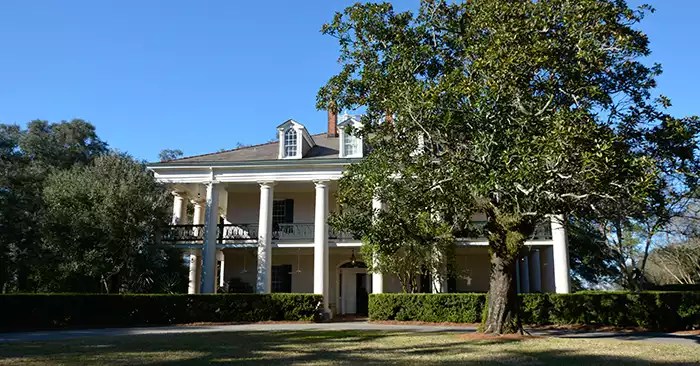
Oak Alley Plantation is sometimes called the Grand Dame of River Road–the 70 mile corridor that runs from New Orleans to Baton Rouge along both sides of the Mississippi River. Oak Alley Plantation is a National Historic Landmark that brings the Antebellum period to life for visitors.
It’s an historical–even magical–place, where you half expect to see Southern belles strolling through the gardens with their gentlemen callers. And maybe hear a steamboat whistle as it makes its way down the Mississippi, past the fields of sugar cane.
The long tree-lined lane that gives Oak Alley Plantation its name was planted between 1725 and 1770. Today, those trees have all the grace and beauty of the women who’ve walked beneath them.
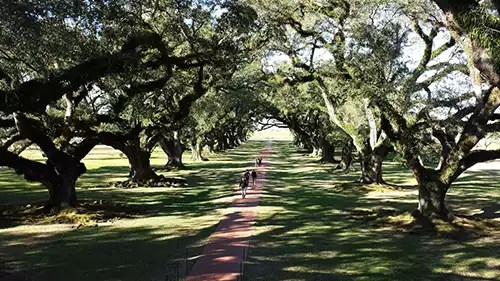
What’s at Oak Alley Plantation?

My tour of Oak Alley began with Thomas, a tour guide dressed in a Civil War soldier’s uniform. He escorted us through the house, providing lots of details about its history as well as answering questions.
Oak Alley, Thomas explained, had been a Creole plantation with 1200 acres of land.
While not as ostentatious as many Antebellum plantation houses belonging to moneyed gentlemen, the furnishings still represented a more-than-comfortable lifestyle.
While not secure, you can check out an interactive timeline that takes you through nearly 300 years of history.
In the Creole plantation home, the social season lasted through the winter from 12th Night when the celebrations became social rather than religious, through Mardi Gras.
The grounds of Oak Alley are just as fascinating as the house, since a number of the cabins of enslaved people have also been restored. Inside, you’ll find artifacts of their lives too–along with the names of those who lived at Oak Alley over the years.
Vampires at Oak Alley
Cultures around the world have centuries-old stories of vampires–nasty, blood-sucking creatures that live forever. In fact, you could say we’ve been fascinated with vampires forever, or about as long as one could live. And movie makers know that what fascinates us makes money for them!
What 1994 vampire movie, starring Brad Pitt, Tom Cruise, and Christian Slater, was filmed at Oak Alley Plantation?
Interview with the Vampire: The Vampire Chronicles, was filmed at Oak Alley Plantation. The movie was based on the novel by Anne Rice–and she also did the movie script. It was a horror movie narrating the life story of a vampire, portraying his life as one of love, betrayal, loneliness, and hunger.
The movie was nominated for 21 awards, and won 18 of them including:
- Saturn Award
- ASCAP Award
- BSFC Award
- British Society of Cinematographers Award
- International Horror Guild Award
- MTV Award
- Razzi Award
In the story, Brad Pitt plays a plantation owner who loses his wife and child in childbirth, and falls into a depression. Lestat, a vampire played by Tom Cruise, offers him the chance to become a vampire, which he accepts.
The film’s budget was estimated at 60 million. Its opening weekend in November, 1994, grossed over 36 million in the United States. The worldwide gross is given as over 223 million by IMDb.
While there are thousands of vampire movies filmed around the world, Louisiana’s Bayou country has been home to some of the best ones. In fact, the vampire movie ranked as the second most popular from 1979 to 2014, was filmed at Oak Alley Plantation, near New Orleans.
Linda’s Pick of the Displays
I particularly enjoyed touring the cabins for the enslaved people and later, the workers. Furnished with simple, handmade furniture and basic necessities, they reflected a different lifestyle than that of those who lived in the big house.

Inside the cabins, I found various information sheets for self-guided tours, something I appreciate.
For example, "the grinding" was the name given to the sugar cane harvest. Why?
It took a month of 18-hour shifts to cut the cane and haul it to the mill on ox-carts. There, it was reduced and ground into sugar, then packed into barrels and sent to New Orleans.
I also enjoyed learning the story of Antoine and the papershell pecan. Antoine had arrived at Oak Alley at the age of 25, and took the role of managing the plantation gardens and orchards.
Dr. Colomb, an amateur botanist, was trying to create a new variety of pecan tree. After giving up in 1846, he went to the owner of Oak Alley and asked if Antoine could take over the experiment. Two years later, Antoine had 110 thriving pecan trees and pecans became a commercial crop.
Linda’s Road Trip Tips
As well as visiting a plantation, every Louisiana visit should include a swamp tour. On this trip, we took one with Captain Allan on the Cajun Pride Swamp Tour pontoon boat right before our visit to Oak Alley. This privately owned swamp is a great option as the boat captains know where the alligators “hang out,” so you’re sure to see them.

From there, we headed to Baton Rouge, which has been called one of the best “foodie” cities in the south. It’s a great place to find both Cajun and Creole dishes, so explore! That’ll be easy if you check out the extensive buffet options at the Golden Corral in Baton Rouge.
Who Should Visit Oak Alley?
A visit to a plantation should be on everyone’s Louisiana itinerary! And I can guarantee that the old adage, if you’ve seen one, you’ve seen them all, doesn’t apply to plantation houses.
Each one is unique and provides stories of bygone centuries for history lovers.
With the mansion, or “big house,” to explore, along with the surrounding 63 acres of land, there’s lots of room for young people to enjoy the visit. Anyone with mobility issues will be able to see the main floor of the house and enjoy the grounds.

How Do You Visit Oak Alley Plantation?
Physical address: 3645 LA-18, Vacherie, Louisiana.
To learn more about the families that have lived at Oak Alley Plantation and restored it to its current beauty, see the Oak Alley website.
Find the admissions and hours on the website, or buy tickets in advance. You can also book a cabin, so you can stay on the historic site for a day or more.
Take a virtual tour of Oak Alley Plantation on YouTube.
Plan your visit to Oak Alley Plantation on Google Maps.
Acknowledgements
Oak Alley Plantation and Cajun Pride Swamp Tours provided my group with free admission tickets. We all enjoyed every minute of our visit!
Read More Louisiana Museum Reviews

More Historic House Museums to Visit
- Historic Home of 1800s Governor in Lafayette, LA: Alexandre Mouton
 Check out this Lafayette, Louisiana, historic house restored to its 1848 grandeur. Its distinctive architectural elements make it listed on the National Register of Historic Places.
 - Adams Museum in Deadwood: Where Legends are Larger Than Life
 Deadwood, South Dakota has been entertaining people since1876. The Adams Museum archives the history of the infamous and the mundane in a house circa 1892.
 - Bishop’s Palace in Galveston, Texas: Victorian Era Castle
 Visit this historic house museum included in the top 100 most important U.S. buildings by the American Institute of Architects. It even withstood the 1900 Galveston Hurricane!
 - Rip Van Winkle Gardens & Historic Mansion: Jefferson Island, Louisiana
 The 1870 historic home of Joseph Jefferson is the location of the Rip Van Winkle Gardens. The New Iberia, Louisiana, house is on the National Register of Historic Places.
 - The Sheriff’s House Museum & Historic Site: A Hidden Gem in Devils Lake, North Dakota
 The Sheriff’s House Museum is an historic house and National Historic site in Devils Lake, North Dakota. The restored brick home is beautifully decorated.
 - Campbell House Museum – 1820s Toronto, Ontario
 The Campbell House Museum is in Toronto, Ontario, Canada. Built in 1822, it’s the oldest remaining house from the Town of York site.
 - Hearst Castle: National Historic Landmark in San Simeon, California
 Visit one of the world’s most luxurious residences — Hearst Castle — in San Simeon, California. With everything from a Roman Pool/bath to 42 bedrooms this spot was a paradise for the rich and famous in the 1920s and 1930s.
 - Oak Alley Plantation: Grand Dame of Louisiana’s River Road
 Oak Alley is an historic plantation that offers everything. You can stay on site, enjoy authentic Cajun and Creole food, and tour the mansion.
 - Evergreen Plantation: National Landmark Site in Edgard, Louisiana
 The Evergreen Plantation is one of the largest, most intact plantation complexes in the south. It has 37 buildings on the National Register of Historic Places.
 - Casa Loma: Historic 98 Room House Museum in Toronto, Ontario
 Casa Loma is an historic home built like a castle. All three floors are furnished with original pieces and open to the public, as are the towers.











 guide2museums.com