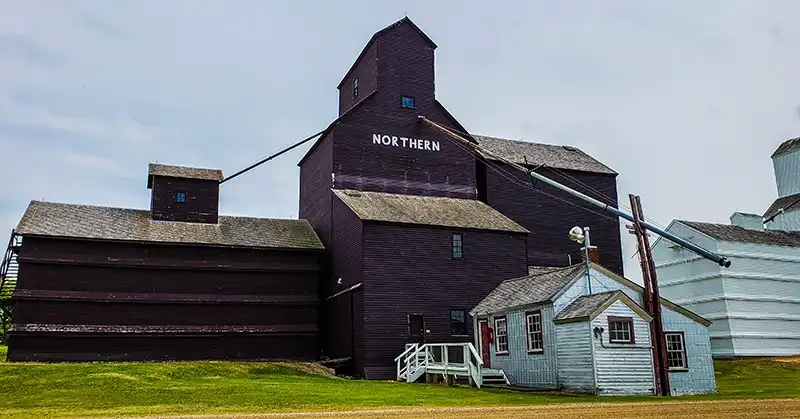
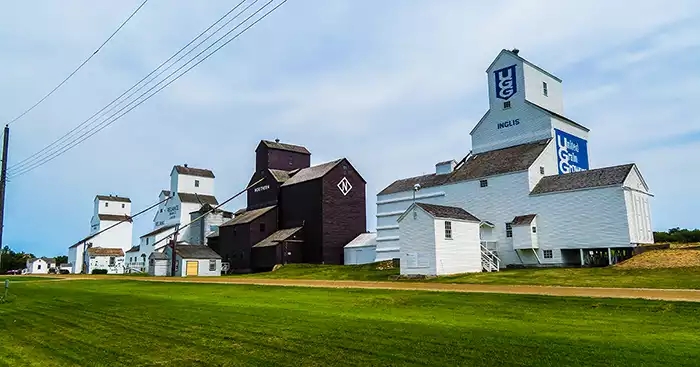
The Inglis Grain Elevators National Historic Site in Inglis, Manitoba, is important to prairie history. Indeed, way back in 1933 there were nearly 6000 elevators on the prairies!
Today, however, you’ll only see few elevators outside of rural museums. That makes sites like Inglis, with its five historic elevators, so significant.
What’s in the Inglis Grain Elevators National Historic Site?
Prairie giants — grain elevators — towered over most prairie towns for a century.
Grain elevators are large bins used to store and transfer various grain crops. The average elevator was square (30 x 30 feet) and 75 feet high, and could hold 30,000 to 40,000 bushels of grain. That’s a lot!
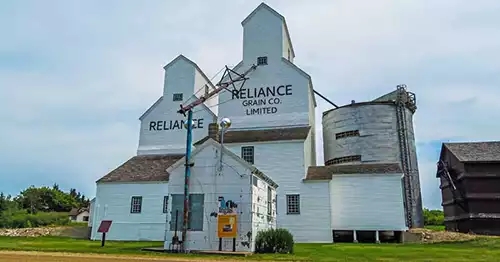
The small town of Inglis was at the end of a rail line that came from nearby Russell, Manitoba. Railway transport, of course, was mandatory for shipping grain. Five grain elevators were built along the Canadian Pacific Railway right-of-way in Inglis, with the first two in 1922.
The Paterson Elevator, owned by the N.M. Paterson company, still stands at the historic site. It operated until 1995 when the CPR discontinued the line. Today, the abandoned train tracks running through the historic site also preserve another part of prairie history that has all but disappeared.
What was the small, square top of an elevator called?
What makes prairie elevators distinctive, though, isn’t just their impressive size and solid structure. It’s the little cupolas that sit on top of the main buildings and look like square heads on top of giant bodies.
If you look closely, you may recognize the cupola as also being on top of castles and forts for lookouts and gun turrets. However, in a grain elevator, they’re where you’ll find conveyor belts (or legs).
These legs carry grain in dozens of small cups or buckets to top chutes leading to the different storage bins.
And while the windows in the “head” of the elevator gave elevator agents a bird’s-eye view on what was happening in town, they had another purpose. They let in light so the elevator agent could work.
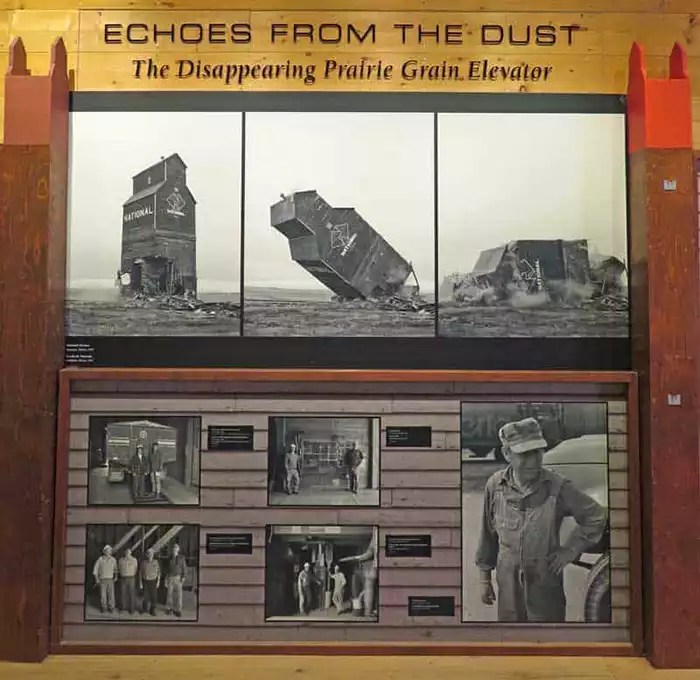
Disappearing Grain Elevators
The prairie giants, once icons of the Canadian plains, have all but disappeared, removed by moving trucks and demolition crews.
The elevators include:
- Reliance Twin Elevators (the smaller one built in 1922 and the larger one in 1941)
- Northern Elevator Company (1922)
- Matheson-Lindsay Company (1922-23)
- United Grain Growers elevator (1925 elevator replaced one burnt earlier)
All of these were built right after the railroad arrived. Through those years, Inglis was known as the “Barley Capital of Manitoba.”
National Historic Site Designation
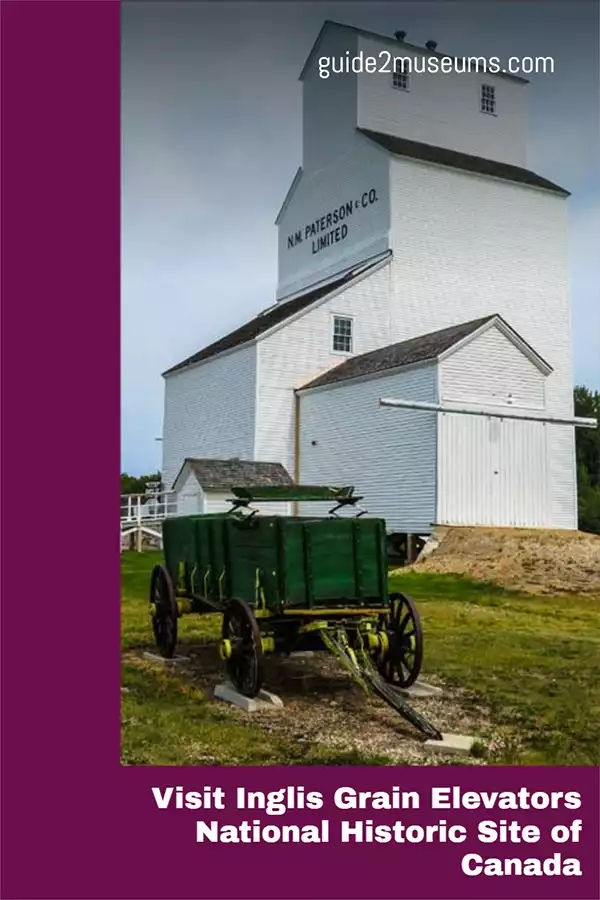
Two years after the closure of the Inglis elevators for grain storage and shipment, the row was designated a National Historic Site in Canada.
That was 1997.
The row is intact, standing as it did during the golden era of prairie grain elevators.
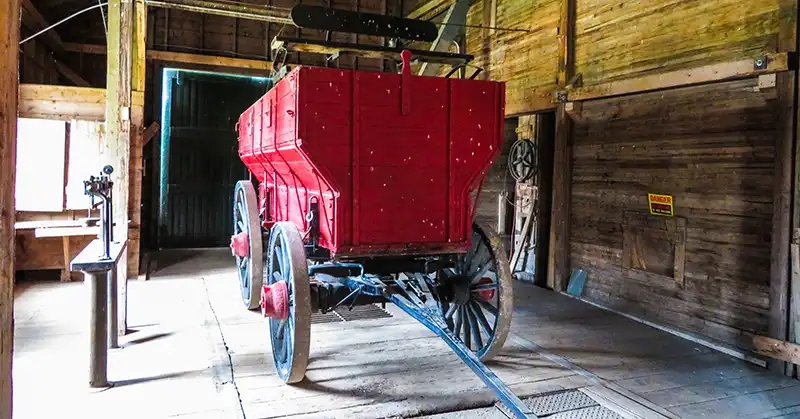
An early grain cart shows how the early grain farmers had to transport crops to market.
According to Parks Canada, “The heritage value of Inglis Grain Elevators National Historic Site of Canada lies in its symbolic, visual and substantial representation of a phenomenon typical of the landscape of prairie towns through the early and mid 20th century.”
History of Grain Shipments in Canada
The first grain shipment in Canada happened in 1876 before railroad cars arrived to carry the grain. Instead, ships carried it down the Red River in Manitoba. In those early days of the industry, handling grain was hard work and took a long time. The first elevator in the West was a round one, in Niverville, Manitoba, in 1879. However, the square country elevator design that flourished on the prairies followed quickly, with the first one built in 1881 in Gretna, Manitoba, by Ogilvie Milling Company.
By the turn of the 20th century, train service had arrived. The vast network of grain elevators also began to spring up. In fact, the Canadian Pacific Railway’s policy was to have an elevator built every seven to ten miles along the CPR tracks. The CPR didn’t build them, but offered incentives to grain buyers and companies that would.
Grain elevators and the grain industry thrived for decades. Most towns had one to five elevators and a whole “Railway Avenue,” with the local hotel, bar and cafe all nearby. Of course, everything changes over time and by the 1950s delivery points started to be consolidated. So, rail lines were gradually abandoned along with rural elevators. Then, grain companies built concrete silos designed as high capacity terminals in the 1990s.
Linda’s Pick of the Displays
My favorite part of this historic site — the inside of the elevators.
As a kid, I thought of elevators as being noisy places! They had a steady chug-chug from the motor that ran the conveyor to move the grain to the right bins. Of course, that sound is missing from the historic site.
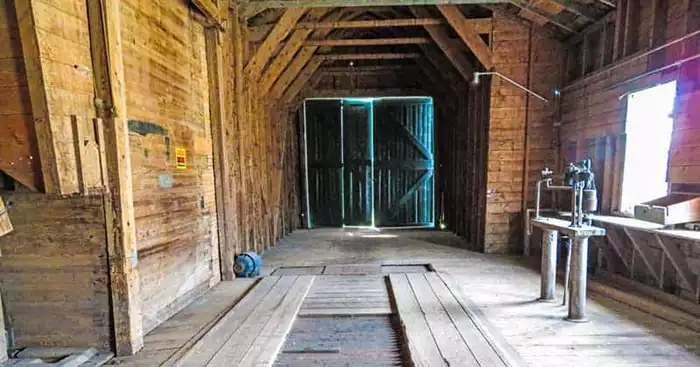
However, if you take a deep breath when you walk in, you’ll likely find, as I did, that you can still smell the grain dust.
As you step carefully over the grates where farmers used to dump their grain, dust on the edges could be chaff. And you don’t have to look too closely to see the elevator’s wooden shaft and chutes worn smooth by years of grain swooshing over the
Everything I remember was still inside the Inglis Grain Elevators. Scales and moisture testers. A tin lunch pail and box of Eddy’s Buffalo matches. The standing scale that weighed the trucks. Even a red wagon from the days before dump trucks.
In fact, the great thing about visiting the Inglis Grain Elevators National Historic Site of Canada is that the interiors look like the agent has just stepped out for a minute.
But now, instead of an agent, there’s a tour guide.
Linda’s Road Trip Tips
David and I stopped in Inglis on a roadtrip to Gimli, Manitoba, to see the Icelandic Festival of Manitoba (which was great fun!). We had a delicious lunch at the Inglis Hotel / Fox and Barrel Pub. My choice: honey garlic chicken flatbread and potato leek soup.
Who Should Visit the Inglis Grain Elevators National Historic Site of Canada?
Of course, everyone should get a close-up look at the grain elevators that contributed so much to Canada’s history! It’s an important place for those working in agriculture to get acquainted (or re-acquainted) with the past.
For those unfamiliar with agriculture, the elevators have a treasure-trove of stories and moments to share. The grounds are spacious, so there’s lots of space for young people to explore. And if you have questions, there’s a local guide.
However, you’ll likely not have too many questions!
The Inglis Area Heritage Committee provides great signage to explain how elevators work and what the different parts are called.
There’s even a display of farm implement toys and the Beth Naylor Historic Clothing Collection to see.
How To Visit the Inglis Elevators National Historic Site of Canada?
The elevator interiors are closed in off-season. However, a Visitor’s Centre, situated in the Paterson elevator annex/office, is open from July 1st to the long weekend in September (also open sometimes in June or weekends until Thanksgiving). The day we visited, a young guide was there to answer questions and manage the gift shop.
Street Address: Railway Avenue, Inglis MB. Inglis is situated on Provincial Highway 83, north of Russell, Manitoba, on the Yellowhead Highway #16.
On the Web, see: Inglis Elevators Hours of Operation.
Travels With Bill Tours the Inglis Elevators on Youtube.
Driving? Here’s a Google map to help you find it.
More Things to See and Do in Manitoba
Read more museum reviews on guide2museums.ca for museum attractions in Manitoba.
Discover More Historic Sites
- Chinatown in Montreal: A Fascinating Historic Site
 Chinatown in Montreal, Quebec, Canada, is one of the country’s oldest Chinese neighborhoods. From its 4 decorative gates to its historic designation to its reputation as a culinary hub, there’s lots to see and do.
 - Canada’s Little-Known Cold War Museum: the Diefenbunker
 The Diefenbunker Museum outside Ottawa, Ontario, was built to house the government in the event of a Cold War nuclear attack. The four underground levels archive 32 years of military use.
 - Discover the Mormon Handcart Historic Site & Devil’s Gate in Wyoming
 Discover the history of pioneers who walked across the U.S. pulling hardcarts holding all of their belongings. The Mormon Handcart Historic Site consists of Martin’s Cove and the Sun Ranch.
 - Historic Home of 1800s Governor in Lafayette, LA: Alexandre Mouton
 Check out this Lafayette, Louisiana, historic house restored to its 1848 grandeur. Its distinctive architectural elements make it listed on the National Register of Historic Places.
 - See 100 Miles Across Nebraska From Scotts Bluff National Monument
 From hiking to museum exhibits about the Oregon Trail that ran through Gering, Nebraska, Scotts Bluff National Monument is a great summer stop. You’ll also see photos, sketches, and watercolors by William Henry Jackson.
 - Bishop’s Palace in Galveston, Texas: Victorian Era Castle
 Visit this historic house museum included in the top 100 most important U.S. buildings by the American Institute of Architects. It even withstood the 1900 Galveston Hurricane!
 - Rip Van Winkle Gardens & Historic Mansion: Jefferson Island, Louisiana
 The 1870 historic home of Joseph Jefferson is the location of the Rip Van Winkle Gardens. The New Iberia, Louisiana, house is on the National Register of Historic Places.
 - Robinson Roadhouse & Robinson Flag Station: Yukon Ghost Town
 The Klondike Gold Rush in 1896 and the later Wheaton Mining District claims resulted in a railway being built between Skagway, Alaska, and Whitehorse, Yukon. Robinson Flag Station and Robinson Roadhouse once served that line, but are now abandoned.
 - USS Lexington Museum: WWII Aircraft Carrier in Corpus Christi, Texas
 The USS Lexington Museum & National Historic Landmark is a must-see aircraft carrier in Corpus Christi, Texas. Onboard experiences include everything from vintage planes to a flight simulator to a 3D theater.
 - Watson Lake Sign Post Forest Historic Site: Watson Lake, Yukon
 The Sign Post Forest in Watson Lake, Yukon, may be one of the most popular roadside stops on the Alaska Highway. It started in 1942 with one sign and has grown to 100,000+ signs!
 - Medalta Museum: Ceramic Arts in Medicine Hat, Alberta
 The Medalta Museum is an industrial museum with displays of stonewear from crockery to hotel ware to historic equipment from the manufacturing process. It’s located in Medicine Hat, Alberta.
 - Claybank Brick Plant National Historic Site: Claybank, Saskatchewan
 The Claybank Brick Plant National Historic Site is an historic Saskatchewan attraction. It’s one of North America’s best-preserved brick-manufacturing sites.
 - The Sheriff’s House Museum & Historic Site: A Hidden Gem in Devils Lake, North Dakota
 The Sheriff’s House Museum is an historic house and National Historic site in Devils Lake, North Dakota. The restored brick home is beautifully decorated.
 - Soo Line Historical Museum & Historic Site: Weyburn, Saskatchewan
 The Soo Line Historical Museum in Weyburn, Saskatchewan, is home to Canada’s largest private silver collection. Exhibits also include artifacts from the Weyburn Mental Hospital. #history #museums #travel
 - Texas Seaport Museum: Gulf Coast History in Galveston, Texas
 The Texas Seaport Museum in Galveston is a many-faceted attraction. See the 1877 tall ship Elissa or experience immigration or see the remains of a concrete ship!
 - Fred Light Museum: Battleford, Saskatchewan
 Battleford, Saskatchewan, is home to the Fred Light Museum. Its collection includes nearly 400 historic guns from flintlocks to bayonets, along with school and store collections and vintage fire trucks.
 - Frontier Prison Museum: Rawlins, Wyoming
 Prison life in the early 1900s was a matter of survival as you’ll learn when you visit the Wyoming Frontier Prison Museum in Rawlins.
 - Toronto’s First Post Office Museum & National Historic Site: Ontario
 Toronto’s First Post Office Museum is in downtown Toronto, Canada. Discover many crazy facts about early postal history in Canada.
 - The Bastion: Designated Historic Place, Nanaimo, British Columbia
 The Bastion is 36-foot high structure built by the Hudson’s Bay Company in 1853 as a trade fort. The exterior is its original timbers and the interior has been restored to the 1853 – 1862 period.
 - Hearst Castle: National Historic Landmark in San Simeon, California
 Visit one of the world’s most luxurious residences — Hearst Castle — in San Simeon, California. With everything from a Roman Pool/bath to 42 bedrooms this spot was a paradise for the rich and famous in the 1920s and 1930s.
Reference(s)
Facts about the history of grain elevators are from:
- Canadian Encyclopedia
- Walking Tour Information Guide from the Inglis Grain Elevators National Historic Site
- Towers of Silence: The Rise and Fall of the Grain Elevator as a Canadian Symbol by Patricia Vervoort.









 guide2museums.com