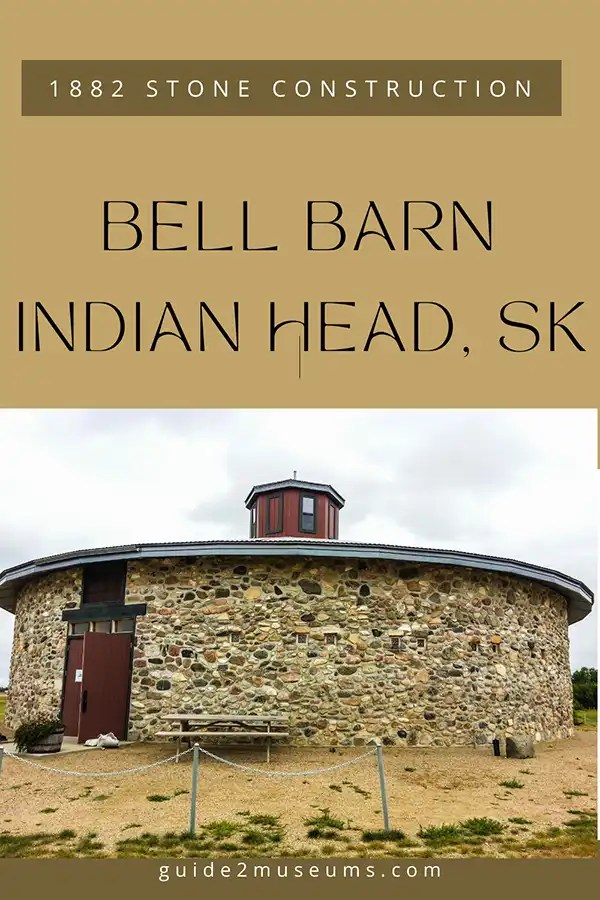
The big, round stone Bell Barn has stood outside the town of Indian Head, Saskatchewan, for nearly 150 years.

Now a museum, the Bell Barn is a popular place to see and visit. Indeed, it’s one of Saskatchewan’s oldest agricultural attractions.
Linda’s Pick of the Exhibits
My favorite part of the Bell Barn exhibits is the story of Major William R. Bell’s dream.
How did Major William R. Bell start the Bell Farm in Indian Head, Saskatchewan?
The farm was the dream of Major William R. Bell, who had walked from Brandon to Indian Head along the proposed path of the Canadian Pacific Railway in 1881. Then, Bell approached the Canadian government with a plan to purchase a chunk of land at Indian Head about 100 square miles in size, which Sir John A. MacDonald approved (23,658 acres, at $1.25 an acre) in April, 1882.
So, farmers for the Qu’Appelle Valley Farming Company’s model farm arrived that summer, along with the railroad.
Originally, the Bell Farm grew to about 70 buildings. Many of them were made of stone like the barn. Today, only the barn remains.
Farming in the area wasn’t nearly as profitable as Bell had hoped though, due to a number of different reasons. In 1885, for example, a lot of the horses, wagons, and men were drawn off by the General in Command of the Forces to fight in the Riel Rebellion. This 1885 document outlines the situation in a report to the Minister of the Interior.
Some of the land (675 acres) was sold the next year, in 1886, to help reduce the farm’s debt–this land was the start of the Indian Head Experimental Farm. But the sale wasn’t enough to put the model farm on a profitable track, and three years later, in April, 1889, the Supreme Court of the North-West Territories ordered that the farm be broken up and sold.
Much like the Bonanza Farms of North Dakota, Bell was a visionary when it came to the farming potential of the prairies. Unlike expedition leader, John Palliser, who declared in 1858 that the area would “forever be comparatively useless,” Bell saw its potential.

I live just 10 miles (17 km) from Indian Head, so have always been fascinated by the stories.
And, of course, I love all the historic stone buildings.
As Palliser pointed out in his journals, there weren’t a lot of trees on the prairies. So, settlers were stuck with either using the sod for buildings or stone. As it happens, this area had quite a lot of stone, so while gathering the stones and laying them was challenging, it was a lot nicer that dirt.
What’s at the Bell Barn Museum?
The Bell Barn Museum consists mainly of the round stone barn. Indeed, it’s the last remaining structure of the historical Bell Farm community.
Built in 1882, this barn was part of an enormous “model” farm. The farm had so much land stories tell of workers ploughing the fields straight ahead in one direction until mid-day. Then, they reversed for the afternoon to come home.
The exterior of the round Bell Barn is 69 feet in diameter and 14 feet high.
The barn had 29 single stalls and two enclosed box stalls that held two horses in each.
Stalls inside the Bell Barn are hung with period harness for workhorses.

Fast Fact: Round barns required fewer materials than square or rectangular buildings. This made round barns a good choice for stone construction, as there were fewer rocks to gather and prepare. Round barns are also structurally enhanced, while using simple construction methods.
The original loft of the stone Bell Barn is now available to rent for weddings, barn dances, and other events. As well, the outside area is perfect for showcasing cars, horses, and more.
Relocating the Bell Barn
The Bell Barn was relocated from its original site to just outside the town of Indian Head beginning in 2008.
A lot of preliminary work had been done at the new site, beginning in 2007. Reconstruction began in 2009.
The barn’s original stones were reused, along with eighteen truckloads of new stones from a local Indian Head farm.
Stonemasons oversaw the construction.
On September 23, 2009, the last stones were laid along the top of Bell Barn wall with grand opening ceremonies.
As well as preserving the barn, the Bell Barn Society has done extensive research on the history of the late 1800s in the area.
Linda’s Road Trip Tips
The Bell Barn is located just outside the town of Indian Head, off of the Trans-Canada Highway on Saskatchewan Highway 56.

While short, Hwy 56 a scenic highway that winds from Indian Head and the Trans-Canada Highway down into the Qu’Appelle Valley. Ending at Echo Valley Provincial Park, it’s a great summer or fall (the colors are beautiful) drive.
The town of Indian Head is also quite scenic, with many restored older homes. If you watched the Canadian tv series, Little Mosque on the Prairie, you’d have seen much of the town’s main street as parts of the show were filmed there.
Who Should Visit the Bell Barn Museum?
The Bell Barn Museum is a must-see for anyone interested in farming history on the prairies.
The museum’s location on the Trans-Canada Highway couldn’t be easier for anyone traveling through the province. As well, it’s less than an hour east of the capital city, Regina.
A visit to the Bell Barn Museum takes an hour or less. The grounds are flat and well-maintained, so should be manageable for those with mobility issues. There’s a second floor for events that has stairs for access.

How Do You Visit the Bell Barn Museum in Indian Head?
To visit the Bell Barn Museum, take the West exit from the Trans-Canada Highway at the town of Indian Head. The museum is on Highway 56, one mile north of town.
Get opening days and admission costs on the Bell Barn Museum website.
Check out upcoming events at the Historic Bell Barn Facebook page.
Watch how the Bell Barn was moved with this YouTube video.
Plan your visit to the Bell Barn with Google maps.
Find More Museum Reviews for Saskatchewan
Check out more reviews for museum attractions in Saskatchewan on guide2museums.com.
Read More History Museum Reviews
- Musée de la civilisation: Quebec’s Museum of Civilization
- Inside the Cattle Raisers Museum: Fort Worth, Texas
- Plains of Abraham Museum & Battlefield Park: Quebec City
- Royal Ontario Museum in Toronto Review
- Amazing Giant Bison, Beaver, Mammoths & More: Yukon Beringia Museum in Whitehorse

- Royal Saskatchewan Museum & World’s Largest T-Rex Dinosaur

- Fick Fossil & History Museum: Buffalo Bill to Prehistoric Fish in Oakley, Kansas
- Ronald Reagan Presidential Library & Museum: Simi Valley, California

- Morro Bay Maritime Museum: Morro Bay, California

- National Cowgirl Museum & Hall of Fame: Cowgirl history in Fort Worth, Texas
- Bell Barn Museum: Historic Round Barn in Indian Head, Saskatchewan

- Naranjo Museum: Dinosaurs & Fossils in Lufkin, Texas

- Texas Seaport Museum: Gulf Coast History in Galveston, Texas

- Levine Museum of the New South: Charlotte, North Carolina

- Jefferson Historical Museum in Big Cypress Bayou: Jefferson, Texas
- Museum of the Fur Trade: Chadron, Nebraska

- Mystic Seaport Museum: Historic Seafaring Village in Mystic, Connecticut

Reference(s)
Climenhaga, C. (2022, August 18). Once thought to be a ‘useless’ desert, Palliser’s Triangle has long been the breadbasket of Canada. CBC. https://www.cbc.ca/news/canada/edmonton/pallisers-triangle-farming-agriculture-alberta-saskatchewan-manitoba-diversification-1.6541681



 guide2museums.com