The Soo Line Historical Museum in Weyburn, Saskatchewan, is proof that even small museums can house fascinating history.

Linda’s Pick of the Exhibits
I live 100 km north of Weyburn, so thought I was pretty familiar with the famous folk who’ve lived there. W.O. Mitchell, whose best-loved novel is the prairie classic, Who Has Seen the Wind, was born there.
So was Guy Gavriel Kay. He’s a popular fantasy writer — my favorite, in fact. And most famous of all, Tommy Douglas, the Father of Medicare and Saskatchewan’s 7th premier, moved to Weyburn with his bride in 1929.
However, I’d never heard of Charles Wilson, local farmer and collector. Collector of what?
Silver (think, aye-aye matey and pirate loot).

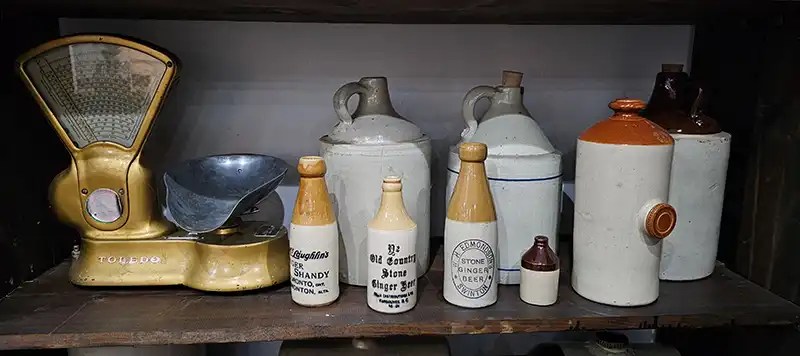
In fact the silver collection is billed as Canada’s Largest Private Silver Collection with 3333 pieces of silver alone! Altogether, his collection has 5000 pieces including other antiques and glassware. They date from 1750 to 1972 and are all labelled.
Historical Significance of Silver
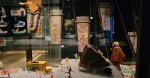
The collection is the main feature of the museum and is housed in a huge room with dozens of display cabinets.
Fast Fact: Silver Service is the all-encompassing word for all types of food and beverage service. It started, as you can guess, with the origin of silver cutlery and tableware. However, silver service dining is only practiced these days in high-end restaurants, hotels, and wealthy homes.
Once the prized possessions of upper class society, you could find almost anything you wanted made from silver. Charlie found his treasured pieces on travels through North America and Europe.
What are a cuspidor, epergne, mote spoon, silent butler, and vesta case? You’ll find them all in the silver collection!
Cuspidor – container for spitting tobacco or snuff into.
Epergne – table centerpiece used for holding flowers, fruit or sweets.
Mote spoon – spoon used to skim off tea leaves or wine sediment from a cup or glass.
Silent butler – container used for ashes or crumbs.
Vesta case – container for wooden matches.
I can’t imagine how amazed people must have felt dropping in to visit Charlie’s bachelor farmhouse and seeing his treasures.
Fun Fact: The museum has an eight-legged calf taxidermy, which came from Charlie's farm. Even with its deformities, it had lived for a short time under Charlie's care. As well as silver, Charlie loved the farm animals he raised.
What’s in the Soo Line Historical Museum Collection?
The Soo Line Historical Museum is in a designated Municipal Heritage property listed on the Canadian Register of Historic Places.
Constructed in 1910, it was built next to the railway, using Estevan brick, as a power generating station.
When it comes to the collection, the museum is super well organized and documented.
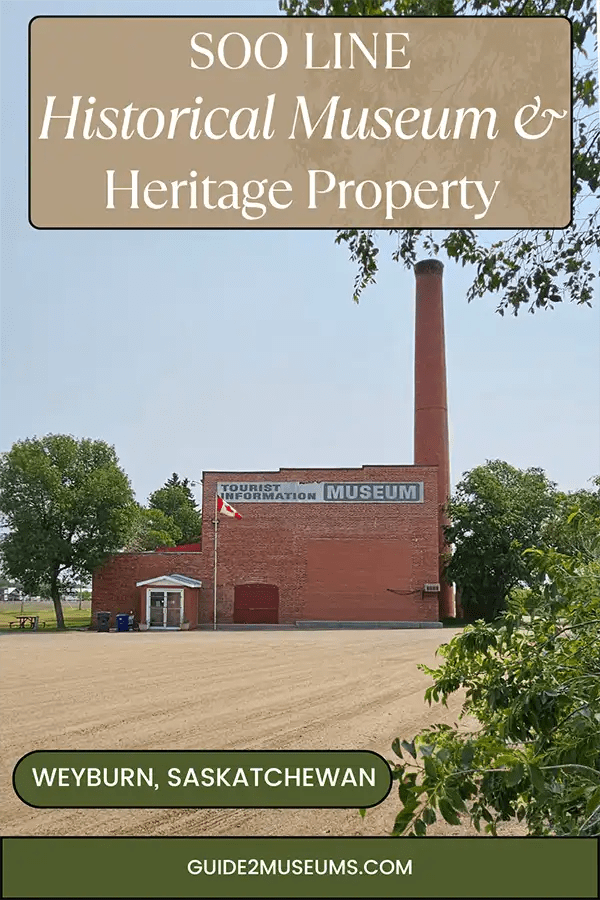
Fast Fact: The city of Weyburn got its electric utility in 1905. It was formed by a group of CPR employees. In 1909, the municipality took over the power station to help attract business and industry to the community.
The displays include:
- General store
- Schoolroom
- Church
- Dentist’s office
- Lawyer’s office
- Weyburn Mental Hospital history room
- Farming artifacts
There are two floors in the museum, split into two areas. The first gives you an overview of the silver collection room, while the second leads to the other display areas.

Linda’s Road Trip Tips
If you enjoy visiting small cities, you’ll love Weyburn. There’s lots for visitors, whether that’s places to eat and stay, or things to do for a day. Since it’s about an hour to the U.S. border crossing at Fortuna, you can also choose to make it a stop on a cross-border holiday.
In fact, Weyburn is the end of the CanAm Highway that connects Mexico to Canada. Starting in Mexico, the CanAm runs along U.S. Route 85 from Texas through six states before reaching Saskatchewan.
When you’re in Weyburn, you’ll also want to check out its Heritage Village Museum. This open air museum village showcases the lifestyles of a small prairie city from the turn of the 20th century to the 1940s.
If you’re interested in Weyburn’s history, you’ll also want to consider a walking tour of the Riverview boardwalk and downtown. The city has prepared a great walking tour guide you can download.
And if you’re looking for something to read on your roadtrip, check out my historic ebooks set in the Big Muddy (1.5 hours west of Weyburn): Badlands and Outlaws, and its sequel, Kidnapped by Outlaws.
Who Should Visit the Soo Line Historical Museum?
The museum is a must-see for those who live in Southern Saskatchewan. It gives some important insights into life in the early half of the 20th century, particularly its coverage of the Weyburn Mental Hospital history. During its nearly 50 years of operation, it touched lives in nearly every Saskatchewan community in some way.
Why was the Weyburn Mental Hospital important?
The Weyburn Mental Hospital opened in 1921 as the largest mental hospital in the British Commonwealth. It was also one of the last “asylums” ever constructed.
While it was a treatment centre, the hospital also operated a farm. Indeed, the group of 10 workhorses grew to 21 by 1945. In 1946 the hospital expanded to include a dairy herd. Earlier, in 1924, a greenhouse had been built on the property, which produced up to 30,000 bedding plants annually. Although patients, mainly men, worked the farm, none were paid until the 1950s.
Inside the hospital walls, staff and residents navigated a variety of challenges. One of the most problematic was likely the variety of patient issues, since residents included everyone from those with psychiatric needs to those suffering from mental and physical disabilities.
None of these things, however, got to the nitty gritty of the hospital’s operation as a psychiatric asylum and its research. Doctors used insulin shock therapy, hydrotherapy, lobotomy, and electroshock. The most famous experiments, however, were those with LSD or Lysergic acid diethylamide.
Indeed, Weyburn Mental Hospital physician, Humphry Osmond, coined the term, psychedelic. Osmond’s experiements led to a better understanding of the biochemical nature of schizophrenia, as well as alcoholism as a disease.
Ward Attendant training programs for men and women started in Weyburn and its sister hospital North Battleford in 19931. The first classes graduated in 1933.
Of course, it goes without saying that anyone who loves fine silver and its historic purposes will find the museum super-amazing.
And even if you’re not a collector, just seeing the enormity of this Saskatchewan farmer’s collection is worthwhile.
Other parts of the museum collection do a nice job of covering life in a small city in the early 1900s.
Since objects are all clearly identified, no guesswork is required. So, the information is accessible to all.

However, since the museum preserves its historic integrity as an historic property, upper levels may not be accessible to those with physical limitations.
How Do You Visit the Soo Line Historical Museum?
Fast Fact: The Soo Line Historical Museum gets its name from the arrival ofthe Soo Line, the Canadian Pacific Railway (CPR), component of the Minneapolish St. Paul and Sault Ste. Marie Railway. The arrival of the Soo Line established Weyburn as a prominent centre in southeastern Saskatchewan, bringing American settlers to the area as well as expanding trade.
The Soo Line Historical Museum is located in Weyburn, Saskatchewan, at 411 Riverfront Rd. along Highway 39 and the CanAm Highway.

Only open seasonally, or by appointment in the off-season, you can check hours of operation and admission rates on the city of Weyburn website.
Take a short virtual tour of the Weyburn Soo Line Historical Museum historic building with Dylan Grant on YouTube.
Plan your visit with Google Maps.
Find More Museums in Saskatchewan
Check out more reviews of museum attractions in Saskatchewan on guide2museums.com.
Read More General Museum Reviews
- Canadian Museum of History: National Museum in Gatineau, Quebec

- Finney County Historical Museum: 150 Years of Garden City, Kansas, History

- Adams Museum in Deadwood: Where Legends are Larger Than Life

- Minnesota Discovery Center: Iron Range Mining History Museum

- Museum of North Texas History: Wichita Falls

- Soo Line Historical Museum & Historic Site: Weyburn, Saskatchewan

- Pioneer Auto Show Museum: Cars & More in Murdo, South Dakota
- Fred Light Museum: Battleford, Saskatchewan

- Bishop Museum: Cultural Treasures in Honolulu, Hawaii
- Vilas Historical Museum: Snowmobiles to Paul Bunyan in a Wisconsin Museum
- Nanaimo Museum: Diverse History of Nanaimo, British Columbia

- Frontier Gateway Museum: Dinosaur Fossils & Glendive, Montana History

- Rosebud County Museum: Homesteader History in Forsythe, Montana
Reference(s)
Crocus Tours. (n.d.). A historical glimpse of Weyburn and its people [walking guide with map]. https://weyburntourism.com/wp-content/uploads/2019/11/Crocus-Tour-Online-Format.pdf
Dyck, E. (2019, July 16). Psychedelic Research in 1950s Saskatchewan. https://www.thecanadianencyclopedia.ca/en/article/psychedelic-research-in-1950s-saskatchewan
Madness Canada. (n.d.). The Weyburn Mental Hospital, 1921. https://madnesscanada.com/contributor-exhibits/the-asylum-project/1921-sask/


 guide2museums.com