The Myra Museum is a North Dakota attraction that provides many surprises for visitors. While you might expect an agricultural history of Grand Forks focus, given the rich farmland of the Red River Valley where the city is located, agriculture is just one small piece of its mosaic.
Linda’s Pick of the Exhibits
My favorite exhibit was a totally unexpected surprise — the Lustron metal house. And I don’t mean doll house. I mean a prefabricated house for families with everything built in.
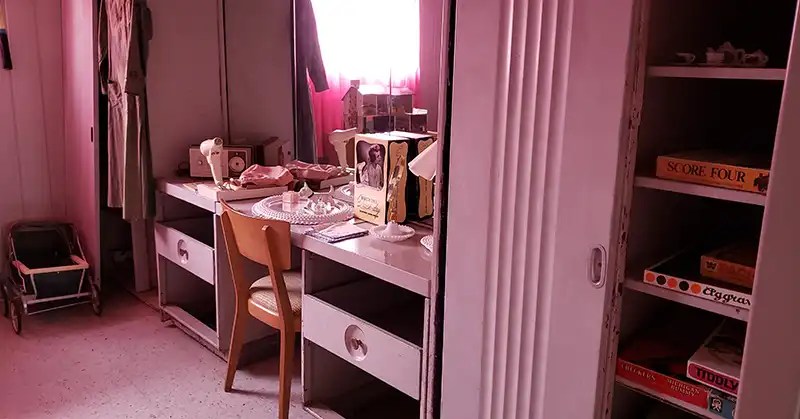
To put it mildly, I was enchanted walking through what seemed to be a fairytale house with its porcelain-finish steel panels.
What’s the history of Lustron Homes?
The Lustron Corporation was founded by engineer, Carl Strandlund. It was established to take advantage of a Federal Housing incentivization of prefabricated, high volume home construction to deal with a post-war housing shortage.
Lustron Homes were dream homes for those who’d survived the hardships of WWII and feared the horror of nuclear war during the Cold War years. Originally, the manufacturers were supposed to produce 100 homes a day when the factory opened in the former Curtis-Wright Navy airplane manufacturing plant in Columbus, Ohio, in 1948 .
People were already used to Sears homes, which had been arriving by railroad boxcar since 1908. So, the idea of ordering a house out of a catalog wasn’t new.
However, producing the homes cost more than original estimates. And soon, a corruption scandal was uncovered. When the money was called in, there wasn’t enough to cover the loans. The Lustron Corporation went bankrupt in 1950.
Out of the more than 20,000 orders, only 2680 homes were built. It’s estimated that 1500 of the homes are still around, several of which have been added to the National Register of Historic Places.
Advertisements of the day indicated the homes were pest-free (find another fall home you pesky mice!), fire and rot proof (no wood anywhere here), and rustproof (porcelain is an amazing material).
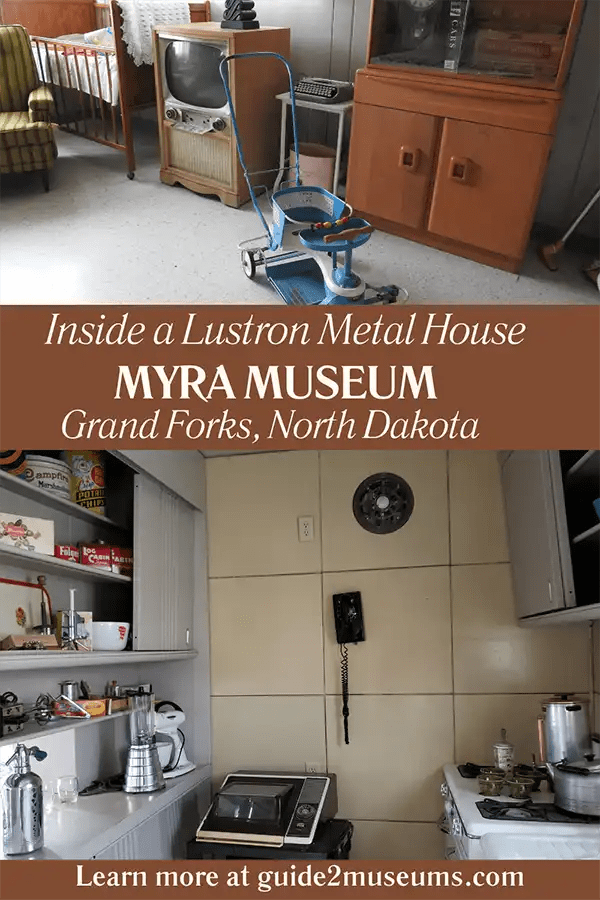
I can’t imagine how challenging it would have been to get my “house” in 3300 pieces! I’m not great at following assembly instructions at the best of times, so it would likely have taken me a lot longer than the estimated 350 hours. Neither a manual or the erection training school would have likely helped me.
The initial Lustron design was a two-bedroom, 1000 sq. ft. ranch-style house. Additional floor plans with more bedrooms were soon added.
But what was in a steel-framed Lustron house?
- Large plate-glass picture and sash windows with screens
- Asphalt tile flooring
- Enameled steel exterior panels
- Space-saving sliding pocket doors
- Open floor plan
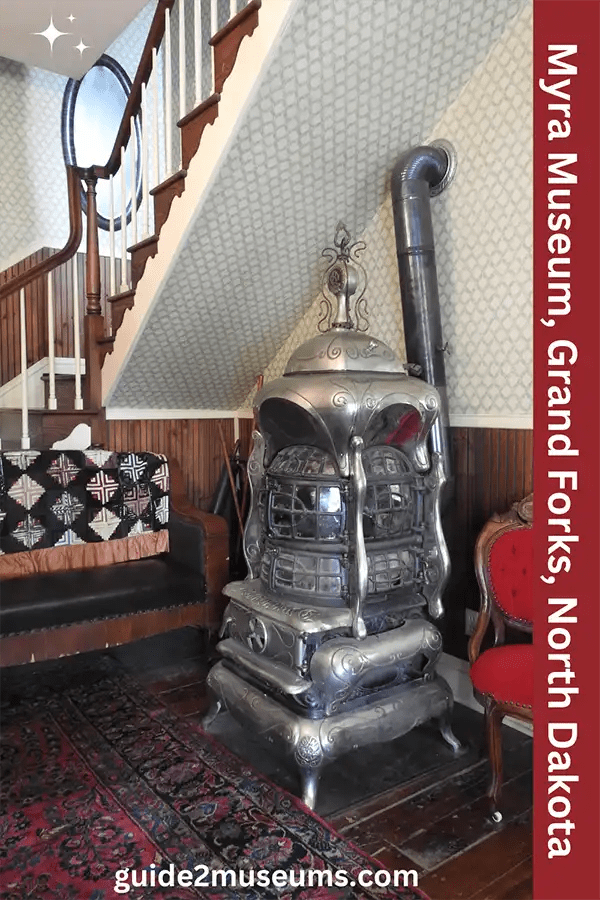
- Radiant ceiling-mounted furnace
- Built in storage features
- Kitchen with a Thor washing machine that fit under the sink and could also be used as a dishwasher (Thornton)
- Exteriors were in Dove Gray, Desert Tan, Surf Blue, or Maize Yellow with six interior color schemes
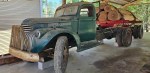
Fast Fact: Lustron houses initially sold for between $8500 and $9500, which was about 25% less than conventional housing. They arrived on a site via special open-sided Freuhauf trucks.
What’s in the Myra Museum?
The Myra Museum is a small, open air museum that started with the Campbell House. Built by Thomas D. Campbell, Sr., the house started out as a log cabin in 1875. In the 1890s, the cabin was incorporated into a classic Gothic Revival house.

The house, along with three acres of land and $12000 for restoration was donated to the Grand Forks County Historical Society.
Tom Jr., Campbell’s son, had operated a gigantic wheat farm on a lease-option for 200,000 acres on the Crow Indian Reservation in Montana and Wyoming in 1918. Indeed, he was known internationally as the “Wheat King.”
Then, in 1976, the Myra Museum was constructed with funds from the Myra Foundation. It was the legacy of John Myra, a North Dakota pioneer who operated a lumber business and farm implement dealership.
Myra Museum Collection
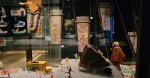
The artifacts inside the Myra Museum building cover a range of eras, starting as far back as the Ice Age.
Some artifacts, of course, stand out more than others. For example, did you know that the Cream of Wheat cereal had its start in Grand Forks?
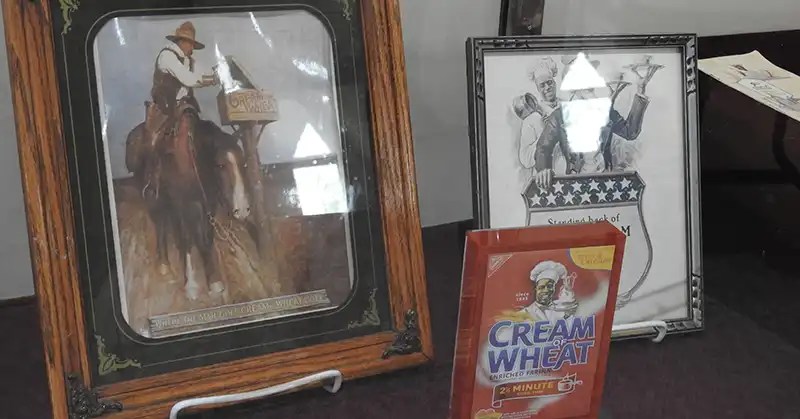
Back in 1893 things were tough for small flour mills. So, head miller, Tom Amidon sold the idea of selling a “breakfast porridge” he’d been using himself.
Amidon’s porridge was made of the part of the wheat taken from the first break rolls in the flour mill — it was referred to as the “middlings.”
Fast Fact: Initially, the cardboard cartons for Cream of Wheat porridge were hand cut and labeled, then crated in wooden boxes made from waste lumber. From this humble start, the business outgrew its Grand Forks plant and moved to Minneapolis by 1897.
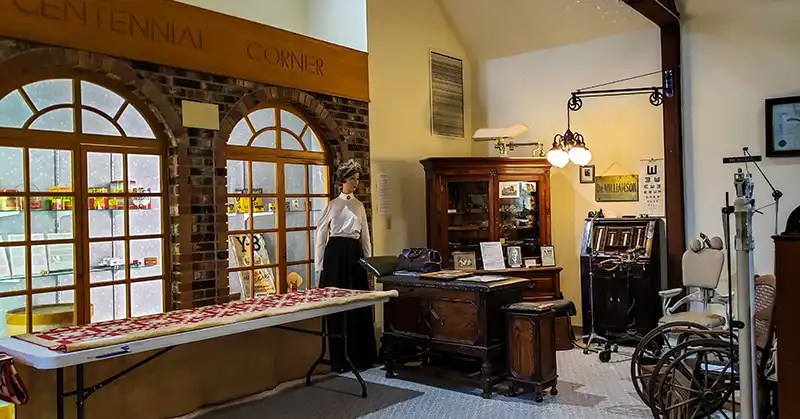
Other artifacts include such things as vintage quilts, equipment from a doctor’s office, church alter, pews, and artifacts, along with historic photos and information.
Other Buildings
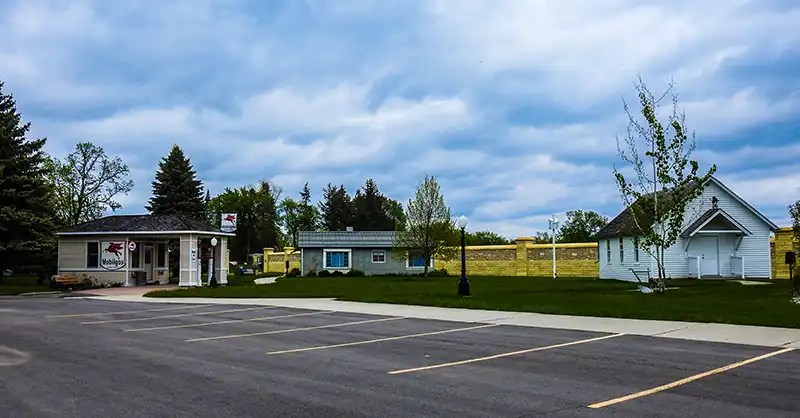
Other buildings have been added to the Myra Museum since its opening. They include:
- Grand Forks original log post office built in 1868 with old store artifacts inside
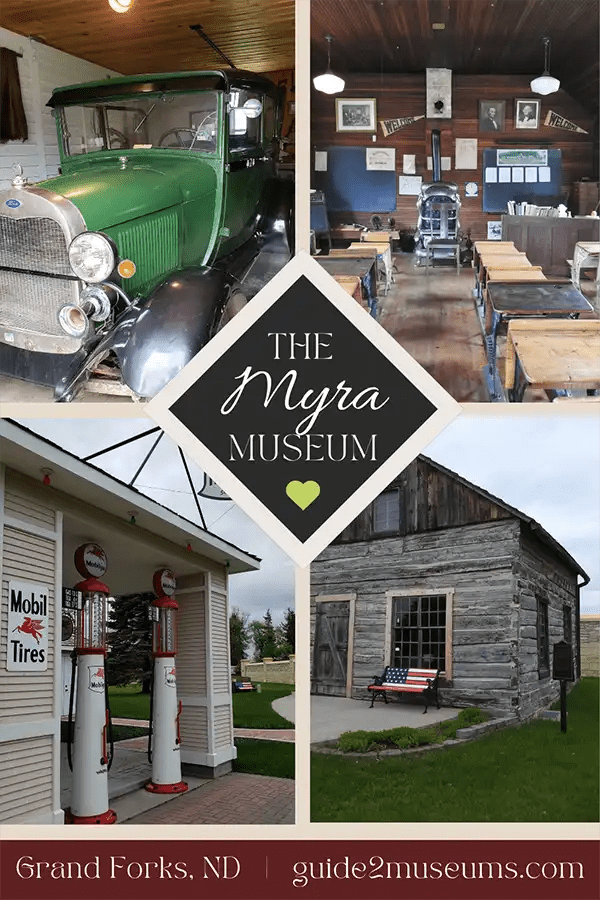
- Carriage House which contains an 1880s Surrey, Trap buggy, Cutter sleigh & grain wagon
- Lustron house originally at 602 Lincoln Drive built in 1950
- Blooming Township Schoolhouse built in 1917
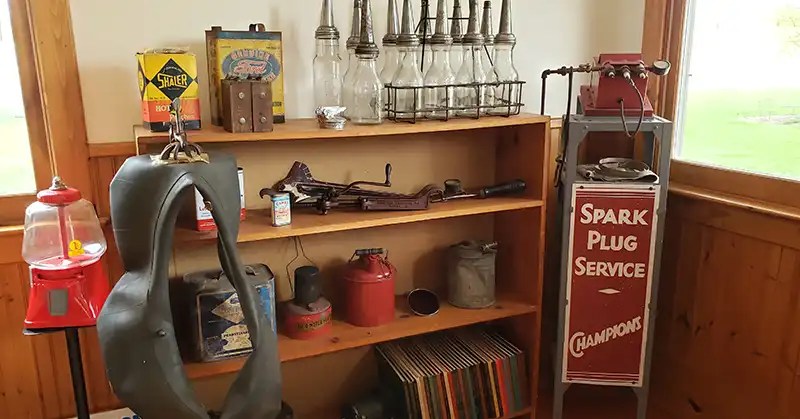
- Mobil Oil replica gas station fully equipped with pumps and gas station artifacts
- Myra Centennial Pavilion (a popular spot for weddings!)
Linda’s Road Trip Tips
We often visit North Dakota, so I have lots of favorite museums when it comes to exploring the state.
My favorite exhibit here, the Lustron house, was particularly exciting as it tied in very well with my interest in Cold War history.
Indeed, the Ronald Reagan Minuteman Missile State Historic site was one of our must-see stops. It’s about 80 miles from Grand Forks.
From Grand Forks we continued 80 miles on I-29 to Fargo. There, I highly recommend the open air pioneer village, Bonanzaville.
Who Should Visit the Myra Museum?
The Myra Museum provides a different experience than many heritage museums in the Midwest that focus on agriculture. Instead, you’ll get more community insights about the growth of the city and important landmarks in its past.
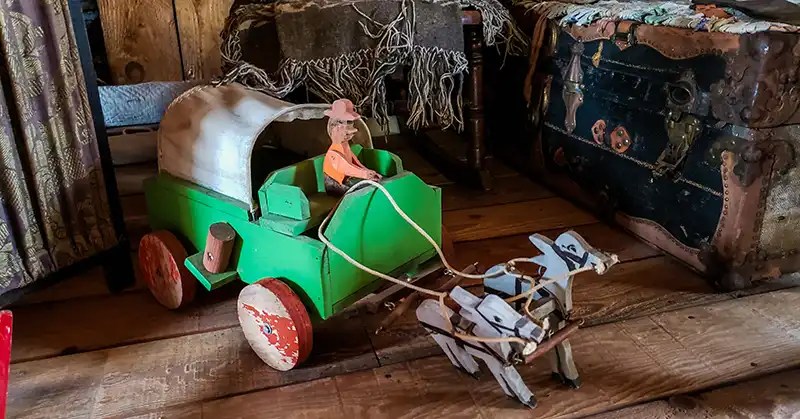
As well as lots of tidbits for history lovers, kids will find several areas interesting. The Lustron House has lots of period games — and kids may marvel at having everything already built-in when it comes to furnishings. They’ll also get to see a few children’s toys from pioneer days in the Campbell House.
The museum will take an hour or so to go through, as there aren’t a lot of signs on artifacts to keep you reading. Buildings are well-spaced apart with good walkways between, so they’re generally accessible.
How Do You Visit the Myra Museum?
The Myra Museum archives some of the significant historical points in the history of Grand Forks, North Dakota.
Location: The Myra Museum is located at 2405 Belmont Road, Grand Forks, ND. Grand Forks is on I-29, about 145 miles (233 km) south of Winnipeg, Manitoba.
Parking: There's lots of free parking on the museum grounds.
Check days open (usually seasonally except by special arrangements) and fees on the Go-North Dakota website.
Take an aerial tour of the Myra Museum on YouTube.
Plan your visit with Google Maps.
Find More Museum Reviews for North Dakota
Check out more reviews of museum attractions in North Dakota on guide2museums.com.
Discover More Heritage Museums
- Boot Hill Museum: Kansas Wild West Myth Meets Lived History
- Maple Creek’s Intriguing Jasper Cultural & Historical Centre

- Front Street Cowboy Museum: Ogallala, Nebraska

- Discover the Mormon Handcart Historic Site & Devil’s Gate in Wyoming

- See 100 Miles Across Nebraska From Scotts Bluff National Monument

- Standout Ranching History at the MonDak Heritage Center: Sidney, Montana

- New Iceland Heritage Museum: Gimli, Manitoba, Canada
- Crazy Horse Memorial & Museums: South Dakota’s Black Hills
- Myra Museum: Lustron House & More in Grand Forks, North Dakota
- Fort Cody Trading Post: Miniature Wild West Show in North Platte, Nebraska

- Miracle of America Museum: 40+ Buildings in Polson, Montana

- Sukanen Ship Pioneer Village & Museum: Moose Jaw, Saskatchewan

- Museum of Northern British Columbia: Indigenous Art & History in Prince Rupert, British Columbia
- Heritage Village: Museum in Weyburn, Saskatchewan
- Vermilionville: Living History Open Air Village in Lafayette, Louisiana

- Museum of the Southern Jewish Experience: New Orleans, Louisiana

- National Doukhobor Heritage Village: Veregin, Saskatchewan

- Bonanzaville: Open Air Pioneer Village Museum in Fargo, North Dakota
- Range Riders Museum: Old West Lives Again in Miles City, Montana

Reference(s)
Danaparamita, A. (2013). Lustrons: Building an American dream house. National Trust for Historic Preservation. https://savingplaces.org/stories/lustrons-building-an-american-dream-house
Liverman, A. (2010, updated 2018). Lustron Housing Corporation. History Colorado. https://www.historycolorado.org/sites/default/files/media/documents/2018/lustronbackground_with_biblio_2018.pdf
Sunwall, C. (Feb. 19, 2009). The wheat king. Dakota Datebook Archive. https://news.prairiepublic.org/show/dakota-datebook-archive/2022-05-21/the-wheat-king


 guide2museums.com