The Yukon Transportation Museum in Whitehorse, Yukon, preserves a lot more than cars, trucks, and snow machines. Many parts of its collection come from building the Alaska Highway and its importance during WWII. This makes the museum a unique attraction with lots of history!
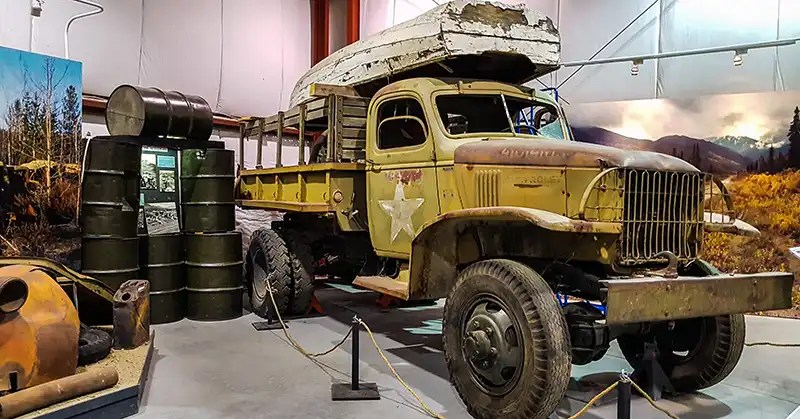
Linda’s Pick of the Exhibits
My favorite exhibit, hands-down, was the LCC-1 LeTourneau Sno-Train from the Cold War.
Nothing could stand out more than the gigantic, bright orange land train in the fenced compound outside the Yukon Transportation Museum.
I can’t imagine what Northerners thought when they saw it driving through the snow back in the late 1950s.

Of course, for us, staring at the sno-train in the museum, it took awhile to even figure out what it might do! Luckily, the museum was selling copies of the operating manual, so we eventually got the whole story, right down to the original plan to run it with a nuclear reactor.
Fast Fact: The Sno-Train was a four-section cargo carrier that was nearly unstoppable over ice, snow, bull-dozer trails, and even brushy terrain.
The front of the sno-train, where David is standing beside the tire, above, was the locomotive – thus the machine’s name as a train. This section was articulated between the front and rear wheels for driving.
How was the Sno-Train used?
The sno-train hauled three freight cars. What did they carry? Supplies and equipment used by the Army Transportation Corps that had purchased it. In fact, it traveled around Greenland, as well as other parts of the north, hauling cargo until 1962.
It was mainly used to support the DEW (Distant Early Warning) line (radar) operated by the US and Canada during the Cold War.
However, the most interesting part of the sno-train, to me anyway, was that it was designed to accommodate three people.
Each pair of locomotive wheels had a compartment built over it. One contained everything necessary to supply DC and AC electrical power. The other provided a living unit kept at 60 degrees at temperatures up to -40 outside, by hot water heat.
Naturally, somebody also had to steer the monster. Small switches, controls, and the potentiometer on the instrument panel made that easy.
And seeing? Well, the locomotive had a viewing bubble and double panes, tinted glass (to avoid snow glare) for that.
The machine is unique, as only one was ever produced.
What’s at the Yukon Transportation Museum?
The Yukon Transportation Museum curates the history of travel in the Yukon from early dog-sledding through the Yukon Gold Rush to the building of the ALCAN (Alaska Highway) highway during WWII to the Cold War.
Travel was no walk in the park in the far north, and the exhibits with their artifacts, photography, and information make that very clear!
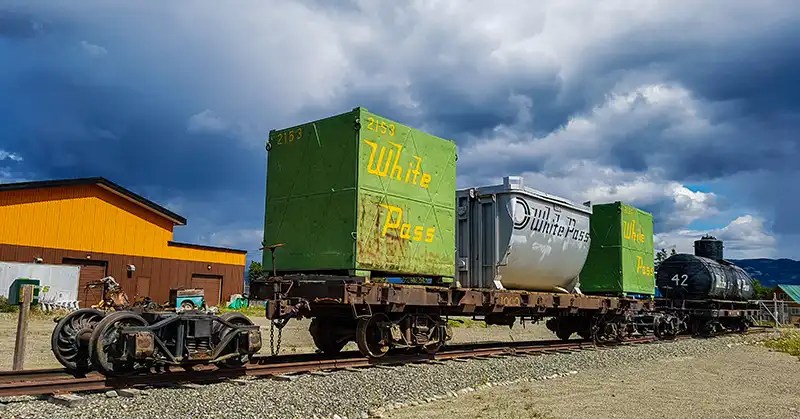
Fast Fact: Container shipping started with the WP&YR in 1955, when they put the world's first container ship into service.
The outdoor collection includes a number of larger pieces, like the Sno-Train, an old bulldozer, even a White Pass & Yukon Route sleigh. Indoors, you’ll find everything from Andy Hooper’s famous truck (an Army Surplus truck used to move buildings around Whitehorse) to Fluffy the Snow Cat – a 1954 Bombardier tractor.
There are a number of must-see key exhibits.
- Straddle Carrier – A straddle carrier is used for intermodal shipping. No wiser? Well, it’s what they use to hoist those giant, steel boxes that are carried by trucks, trains, and ships. Their advantage, of course, is that the shipping box fits everywhere. See the pin below for a photo with David standing in front of it!
- The Queen of the Yukon is a replica of the Ryan B-1 Monoplane that arrived in Mayo, Yukon, in late 1927. Owned by retired RCMP corporal, Andy Cruickshank, and his partner, the Queen started commercial aviation in the area.
- Machinery & photo of machines (outdoor photo on the wall below) used to build the Alaska Highway.

From the world’s biggest wind vane to the early boats and dogsleds used by the First Peoples in this area, there’s lots to see at the Yukon Transportation Museum.
Fast Fact: Over 7000 pieces of U.S. military equipment were used to build the Alaska Highway. That included 5000 trucks, 904 tractors (mostly Caterpillar D8 and D4 bulldozers), 374 graders, and 174 shovels according to this MVPA (Military Vehicle Preservation Association) document. However, very few of these pieces have survived.
Linda’s Road Trip Tips
David and I had a two-day stop in Whitehorse when we drove the Alaska Highway on this summer trip. From Whitehorse, we took the Klondike Highway to Skagway, then rode the Alaska Marine Highway ferry to Juneau and Prince Rupert.

Back on land, we drove the Yellowhead Highway from Prince Rupert back to Saskatchewan. It was an amazing road trip!
But back to Whitehorse. We stayed at the Sternwheeler Hotel & Conference Centre, which was comfortable.
Whitehorse has several great museums in addition to the Transportation Museum. We especially enjoyed the Yukon Beringia Interpretive Centre and going back in time to the Yukon’s unique ice age history.
The Copperbelt Railway and Mining Museum also provided more insights into Yukon history.
Who Should Visit the Yukon Transportation Museum?
If you’re in Whitehorse, the Transportation Museum is a must-see!
The museum provides insights into the importance the Yukon and Alaska have had in protecting North Americans. It’s hard to imagine the hardships of those who built the Alaska Highway without seeing the enormity of the machines and explanations of things like corduroy roads.
It’s a great museum for kids and adults alike, with lots of outdoor exhibits and everything inside on a single floor.

Our visit took a couple of hours, but we ran out of time so could have taken longer.
How Do You Visit the Yukon Transportation Museum?
The Yukon Transportation Museum is located in Whitehorse, Yukon, Canada. It provides remarkable insights into the machines built especially for the northern environment.
Parking: There's lots of free parking right outside the museum.
Location: 30 Electra Crescent, Whitehorse.

The museum is open year-round, but check days and hours open at the Yukon Transportation Museum website.
Keep up to date with what’s happening at the Yukon Transportation Museum Facebook page.
Subscribe to the Yukon Transportation Museum’s YouTube channel.
Plan your visit to the Yukon Transportation Museum with Google maps.
More Things to Do in the Yukon
Check out all of guide2museum.com’s reviews of museums in the Yukon.
Read More Transportation Museum Reviews
- Livingston Depot Center: Museum in the Heart of the Historic District
- Canada Aviation and Space Museum: Iconic Civil & Military Airplanes
- Little Known Saskatchewan Transportation History: Moose Jaw WDM Museum

- EAA Aviation Museum in Oshkosh, Wisconsin: Airplanes from All Eras

- Yukon Transportation Museum: Whitehorse, Yukon
- Oklahoma Route 66 Museum: Clinton, Oklahoma, Exploring the Mother Road History

- Museum of the Yellowstone: 150 Years of Travel In Yellowstone National Park
- Pioneer Auto Show Museum: Cars & More in Murdo, South Dakota
- Frontier Auto Museum: Classic Cars & Collectibles in Gillette, Wyoming
- Polaris Experience Center: Polaris Snowmobile Museum in Roseau, Minnesota

- Museum of Ingenuity: Ski-Doo Snowmobile Museum in Valcourt, Quebec

- Legends Motorcycle Museum: Harleys to Merkels in Springville, Utah
- Top of the Lake Snowmobile Museum: Naubinway, Michigan






 guide2museums.com