The Medalta Museum is a ceramic arts museum is Medicine Hat’s historic clay district. Indeed, during the early 20th century, the facility was the centre of the clay products industry in western Canada. Today, it’s an attraction enjoyed by locals and visitors alike.

Linda’s Pick of the Exhibits
The Medalta Museum is one of the most fascinating museums in Western Canada. And that’s not just because I had to work with clay in art classes.
Back in the day, making a clay cup was part of the school curriculum I think. Like my classmates, I remember fussing over rolling clay handles and trying to stick them in place.
So, I loved the Sanitas cups one-step process!

I can’t imagine big brass worrying about getting germs from a flaw where a cup handle joined the cup body. But apparently they did in WWII.
And Medalta came up with a solution.
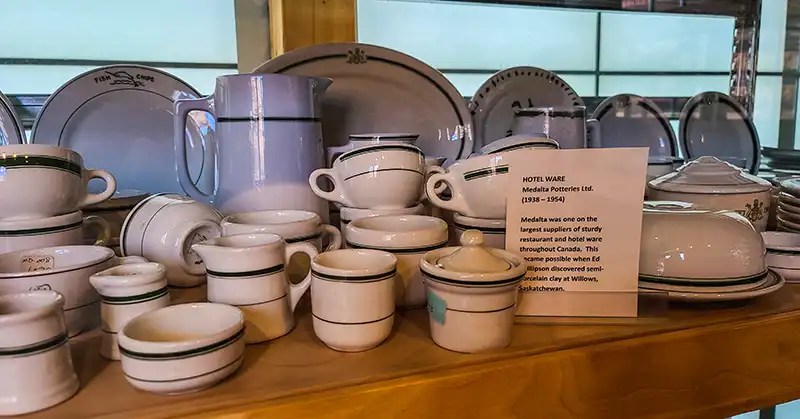
Fast Fact: Medalta was the largest supplier of hotel ware in Canada. This became possible when Phillipson discovered semi-porcelain clay (it's harder than regular clay) at Willows, Saskatchewan.
Ed Phillipson, superintendent of the Medalta Plant from 1937 until 1957, invented the Sanitas Handle Cup Machine. What did it do? It made handled cups in one operation. This not only meant no germs could hide out anywhere. It also made the process faster and the product stronger.
Win-win for everyone. I don’t know about you, but I’ve drank coffee in a lot of restaurants from cups that looked exactly like these ones!
What’s at the Medalta Museum?
The Medalta Museum is a focal point in Medicine Hat’s historic Clay District. Indeed, the clay industries that ranged from bricks to sewer pipes to pottery were the foundation of the city.
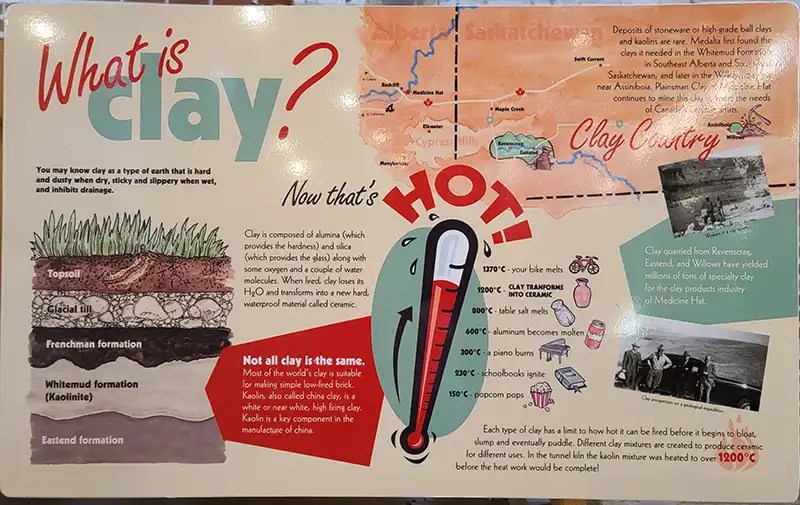
Operating from 1916 to 1954, Medalta Potteries is also on the Alberta Register of Historic Places. At its core, the Medalta Museum is an industrial museum preserving the tools that helped build western lifestyles. It’s also an arts facility, art gallery, and community hub.
Fast Fact: Between 1928 and 1950, Medalta produced 67% of all Canadian pottery.
Visitors are able to go through the complete manufacturing process in the Ol’ Factory. You’ll see original equipment and tools, along with kilns, in either a self-guided or guided tour. You can even take an amazing virtual tour of the Medalta Museum!
Once you finish the manufacturing area, you’ll see the Collector’s Gallery and many different collections of original stoneware.
From Clay to Products
The Medalta Museum illustrates the various steps in the manufacturing process of stoneware. Some of the machinery and processes were innovative and had a major impact on ceramics technology.
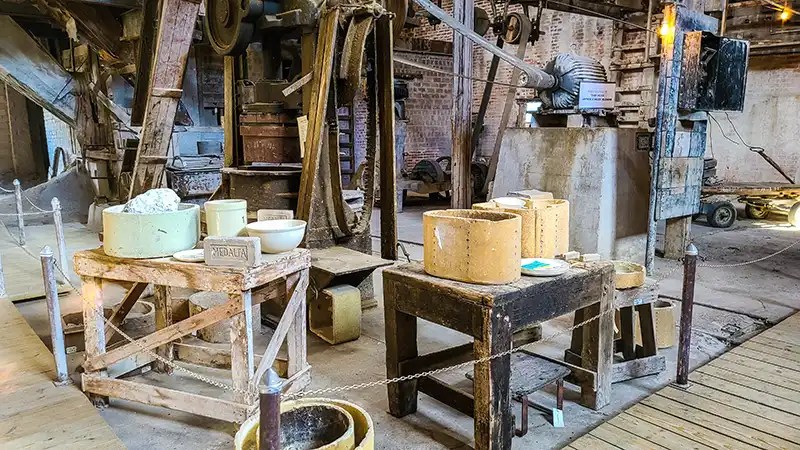
As you walk through the manufacturing area you can almost hear the machines and feel the heat. The day I visited, there was a guide on hand to ask questions. However, the signage does a good job of explaining each step.
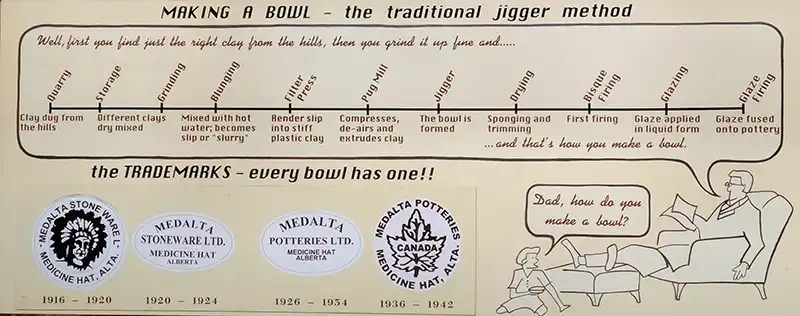
You’ll read about sponging and stamping, slip casting, jiggering and more!
From the machine area, you move to the Collector’s Gallery. It’s a fascinating area that shows some of the major changes experienced by Medalta.
Significant Parts of the Collection
You’ll learn about those lil’ brown jugs you’ve likely seen in antique shops and old farm sales.
Fast Fact: Until 1927, stoneware crocks with those top brown finishes were used for shipping bulk wine, spirits, preserves, even shellac.
During WWII, Medalta turned all production to the war front. The Canadian Armed Forces had Medalta ware in mess halls, trains, ships, hospitals and POW camps.
Later, the Canadian National and Canadian Pacific Railways became Medalta’s largest customers. Medalta made many specialty items for serving their guests.
What are ramekins, petite marmites and cocottes?
The short answer is that they can all be used as individual serving dishes. And here’s the long answer.
Ramekins – small ceramic dish used for baking traditional French desserts like soufflé or crème brûlée. These were small, straight-sided dishes meant to go from preparation to baking to serving.
Petite Marmites – small traditional crockery casserole vessels known for their pot-belly shape. The pot may have two finger-grips on each side.
Cocottes – stonewear small pots with lids used for individual servings.
Television and Medalta’s Demise
Are you wondering how television could possible be related to the closing of a stoneware manufacturing facility?
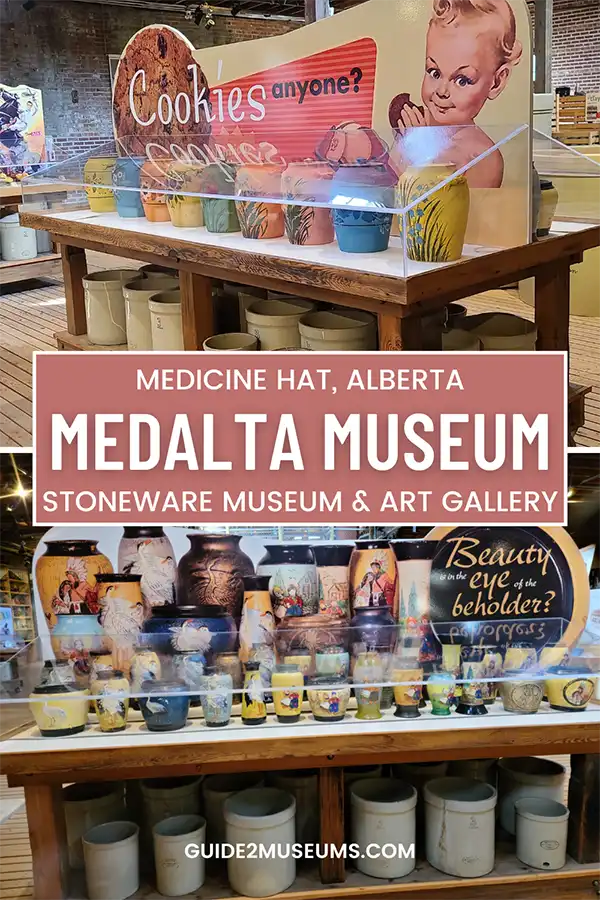
While a lot of management stayed with Medalta for decades, ownership changed several times. In 1952 it was acquired by W.G. Pulkingham.
Pulkingham decided to change direction from the lucrative hotel china and artware market. Phillipson disagreed.
However, Pulkingham re-tooled the plant to produce a product to sell movie theatres to give away to their patrons.
Re-tooling took longer than expected. It also cost more than expected. But the icing on the cake — or the final nail in the coffin — was that rather than going to movies, people started staying home watching television.
Linda’s Road Trip Tips
Medicine Hat is located on the Trans-Canada Highway, so I drive through regularly on my way to Calgary.
It’s a great stop whether you’re looking for a hotel or a restaurant or to spend a little time.
As you can imagine, with the abundant clay the city has a lot of historical brick buildings.
You’ll see a lot of them on a walking tour of the historic downtown.

Another great thing about Medicine Hat is that its winters are warmer than Saskatchewan’s — it also has an average of 330 days of sunshine. You’ll find lots of outdoor fun patios and bars once the snow is gone!
Who Should Visit the Medalta Museum?
Pottery lovers should put the Medalta Museum at the top of their lists to visit! From the process to the artistic aspects, you won’t be disappointed. Of course, there’s a lot of western Canadian history in general in the museum that many people will find interesting.
As well as the museum collection, you can also see their nationally-recognized archeological excavations.
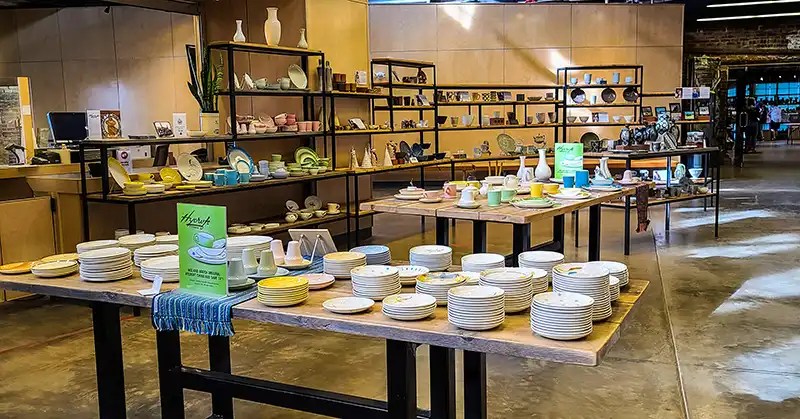
When you’re going through the museum, it’s important to keep children close by. There are a lot of breakable artifacts within reach of little hands!
If you can, it’s wise to plan your visit in advance. The museum hosts a lot of events, so the Collector’s Gallery and kilns may sometimes be unavailable.
The main floor and washrooms are wheelchair and stroller accessible. However, the basement area isn’t. There’s one wheelchair available for public use, and service animals with identification are allowed.
How Do You Visit the Medalta Museum?
Medicine Hat is located on the Trans-Canada Highway that crosses Canada, making it easy to visit the museum.
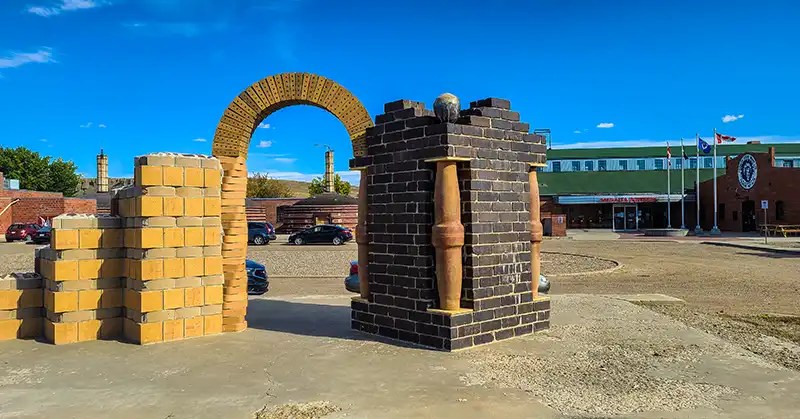
Street Address: 713 Medalta Ave SE, Medicine Hat, Alberta.
Parking: There's lots of free parking in front of the museum.
Check days open, visiting hours, and admissions costs online at the Medalta website.
Keep up to date with what’s happening on the Medalta Facebook page.
Take a virtual tour of the Medalta Museum on their website.
Plan your visit with Google Maps.
More Places to See in Alberta
Check out more things to see and do in Alberta with all of guide2museum.com’s reviews of museums in Alberta.
Explore More Technology Museums
- Texas Forestry Museum: Lufkin’s Hidden Gem
- Discover the Amazing Canada Science and Technology Museum

- EAA Aviation Museum in Oshkosh, Wisconsin: Airplanes from All Eras

- Medalta Museum: Ceramic Arts in Medicine Hat, Alberta
- Claybank Brick Plant National Historic Site: Claybank, Saskatchewan

- Ocean Star Offshore Drilling Rig & Museum: Galveston, Texas, Oil Drilling History

- McCormick Bridgehouse & Chicago River Museum: Chicago, Illinois

- Stafford Air & Space Museum: Space Shuttles to Rockets in Weatherford, Oklahoma

- Texas Energy Museum: Oil History in Beaumont, Texas
- Dr Pepper Museum: Great Tastes in Waco, Texas
- Museum of Clean: Pocatello, Idaho

- Alexander & Baldwin Sugar Museum: Puunene, Maui, Hawaii
- Idaho Potato Museum: Blackfoot, Idaho
- Manitoba Agricultural Museum: Rare Historic Farm Machines in Austin, Manitoba





 guide2museums.com