The Sign Post Forest is a unique historic site in Watson Lake, Yukon. Indeed, the 100,000+ signs cover a two-acre outdoor area! The signs are for just about everything — and from just about anywhere.
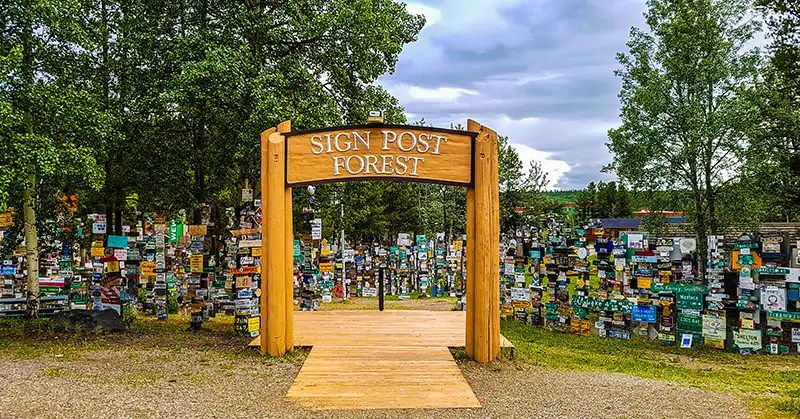
Linda’s Pick of the Exhibits
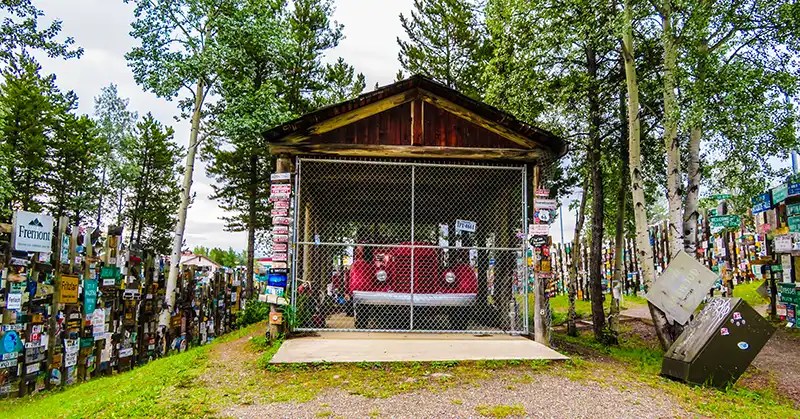
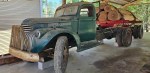
Sometimes it’s hard to pick a favorite when I visit historic places. This was one of those times. However, in the end I selected the vintage road building equipment still parked at the sign post forest.
Why? Because the reason the forest exists is a homesick soldier building the Alaska Highway put up his own sign as well as the required highway marker.
The soldier, Carl K. Lindley, was assigned the task of putting up signs for the newly built section of highway. But he didn’t stop there. Instead, he added a sign for Danville, Illinois, his hometown back in the USA.
That was 1942.
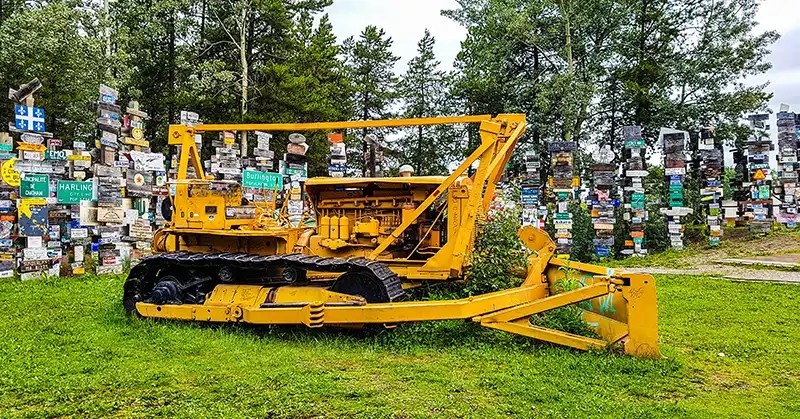
But back to the bulldozers. The bulldozers used to build the Alaska Highway — also called the ALCan Highway — were D8 and D4 Caterpillars.
What’s in the Sign Post Forest?
The Sign Post Forest consists of a few pieces of 1940s road building equipment and signs. That’s it!
Fast Fact: The Sign Post Forest is a designated historic place at the Territorial level by the Yukon Government. It was designated August 30, 2013.
Signs were important building the Alaska Highway. The highway begins with Mile 0 in Dawson Creek in British Columbia, Canada. The official end was at Historical Mile 1422 in Delta Junction, Alaska. Fairbanks, Alaska, another 298 miles further at Historical Mile 1520, was its unofficial end.
Why is the Alaska Highway mostly in Canada?
Like many projects that involve political decision between countries, a lot of talk happens before any action begins. Mainly the issue was whether Canada or the United States should pay for a highway to connect the U.S. by a land route to its distant state, Alaska.
Of course, there were already a number of roads in Northern British Columbia and Northern Alberta. None crossed the Yukon.
However, the need for a highway became urgent when the Japanese bombed Pearl Harbor on December 7, 1941. Two months later, President Roosevelt and the U.S. Congress approved building the Alaska Highway, on February 6, 1942.
And Canada? Well, they agreed to let the U.S. build the road as long as it didn’t cost the country anything. Plus, there was an additional caveat. Canada got ownership to all of the highway in its boundaries when the war ended.
It took 10,000 U.S. soldiers just eight months to push through the forest wilderness and five mountain ranges to build the road. Why so quickly? After Pearl Harbor, the U.S. knew the Japanese would invade if they could. That meant they needed the highway as a supply route to defend Alaska.
So, the completed highway ran approximately 1,700 miles (2,700 km), in 1942. Due to improvements over the years that grew into 1,387 miles by 2012. Of the total mileage there are 240 miles (321 km) in Alaska, the rest are in Canada.
The Sign Post Highway is at the junction of the Alaska Highway and Robert Campbell Highway — Mile Marker 635.
While Lindley put up the first sign, other soldiers missing mom’s home cooking and Saturday nights with their girlfriends soon followed suit.

Over the years, the forest grew and was maintained by different groups. In 2004 there were 55,000 signs in the forest. By 2024, there were 100,000 signs!
What’s On the Signs?
Signs come from everywhere. A license plate from Nova Scotia, Canada’s ocean playground. A stolen highway sign with an arrow pointing to Birch Lake. It could have come from anywhere, as there’s a Birch Lake in many provinces and states. A simple gold arrow on a board that said: Heidenburg, Uster, Switzerland.

There were speed signs: Reduced Speed Ahead.
City Signs: Entering the city of Tacoma, Population 158,900.
Warning Signs: Divided Highway Ahead.
And then there were the signs people made deliberately to leave behind on their Alaska Highway road trip. Indeed, anyone can add a sign to the forest.
Or, they can make one at the Watson Lake Visitor’s Interpretive Centre.
Linda’s Road Trip Tips
Driving the Alaska Highway should be on everybody’s road trip bucket list! It’s a trip through wilderness, lots of it rugged and empty except for wildlife. Don’t worry about your cell phone coverage, because most of the time there just isn’t any, regardless of your carrier.
I booked accommodations in advance, although I wouldn’t have needed to in most places.
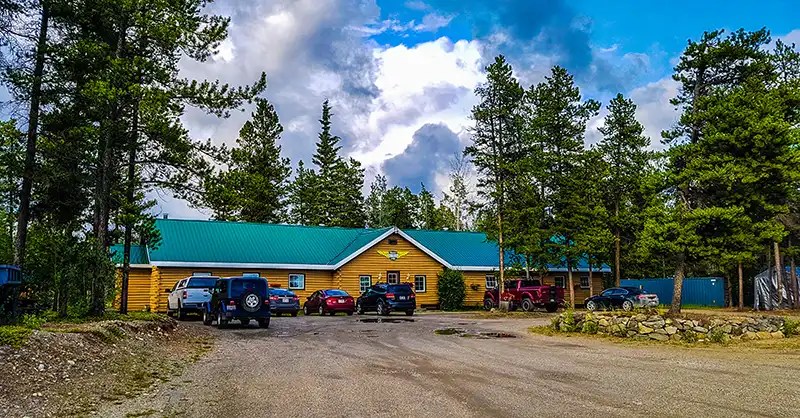
In Watson Lake we had decided to try out the Air Force Lodge. It’s the oldest local building, having been built at the Watson Lake Airport in 1942 as barracks. Pilots flying in WWII stayed in it, then it was moved to town when it was no longer needed.
Luckily, the present owner purchased and restored it meticulously.
So, it was our opportunity to spend a night as the military did some 80 years before — no air conditioning and bathroom down the hall! However, there are some modern amenities including satellite TV and fiber optic high-speed Internet.
For restaurants, I’d recommend Lauries Bistro and Coffeehouse and Andrea’s Restaurant.
Who Should Visit the Sign Post Forest?
If you’re driving the Alaska Highway, you should definitely take the time to stop at the Sign Post Forest.
It’s considered to be one of the most famous and popular landmarks along the Alaska Highway.
Whether you’re traveling with kids or pets, there’s lots of room to run off some energy.
While the ground is level, it’s grassy, so wheelchairs and strollers might find getting around everything a bit more challenging.
We spent around an hour, but that could vary depending on how many of the signs you want to read.
How Do You Visit the Sign Post Forest?
The Sign Post Forest is a popular free historic attraction open year-round in Watson Lake.
Physical Address: Mile 635, Alaska Highway, Watson Lake, Yukon Territory.
Parking: There's lots of free parking at the entrance to the Sign Post Forest.
Check out the unofficial Sign Post Forest Facebook page for more photos and updates.
Take a virtual tour of the Sign Post Forest with Free Jazz on YouTube.
Plan your visit to the Sign Post Forest with Google maps.
More Things to Do in the Yukon
Check out all of guide2museum.com’s reviews of museums in the Yukon.
Read More Historic Site Reviews
- Chinatown in Montreal: A Fascinating Historic Site

- Canada’s Little-Known Cold War Museum: the Diefenbunker

- Discover the Mormon Handcart Historic Site & Devil’s Gate in Wyoming

- Historic Home of 1800s Governor in Lafayette, LA: Alexandre Mouton

- See 100 Miles Across Nebraska From Scotts Bluff National Monument

- Bishop’s Palace in Galveston, Texas: Victorian Era Castle

- Rip Van Winkle Gardens & Historic Mansion: Jefferson Island, Louisiana
- Robinson Roadhouse & Robinson Flag Station: Yukon Ghost Town

- USS Lexington Museum: WWII Aircraft Carrier in Corpus Christi, Texas

- Watson Lake Sign Post Forest Historic Site: Watson Lake, Yukon
- Medalta Museum: Ceramic Arts in Medicine Hat, Alberta

- Claybank Brick Plant National Historic Site: Claybank, Saskatchewan

- The Sheriff’s House Museum & Historic Site: A Hidden Gem in Devils Lake, North Dakota

- Soo Line Historical Museum & Historic Site: Weyburn, Saskatchewan

- Texas Seaport Museum: Gulf Coast History in Galveston, Texas
- Fred Light Museum: Battleford, Saskatchewan

- Frontier Prison Museum: Rawlins, Wyoming

- Toronto’s First Post Office Museum & National Historic Site: Ontario

- The Bastion: Designated Historic Place, Nanaimo, British Columbia
- Hearst Castle: National Historic Landmark in San Simeon, California




 guide2museums.com