The Fick Fossil & History Museum in Oakley, Kansas, showcases millions of years of history — much of it local. Indeed, most of the collection’s fossils are from a twenty-mile radius of the Fick Ranch in the nearby Monument Rocks region.

What’s in the Fick Fossil and History Museum?
The Fick Fossil and History Museum opened in 1975. The foundation of the collection is thousands of fossils, most donated by Vi and Ernest Fick. And while many are labeled and displayed, others were made into art.
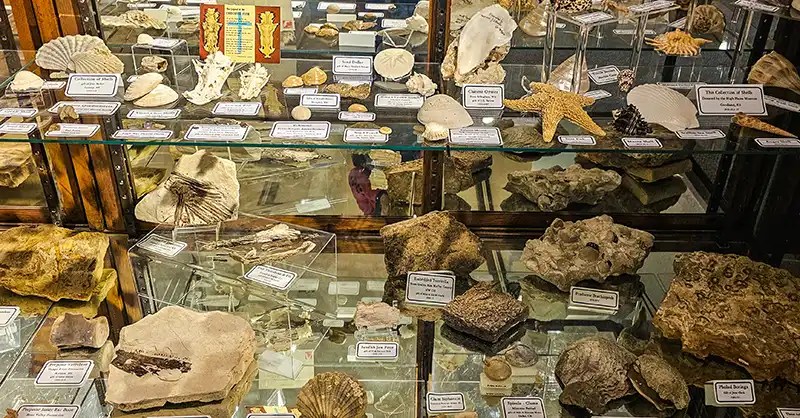
It’s this artwork that truly makes the museum’s fossil collection stand out. Vi, being quite artistic, used sharks’ teeth, vertebras, crinoids, and oyster shells to create works of art.
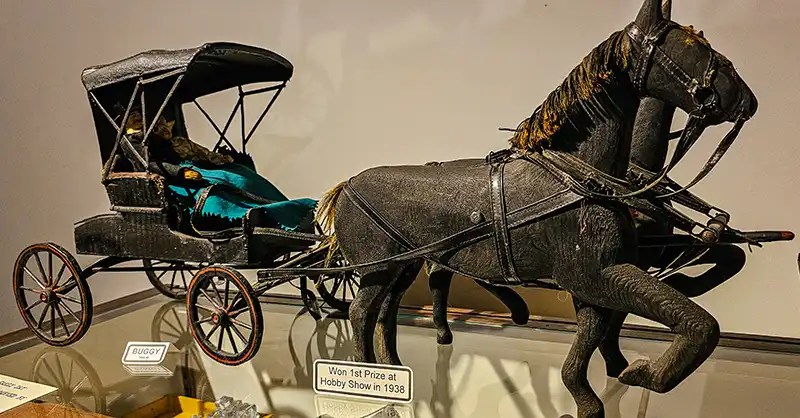
The museum collection also contains various other pieces of art. Paintings by local artists bring the area history to life. Various wood carvings of wagons and buggies commemorate the horse-drawn transportation era. A number of bronze statues celebrate western history, especially Buffalo Bill’s era.
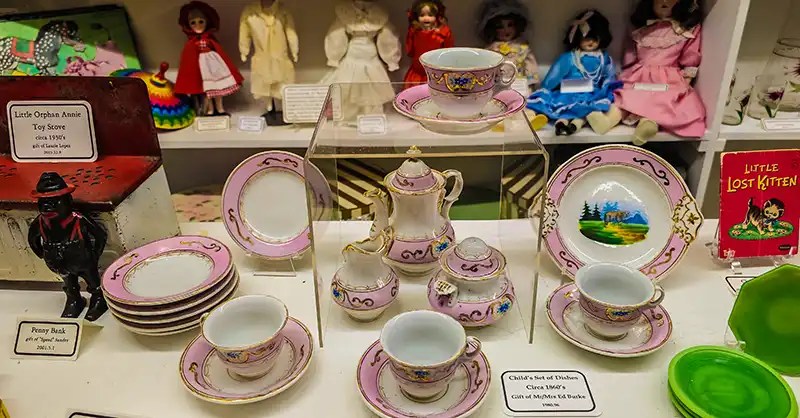
Other Featured Exhibits
The displays are very well laid out in the museum. Everything is labeled, so there’s no guesswork as to what it is or what community member donated it.

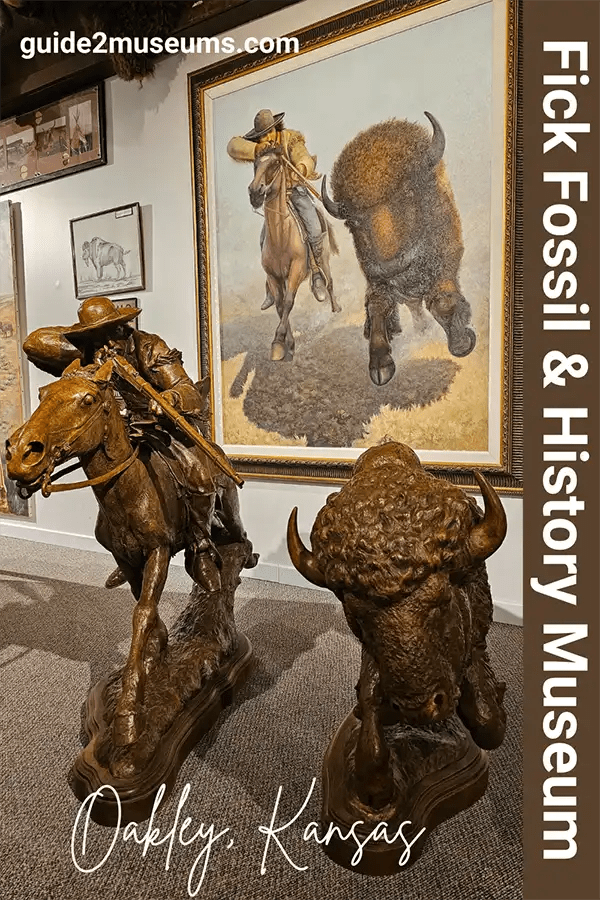
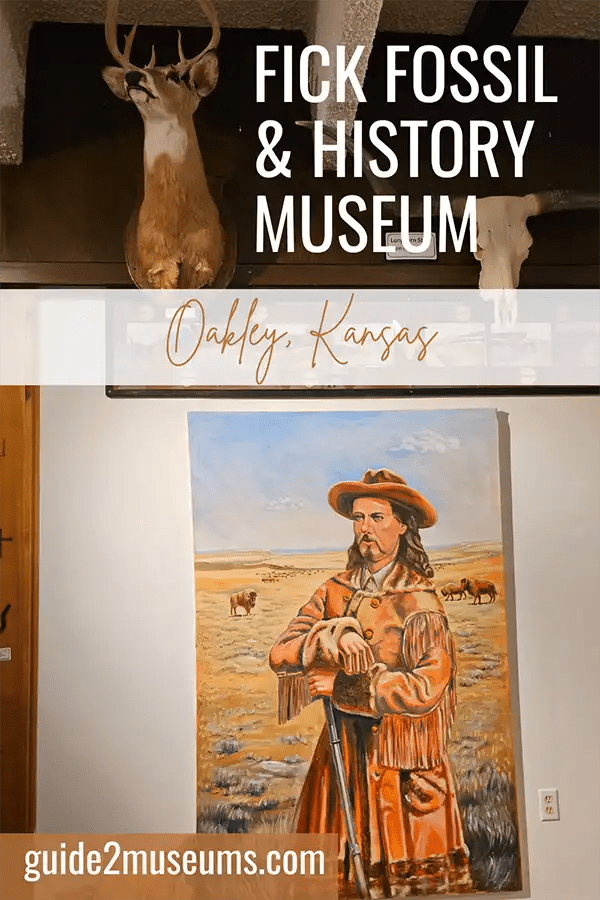
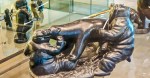
A Buffalo Bill sculpture with his horse, Brigham, running alongside a buffalo is an exhibit that stands out. It’s placed under a painting of the same scene.
Fast Fact: Buffalo Bill hunted buffalo to feed the Kansas Pacific Railroad work crews in 1867. It's where he earned his moniker “Buffalo Bill” and his reputation as an expert shot.
These are some of the other displays that stand out.
- Replica of a sod house
- Prehistoric fish, Xiphactinus Audux, over 15 ft long
- Oldest documented skull of a Mosasaur
- Prather Creamery
- Household artifacts from a 1900s Kellogg Wall phone to Brownie cameras
- Various vintage toys and ice skates
- Western Union Telegraph and Cable Office
- Union Pacific Depot
- Vintage firetruck
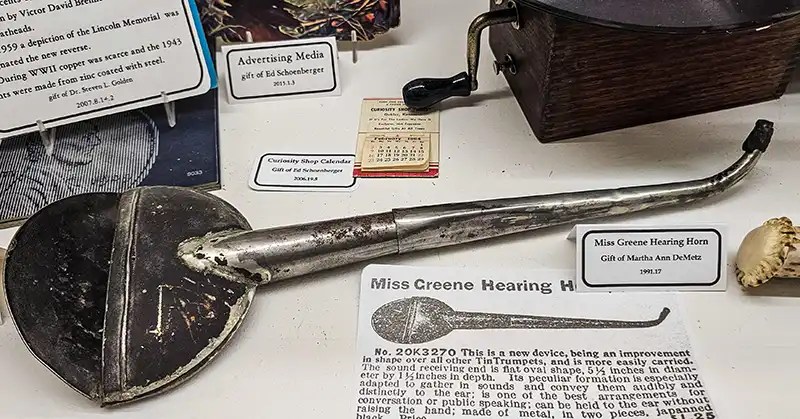
Fast Fact: The Miss Greene Hearing Horn below was sold as an improvement over all other tin trumpets (hearing aids). Shaped in an oval, it was 5.5 inches in diameter and 1.5 inches in depth - on an adjustable handle! It sold for $1.25 in 1902.
Linda’s Pick of the Exhibits
The range of exhibits in this history museum made it really hard to pick a favorite. In the end though, I had to choose the brick that said, “Don’t Spit on the Sidewalk.”
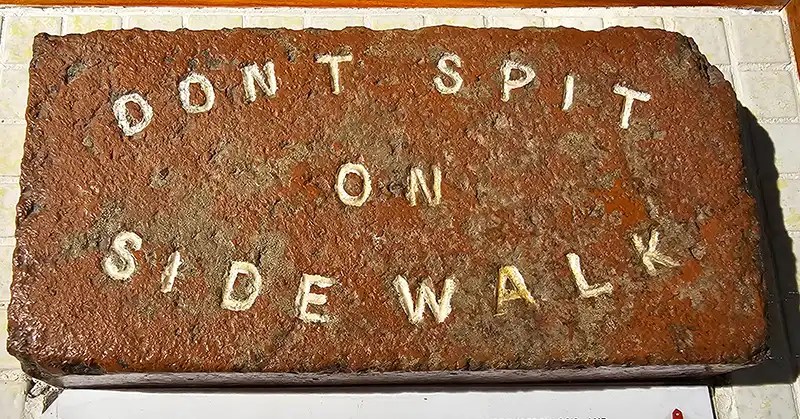
Obviously it’s more about the story than the brick itself!
Fast Fact: In the 1880s, tuberculosis (TB) was the leading cause of death in the United States. One in seven people died of the very contagious disease.
So, thousands of people east of the Mississippi in the heavily settled states headed west looking for pure air.
Of course, it wasn’t the air itself that was the problem. Dr. Samuel J. Crumbine, while taking the train across Kansas, realized it was what people suffering from the disease did that spread TB. They coughed into the air. They spit on the train floor, sidewalks and other places. They even shared the train’s community drinking glasses.
How did the Health Bricks come to be?
Dr. Crumbine started his campaign to stop the spread of TB by approaching the railroad owners. He asked them to remove drinking glasses and replace them with paper cups sold for a penny each. The owners paid little heed to the request.
But that didn’t stop the good doctor. He went to a brick manufacturer in Topeka and asked him to imprint the words, “Don’t Spit on the Sidewalk” on bricks used for sidewalk and street building. The manufacturer reluctantly agreed and imprinted every fourth brick.
Crumbine added two additional mandates to his fight against TB. 1) Out with the common roller towel, and 2) Swat the fly.
It took a few more years, but in 1909 he got the Kansas State Legislature to pass a law on spitting. Yup, spitting. Spitting was prohibited except in cuspidors and community drinking vessels were outlawed. In 1911, the Legislature provided money for a TB state sanitarium.
Eventually, as the rate of TB slowed in Kansas, other states followed suit.
So how did bricks like this one end up in museums? Fifty years after their introduction, Tuberculosis and Health Associations asked anyone in the state who could find a brick to send it to them. Every county in the state was successful.
Read more about Dr. Samuel J. Crumbine.
Linda’s Road Trip Tips
On this leg of our trip to Galveston, Texas, we were traveling on U.S. Route 83 South. We’d spent the previous night an hour-and-a-half away in McCook, Nebraska, at the Cedar Inn. While the inn was simple, it was good value for the cost.
One of our roadtrip goals was to taste a variety of BBQs, which we did at Taste of Texas BBQ in McCook. We loved their brisket!

After visiting the Fick Museum we stopped at the iHop at the Oakley truck stop. While we usually find the chain’s food tasty, this one was a big disappointment.
From Oakley, we stayed on US-83 into Garden City. The Finney County Historical Museum was small but interesting, with the attached zoo also a great stop.
Who Should Visit the Fick Museum?
While art isn’t what I usually look for in a history museum, this one had an excellent collection. Art lovers interested in sculptures and carvings will find lots of great pieces. Also, of course, the fossil art is very unique.
Fossil hunters will find lots to keep them going through the collection for hours. It’s not often you find 11,000 shark teeth!
The Fick Museum will be particularly interesting to anyone in the county, or whose family has connections to the area. All of the artifacts are labeled with their original owner names, so there’s a lot of local history here!
However, this history museum also hosts traveling displays. So, everyone will find new things to see when they visit.
With just a main floor and spacious aisles, the building is accessible for strollers and wheelchairs.
We spent about an hour-and-a-half, however, anyone with a keen interest in fossils will need much longer.
How Do You Visit the Fick Fossil & History Museum?
The Fick Fossil and History Museum is a shared facility. The Oakley Community Library is in half of the building.
Parking: There's lots of free street parking in front of the building.
Street Address: Bertrand Park, 700 W 3rd St, Oakley, Kansas.
The museum is open year round. You can check days and hours for the museum on the Oakley website. Note that the museum is currently free.
Fiind out what’s happening at the Fick Fossil and History Museum Facebook page.
Here’s a short YouTube video with museum photos.
Plan your visit with Google Maps.
Find More Museums to Visit in Kansas
Check out all of guide2museum.com’s reviews of museums in Kansas.
Discover More History Museums
- Musée de la civilisation: Quebec’s Museum of Civilization
- Inside the Cattle Raisers Museum: Fort Worth, Texas

- Plains of Abraham Museum & Battlefield Park: Quebec City
- Royal Ontario Museum in Toronto Review
- Amazing Giant Bison, Beaver, Mammoths & More: Yukon Beringia Museum in Whitehorse

- Royal Saskatchewan Museum & World’s Largest T-Rex Dinosaur

- Fick Fossil & History Museum: Buffalo Bill to Prehistoric Fish in Oakley, Kansas
- Ronald Reagan Presidential Library & Museum: Simi Valley, California

- Morro Bay Maritime Museum: Morro Bay, California

- National Cowgirl Museum & Hall of Fame: Cowgirl history in Fort Worth, Texas
- Bell Barn Museum: Historic Round Barn in Indian Head, Sskatchewan

- Naranjo Museum: Dinosaurs & Fossils in Lufkin, Texas

- Texas Seaport Museum: Gulf Coast History in Galveston, Texas

- Levine Museum of the New South: Charlotte, North Carolina

- Jefferson Historical Museum in Big Cypress Bayou: Jefferson, Texas
- Museum of the Fur Trade: Chadron, Nebraska

- Mystic Seaport Museum: Historic Seafaring Village in Mystic, Connecticut






 guide2museums.com