The Royal Saskatchewan Museum stands out for many reasons! It’s home to the world’s largest Tyrannosaurus rex dinosaur. It’s Saskatchewan’s first museum. And, it received royal patronage from Queen Elizabeth II.
Linda’s Pick of the Exhibits
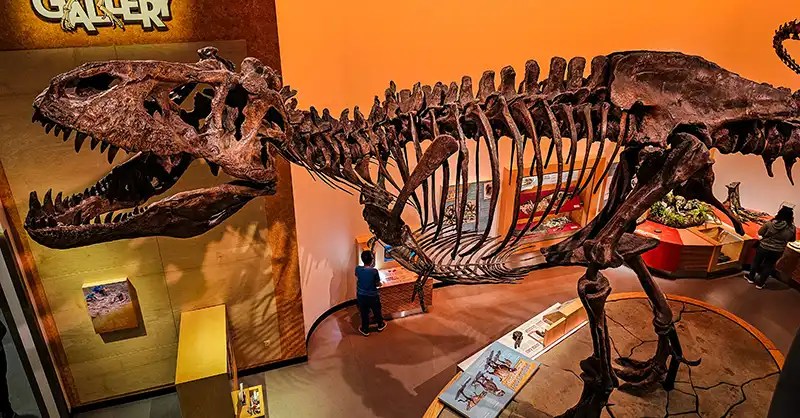
My favorites here? The dinosaurs, of course in the CN T. rex Gallery!
Scotty was found in Saskatchewan’s Frenchman River Valley badlands near Eastend in 1991. The excavation took almost 20 years, but succeeded in finding 65% of his bones, making Scotty the most complete T. rex skeleton ever found.
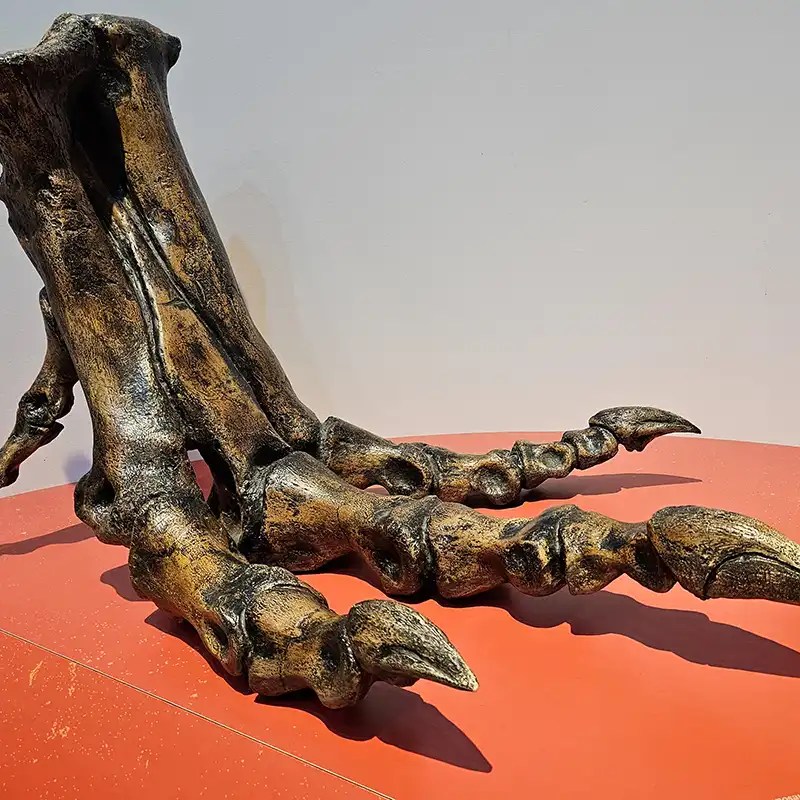
Dedicated staff from the museum, students, and other volunteers removed the skeleton. It had been embedded in rock and almost all the work was done with hand tools.
Fast Fact: Tyrannosaurus rex was named the provincial fossil of Saskatchewan in 2018.
So how big is Scotty? He’s nearly 42 feet (12.8 m) long and is estimated to have weighed 19,555 pounds (8,870 kg). Sue the dinosaur, at the Chicago Field Museum, is 19.6 inches (50 cm) shorter and 880 pounds (400 kg) lighter.
Paleontologists know a lot about Scotty. He had, for example, a bone infection that left a puckered hole just behind his eye. Plus, he lost a tooth due to a jaw injury–the hole filled with bone. Likely he still came out the winner in the fight, though!

What did Scotty sound like? Recent research suggests that tyrannosaurs and other hadrosaurs used low-frequency booms to communicate.
Fast Fact: If T. Rex were around now, we'd be more likely to feel the vibration of the sounds rather than hearing them.
And if you’re wondering what Saskatchewan looked like when Scotty lived, well very differently! From the dig where Scotty was found, research has also changed our knowledge of the area 65 million years ago.
What was Saskatchewan like when Scotty lived 65 million years ago?
Here are a few things researchers have learned from the site where Scotty’s skeleton was found.
Temperatures at that time were warm from the equator to the poles. The land mass we call Saskatchewan was situated even further north at the time. So, winters were darker than now–there were few hours of daylight.
However, we know from the plants and wildlife that it was subtropical. Today, short days and subtropical weather just don’t occur together on earth.
Some facts:
- Scotty lived in a broad river valley with forested lowlands
- There were palms and bald cypress-like conifers
- Fish, salamanders, crocodiles, and turtles lived in the water and lowlands
- There were also various other dinosaurs such as Triceratops, Edmontosaurus, and raptors like the Dromaeosaurs
- Mammals such as three-toed horses, rhinoceroses, and pronghorn relatives lived in the area
What’s at the Royal Saskatchewan Museum?
The Royal Saskatchewan Museum is situated in Regina’s Wascana Park. Its current building was constructed on the site of the Chateau Qu’Appelle Hotel and opened in 1955. The hotel had been abandoned with only five of its ten stories built back before WWI.
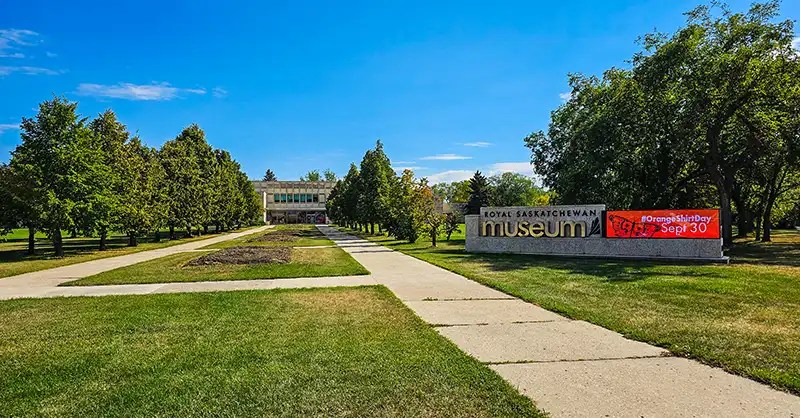
Some of the museum’s design elements are due to its origins. It is, for example, built on an angle with a large front lawn to cover the original basement.
Established in 1906, the museum has amassed a large collection. Indeed, it houses over 3.5 million items, including archaeological artifacts, insects, fossils, birds, plants, arachnids, mammals, reptiles, and fish.

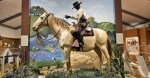
The murals behind the exhibits are particularly amazing at the Royal Saskatchewan. Painted in intricate detail, they bring all seasons of the prairies to life. Artists include Fred Lahrman, Ralph Carson, and Robert Boyer.

Several galleries display the collection. They include the Earth Sciences Gallery, First Nations Gallery, Life Sciences Gallery, Life in the Anthropocene, and the CN T. rex Gallery. There are also Bees of Canada and Bird Eggs of Canada collections. Plus, the museum has a large auditorium and stage.
Linda’s Road Trip Tips
There’s lots to see and do in Regina, the province’s capital city. The Saskatchewan Legislative Building is just across Wascana River from the museum, only a kilometer away. Free tours of the Legislative Building are available in English and French, and are very informative.
The Saskatchewan Science Centre is a fun stop for adults and kids alike. It showcases a lot about Saskatchewan’s industries from agriculture to oil, as well as its sports such as hockey.
You can also get a century of Royal Canadian Mounted Police (RCMP) history at the RCMP Heritage Centre.
It’s located at the RCMP Academy, Depot Division, where mounties have trained since 1885.

Fast Fact: And if you're looking for a unique, Saskatchewan-made, restaurant for lunch, try The Moose & Bannock. It serves Indigenous cuisine and bannock-inspired Western cuisine as eat-in or take-out options. My favorite is their bannock bison burger.
Who Should Visit the Royal Saskatchewan Museum?
The Royal Saskatchewan Museum is the key destination to learn about the province’s natural and cultural history. It’s popular with families due to the detailed exhibits and many taxidermy mounts. And even if wildlife isn’t your thing, the artwork is well worth the visit.
In addition to Scotty, the dinosaur, many visitors go to see the First Nations Gallery. A collaborative effort of researchers, Indigenous Elders, students, and community members, it opened in 1993. Some dioramas are life-size and some smaller.

All, however, examine the culture and traditions of Saskatchewan’s Indigenous peoples over the past 10,000 years.
Recent renovations were done to improve accessibility to the museum. Wheelchairs and strollers can easily navigate the museum, which is mostly on one floor. There’s also elevator access to the CN T. rex Gallery, the two-story space where you’ll find Scotty.
I spent a couple of hours going through the museum. However, that wouldn’t be enough time for someone unfamiliar with Saskatchewan’s natural science.
How Do You Visit the Royal Saskatchewan Museum?
The Royal Saskatchewan Museum is on Albert Street in Regina, one of the city’s main east-west streets.
Parking: There's free public and bus parking available on the west and south sides of the museum. The south doors are the best entrance. The north doors, facing the corner of Albert Street and College Avenue, are exit only.
Street address: 2445 Albert Street, Regina, Saskatchewan

The museum is open daily and operates on a $5 donation per visitor. Check hours and to confirm other admission information on the Royal Saskatchewan Museum website.
Keep up-to-date with what’s happening on the Royal Saskatchewan Museum Facebook page.
Take a virtual tour of the Royal Saskatchewan Museum on YouTube.
Plan your visit with Google maps.
More Places to See in Saskatchewan
Check out all of guide2museum.com’s reviews of museums in Saskatchewan.





 guide2museums.com