The University of Louisiana at Lafayette Science Museum blends education with interactive fun, making it an excellent attraction. Covering all kinds of “science,” the museum highlights Louisiana’s unique natural history and cultural heritage.

Linda’s Pick of the Exhibits
If there’s a dinosaur involved, I’ll pick it every time! So, my favorite exhibit at the University of Louisiana at Lafayette Science Museum is the Paleontology exhibit. Their archive has nearly 150,000 specimens, so there’s a lot to see!
The rarest fossils at the Lafayette Science Center are those of a Megatylopus. What’s a megatylopus? Basically, it’s an ancient giraffe-like fossil camel that stands 12 to 14 feet tall. This skeleton is the most complete known of for this type of giant from the Late Miocene to Pliocene epochs.
Fast Fact: This megatylopus was discovered in 2014 in Oregon. Two technologies were used to excavate the skeletons. 1) 3D laser scan of the site before excavations. And 2) Ground Penetrating Radar (GPR) to discover other bones beneath the surface.
When was Pliocene Epoch? About 13.6 to 1.8 million years ago, so almost yesterday in world history!
Here are some of the exhibits I found most intriguing:
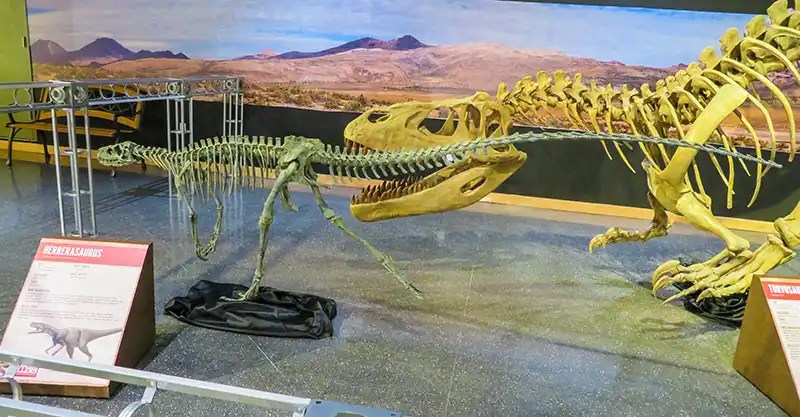
- Fossil casts from the late Jurassic Period or Age of Dinosaurs: Allosaurs, Camptosaurus, and Stegosaurus. Time period: 199 to 145 million years ago.
- Mastodon and mammoth fossils that first appeared in the Miocene epoch, around 24 to 5 million years ago when they diverged from other elephant-like relatives
- Saber-tooth tiger remains from the Pleistocene epoch about 2.6 million to 11,700 years ago.
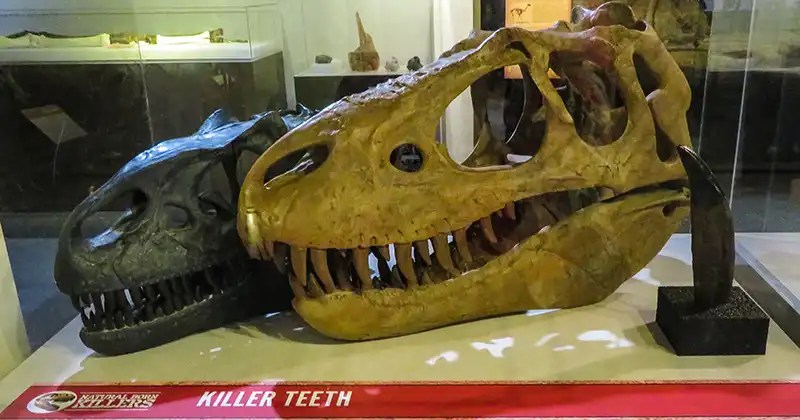
Fast Fact: Ancient animals needed killer teeth as illustrated above. Allosaurus teeth had a wider gap, so it could open its mouth at a 92-degree angle. Albertosaurus teeth had features that helped spread strain from biting and feeding to protect the tooth from breaking. Tyrannosaurus may have had it all. Its large, sharp, strong teeth could regrow every few years. It needed to, as the Tyrannosaurus bite force helped it crush bones while snacking!
And of course, there’s also a Prehistoric Louisiana or Ice Age Acadiana exhibit. It has fossils from sites like Jefferson Island, Avery Island and Acadia Parish. As you’ll learn, during the Pleistocene, Louisiana’s landscape was very different than it is now.
What was the Pleistocene Era like?
The Pleistocene Era is the geological epoch that lasted from about 2,580,000 to 11,700 years ago. It spanned the Earth’s most recent period of repeated glaciations. Humans first appeared during this period.
You can learn more from the YouTube video, The Pleistocene Era.
The Pleistocene Epoch was basically an ice age. You can learn more at this PBS article on the Pleistocene Epoch.
What’s in the Lafayette Science Museum?
The University of Louisiana at Lafayette Science Museum is situated in downtown Lafayette. It has over 10,000 square feet of exhibition space.

Started in 1969, it was first named the Lafayette Natural History Museum and Planetarium. In 1992 the museum relocated to the downtown to be more accessible. It became the Lafayette Science Museum in 2009, then the University of Louisiana at Lafayette Science Museum in 2022.
Fast Fact: How hot is hot? A geology exhibit explains it's really hot -- from 0 to 800 degrees Celsius! Hydrothermal minerals form at the Earth's surface, like the travertine you see in the pools at Yellowstone National Park. Water heating underground is what makes Old Faithful erupt.
The Exhibits
There are lots of amazing exhibits in addition to the Paleontology area. Here are some.

- Virtual Reality Laboratory Experience. The eight stations immerse visitors in diverse adventures such as exploring outer space or the depths of the ocean.
- Petroleum Industry Exhibit. Artifacts and signage detail the history of the petroleum industry.
- Ethnographic Collection. Here, artifacts represent the diverse cultural communities of Acadiana and Southeast Louisiana.
- Nanotechnology Exhibit. This interactive exhibit uses hands-on displays to introduce visitors to nonoscale science, engineering, and technology.
- The Crawl Space. This interactive exhibit has — you guessed it — live terrariums with all kinds of bugs.
- Planetarium. This second floor attraction has a 40 ft (12.2 meter) dome and seats 72 people. It shows various live and prerecorded programs included in your regular museum admission.
Fast Fact: The British were the first to use rockets in the New World. Indeed, they used them against the United States in the War of 1812. The rockets inspired the phrase "rockets' red glare" in the lyrics in the Star Spangled Banner.
Linda’s Road Trip Tips
I’ve visited Louisiana many times (it’s one of my favorite states), but didn’t spend time in Lafayette until this trip. Years earlier, we’d been driving through and got caught up with the Mardi Gras day parade. That day, we ate in one of my favorite Southern chains, Cracker Barrel Old Country Stores. Try the biscuits. They’re delicious.

During my last five day stay, I attended a conference at the Cajundome, so had lots of time to explore. I enjoyed my stay at the Hilton Garden Inn, opposite the Cajundome. While most of my meals were at the conference, I found great authentic local dishes at the Acadian Superette. Do try their boudin — it’s amazing!
Even though Lafayette is just a small city of around 122,000, there’s lots to do. If you’re visiting with kids, their Children’s Museum of Acadiana is a perfect stop. I even enjoyed the colorful centers and activities.
And if you want to learn more about the local culture, the living history Vermilionville Village is perfect.

On an earlier trip I also took part in the Atchafalya Basin Landing swamp tours. If you’re a first-timer to Louisiana, a swamp tour is a must!
Who Should Visit the Lafayette Science Museum?
The University of Louisiana at Lafayette Science Museum is one of those museums that has something for everyone.

It’s a great stop for families and children. All of the interactive hands-on installations are both fun and educational.
Of course, schools and educators are frequent visitors.
For those interested in Louisiana culture, you’ll learn a lot here about the natural history.
And if you love stars, the museum’s state-of-the-art planetarium has the highest-resolution screen in Louisiana.
The museum is fully accessible for families and those with other physical challenges. I spent about three hours to explore the exhibits, but wasn’t able to stay for the show at the planetarium.
How Do You Visit the Lafayette Science Museum?
The University of Louisiana at Lafayette Science Museum is situated in downtown Lafayette. It’s surrounded by various amenities.
Parking: Visitors can find metered street parking. There are also parking garages nearby: Parc-Auto du Centreville at 121 E. Vermillion Street and the South Buchanan Street Garage at 809 South Buchanan Street.
Museum street address: 433 Jefferson St., Lafayette, Louisiana
The Lafayette Science Museum is open year-round. However, you’ll need to check days and hours open at the museum website.
Keep up-to-date with what’s happening with the UL Lafayette Science Museum Facebook page.
Take a virtual tour of the University of Louisiana at Lafayette Science Museum on YouTube.
Plan your visit with Google maps.

Find More Museums in Louisiana

Explore More Science Museums
- Tour The Biosphere: Montreal’s Environment Museum

- Discover the Amazing Canada Science and Technology Museum

- Fort Worth Museum of Science & History: Museum School™

- Lafayette Science Museum: From Dinosaurs to the Space Age in Louisiana

- McCormick Bridgehouse & Chicago River Museum: Chicago, Illinois

- Moody Gardens: Resort & Fun Attractions with Pyramids in Galveston, Texas

- Museum Of Illusions Toronto: Mind-Bending Exhibits

- Field Museum: Natural History Museum in Chicago, Illinois

- Audubon Insectarium: Natural Science Museum in New Orleans, Louisiana

- Glendive Dinosaur & Fossil Museum: 25+ Dinosaur Skeletons in Glendive, Montana











 guide2museums.com