The Yukon Beringia Interpretive Centre brings the mammoth steppe to life. This museum is one of the key visitor attractions in Whitehorse, Yukon Territory.
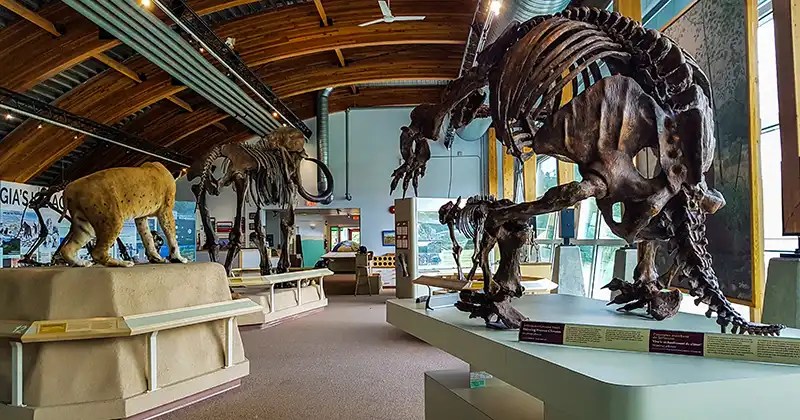
Linda’s Pick of the Exhibits
I’ve always found the woolly mammoth one of the most fascinating giant animals of the ice age. Indeed, they were first recorded in Eurasia around 150,000 years ago in deposits of the 2nd last glaciation.

A couple of million years isn’t long on the geological time scale. Indeed, earth’s largest animals, the dinosaurs, mainly lived during the Mesozoic era some 250 million or so years ago!
However, woolly mammoths are fascinating because they lived alongside humans.
Fast Fact: Mammoths are the most important Ice Age animals in aboriginal stories. Many stories tell of attacks by mammoths and how the enormous beasts were trapped and killed.
Most mammoths became extinct about 11,000 years ago, but some dwarf woolly mammoths survived until 3,700 years ago. Where? On Wrangle Island off the Siberian coast. In terms of human history, that puts them roaming the land while the pyramids and Stonehenge were being built!
Fast Fact: Mammoth tusks are often uncovered by placer miners and paleontologists in the Yukon. The tusk ivory is different from their modern relatives, elephants. Mammoth ivory tusks have intersecting lines less than 90 degrees while elephant's are greater. Like trees, a mammoth's life story can be read from tusk rings visible when the tusk is cut in half.
What about Yukon discoveries of woolly mammoths?
- Late 1840s: first mammoth bones discovered in the Yukon by a fur trader & explorer for the Hudson’s Bay Company. It was a full skeleton at the confluence of the Yukon and Pelly Rivers.
- 1967: nearly complete woolly mammoth skeleton discoverd by Ice Age Palaeontologist Richard Harrington. It was on the shores of the Whitestone River.
- 2002: huge woolly mammoth tusk found at Last Chance Creek. The tusk was 10′ 6″ (2.8 m) long and weighed 183 lbs (85 kg).
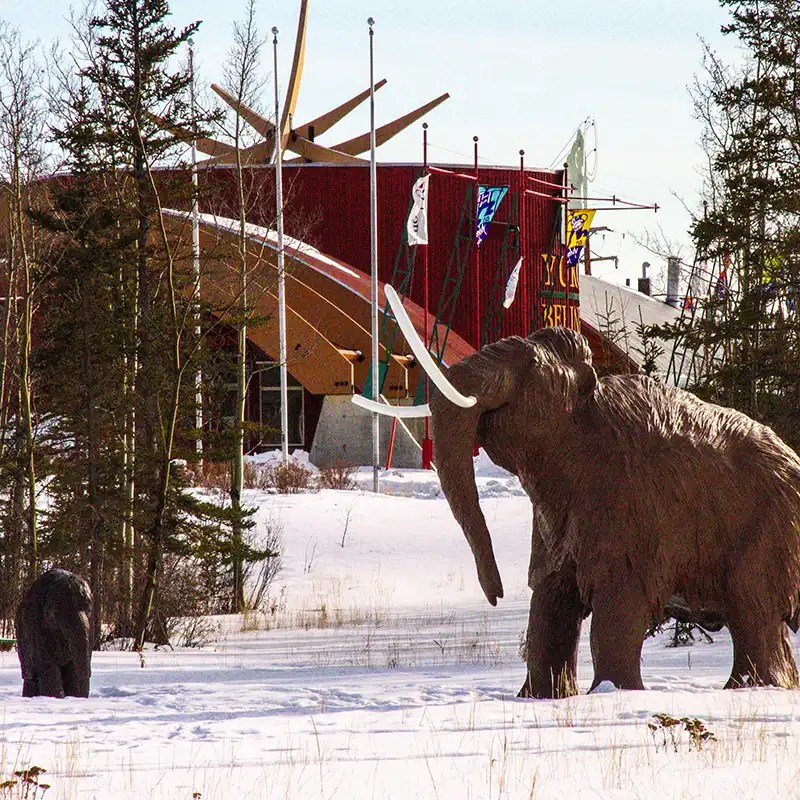
What’s in the Yukon Beringia Interpretive Centre?
The Yukon Beringia Interpretive Centre is a fascinating mix of science, history, and Indigenous culture. It opened in 1997 in the repurposed Yukon Visitor Reception Centre.
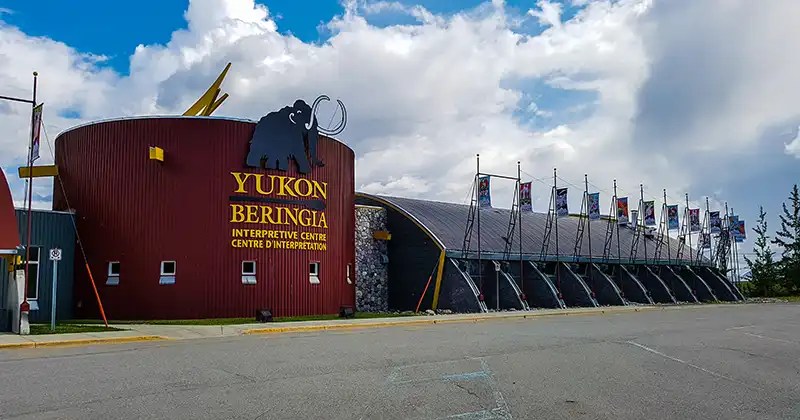
Beringia was a vast Ice Age mass of land often referred to as The Bering Land Bridge. It spanned the area from eastern Russia to Canada, providing a cold, but mostly glacier-free grassland for thousands of years. So, the museum focuses on the area’s history and its Ice Age animals and peoples.
Over 50 Yukon fossils are featured in the main exhibit hall of the Beringia museum. Its collection, however, has over 40,000 specimans with thousands more waiting for cataloging.
The key exhibits include:
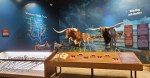
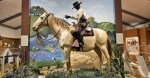
- Life-size replicas of woolly mammoths, giant beavers, steppe bison, a Yukon horse, scimitar cats, and American lions.
- Maps and explanations of Beringia during the Ice Age.
- Ancient tools, hunting techniques and archaeological discoveries of the First Peoples of Beringia.
- Fossils from digs such as Bluefish Caves where some of the oldest human tools in North America were found.
- Documentary, Beringia: Land of the Ice Age, along with touchscreens and digital displays.
- Outdoor displays
More Notable Giants at the Museum
So what makes the beaver important to the Yukon? The beaver became Canada’s official national animal in 1975. Plus, it’s been on the nickel (5-cent coin) since 1937! Why? The demand for beaver pelts during the fur trade drove much of Canada’s exploration up to the 1800s.
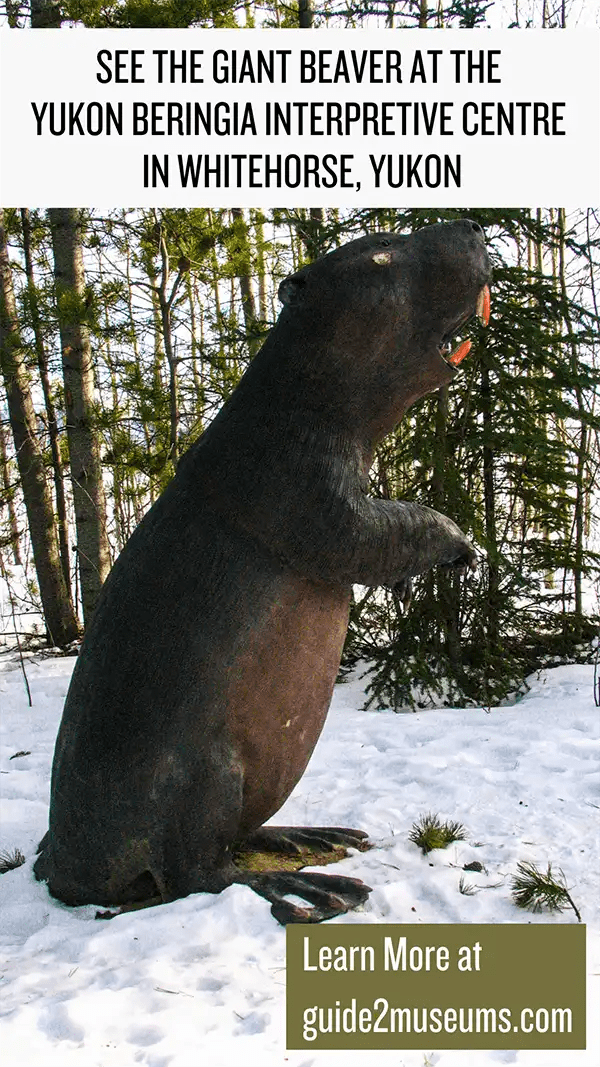
However, the giant beaver sculpture at the Beringia museum isn’t like today’s iconic semi-aquatic rodent. While the life-sized creature isn’t a direct ancestor to the beaver, it’s a distant relative.
How big was the giant ice-age beaver-like creature?
Castoroides grew up to 8 ft (2.5 m) long and weighed around 220 lbs (100 kg), similar to a modern black bear. Its height was about 4 ft (1.3 m) at the shoulders.
Indeed, the castoroide was one of the largest rodents that have ever lived. It lived during the Pleistocene Epoch ~1.5 million to 10,000 years ago.
As you might guess, these giant beavers had giant teeth. How big? Their curved front teeth (incisors) grew up to 6 in (15 cm) long!
While today’s beavers have a flat, paddle-like tail, the castoroide’s tail was more rounded.
Modern beavers are 35 to 47 in (90 to 120 cm) long, including their 10 to 14 in (25 to 35 cm) long tails. They’re about 12 in (30 cm) at the shoulder and weigh 35 to 70 lbs (16 to 32 kg).
Steppe bison were another important animal in ice-age Beringia through what’s now Siberia, Alaska, and the Yukon.
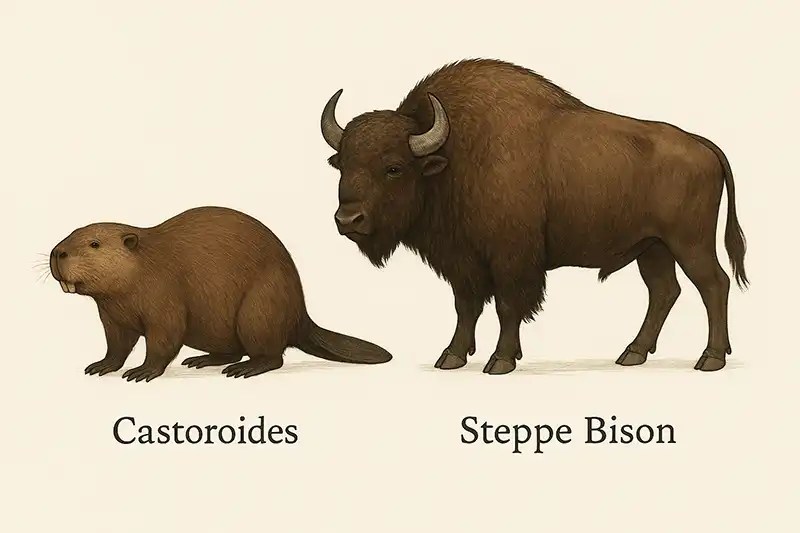
Steppe Bison are an ancestor to all modern North American bison. And, as you can see in the image comparing their size to castoroides, they were big. How big?
The average steppe bison was up to 2 m (6.5 ft) tall at the shoulders. They were around 3 – 3.5 m (10 – 11.5 ft) long and weighed 900 to 1,200 kg (2,000 to 2,600 lbs). Compared to today’s bison, Steppe bison were slightly taller at the shoulder, up to two feet longer, and 180 kg (400 lbs) heavier.
Fast Fact: Blue Babe, a mummified Ice Age steppe bison, was found near Fairbanks, Alaska in 1979 by gold miners. It was so well-preserved that researchers could study its last meal and even cooked a sample of its flesh!
Linda’s Road Trip Tips
A trip up the Alaska Highway won’t disappoint anyone looking for rugged beauty and a road-less-traveled. Whitehorse is the second largest city if you’re driving the whole 1,387 miles (2232 km) from Dawson Creek, BC, to Delta Junction, Alaska.
When we visited, we stayed at the recently renovated Sternwheeler Hotel and Conference Centre. It’s the Yukon’s premier facility for conferences and special events. We also dined in the hotel with its upscale Tony’s Pasta & Seafood House.
Whitehorse has several museums. If you’re interested in how transportation evolved in the north you must see the Yukon Transportation Museum. It’s got some great WWII and Cold War machines you won’t see anywhere else!
There’s also the MacBride Museum, which was closed during our visit, and the MacBride Copperbelt Mining Museum on the Alaska Highway just outside the city.
Who Should Visit the Yukon Beringia Museum?
We’ve visited the Yukon Beringia Interpretive Centre a couple of times — it’s that interesting! Once was a winter adventure flying into Whitehorse to snowmobile and one was a summer adventure driving the Alaska Highway.
So, no matter what season you plan to visit the Yukon, I guarantee the museum is a must-see attraction.
Whether or not you’re interested in natural history museums, you’ll find lots of fascinating displays and facts to enrich your Yukon visit.
Children and teenagers will find the replicas of giant animals impressive, and kids will enjoy the play area.
Plan to spend at least a couple of hours to go through the exhibits.
The museum is wheelchair accessible throughout the grounds, exhibits, theatre, and washrooms. A wheelchair is available to borrow.
How Do You Visit the Yukon Beringia Interpretive Centre?
The Beringia Centre is located just south of the Erik Nielsen Whitehorse International Airport on the Alaska Highway.
Parking: There's lots of free parking at the museum. The Interpretive Centre is only a minute (1640 feet or 500 m) away from the Yukon Transportation Museum.
Street address: Kilometer 1423 (Mile 886) Alaska Highway, Whitehorse, Yukon.
The museum is open year-round with reduced hours for the winter season. Check days open, times, and costs at the Yukon Beringia Interpretive Centre website.
Keep up to date with what’s happening at the natural history museum with the Yukon Beringia Interpretive Centre Facebook page.
Check out the videos done by the Yukon Beringia Interpretive Centre on YouTube.
Plan your visit to the Yukon Beringia museum with Google maps.
More Things to Do in the Yukon
Check out all of guide2museum.com’s reviews of museums in the Yukon.
Read More Natural History Museum Reviews
- Royal Ontario Museum in Toronto Review
- Amazing Giant Bison, Beaver, Mammoths & More: Yukon Beringia Museum in Whitehorse

- Royal Saskatchewan Museum & World’s Largest T-Rex Dinosaur

- Naranjo Museum: Dinosaurs & Fossils in Lufkin, Texas

- Field Museum: Natural History Museum in Chicago, Illinois

Reference(s)
OpenAI. (2025). Comparison of Castoroides and steppe bison sizes [AI-generated image]. ChatGPT. https://chat.openai.com/
Yukon Beringia Interpretive Centre. (1996). Beringian research notes. https://yukon.ca/sites/yukon.ca/files/tc/tc-reasearch-note-woolly-mammoth-1996.pdf







 guide2museums.com