From the latest sneakers to fashionable ultrahigh heels, shoes say a lot about us. They reflect social standing, occupation, traditions, and more. And the Bata Shoe Museum in Toronto, Ontario, curates over 4,500 years of shoe history and our relationship with shoes
Linda’s Pick of the Exhibits
My pick of the exhibits at the Bata Shoe Museum was the permanent exhibition, All About Shoes.
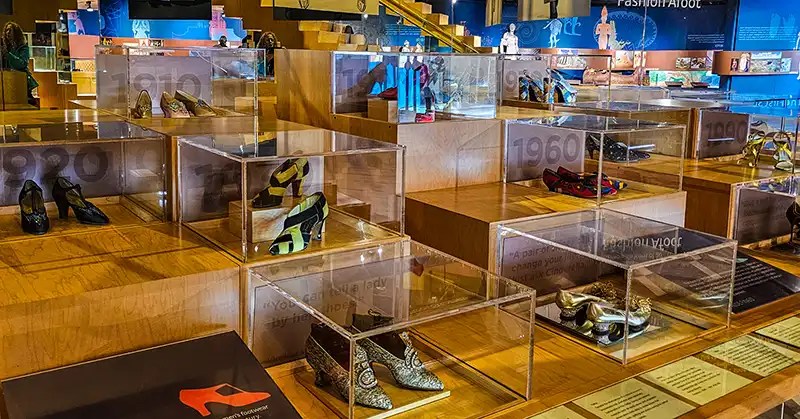
The exhibit provides a journey through the history, culture, and function of footwear. And I’ll be the first to admit it’s full of surprises.
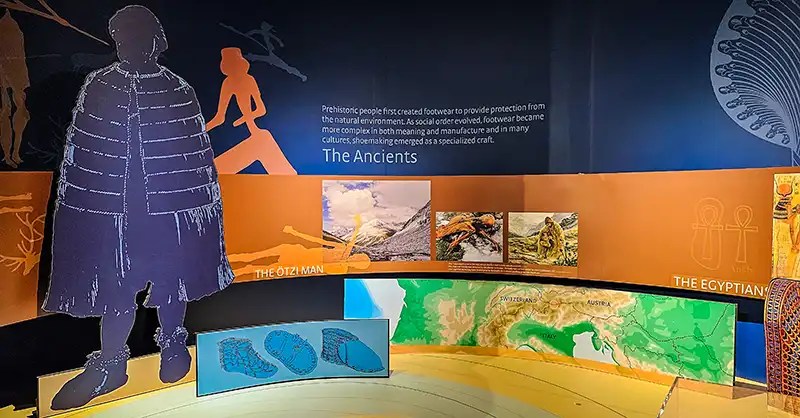
Shoes didn’t become a need until our ancient ancestors stood upright to walk on their feet. When was that? Around 3,700,000 years ago! Anthropologist, Mary Leakey, uncovered footprints preserved in volcanic ash that have been dated to be that old.
Of course in the beginning shoes were just to provide protection from whatever we were walking on. It took millennia to arrive at shoemaking as a specialized craft.
Fast Fact: The Ötzi Man lived around 5300 years ago in the Ötztal Alps. When his body was discovered in 1991, a shoe was still on his foot. The museum's replica is made of the same materials of bearskin, deerskin, twined linden bark and grass padding.
Many ancient Greeks and Romans wore sandals — indeed, the word sandal comes from the Roman word, sandalia. Their sandal-boots, called caligae, had hobnailed soles that helped them achieve Roman military success.
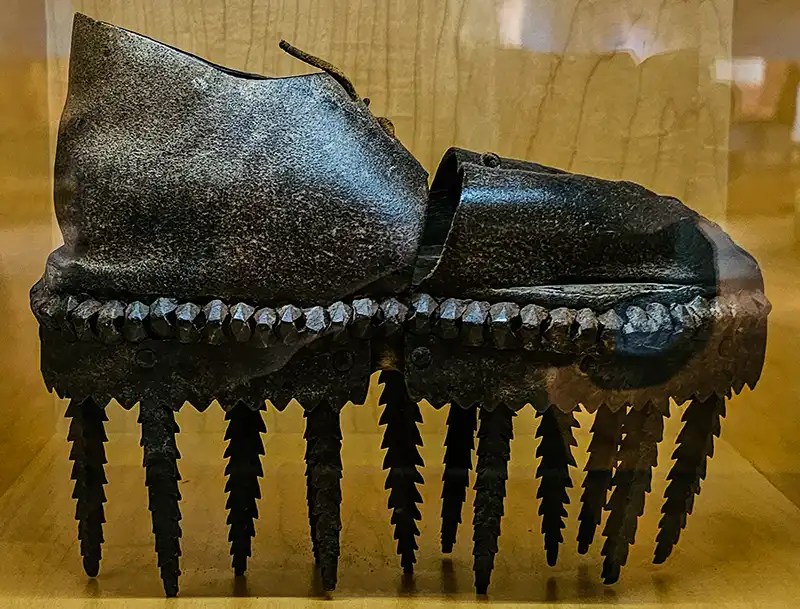
The museum collection moves through the centuries, providing amazingly preserved samples of shoes from many cultures. These were a few of my favorites.
- Mojari – the museum has a pair of saffron-coloured Mojari shoes worn by a temple dancer in Rajasthan, India. These shoes have gold embroidery, jade beads, and brass bells that tinkled during the dance.
- During the Renaissance in the Ottoman Empire, women wore special shoes to visit a public bath. These were like small, intricately designed stilts that kept them above the heated flooring. Called nalins, the shoes helped women make a fashion statement when not wearing clothes.
- Sandals were worn in the Asante Empire during the 200 years the Empire controlled trade along the Gold Coast. What set these sandals apart were the huge solid gold ornaments that adorned them.
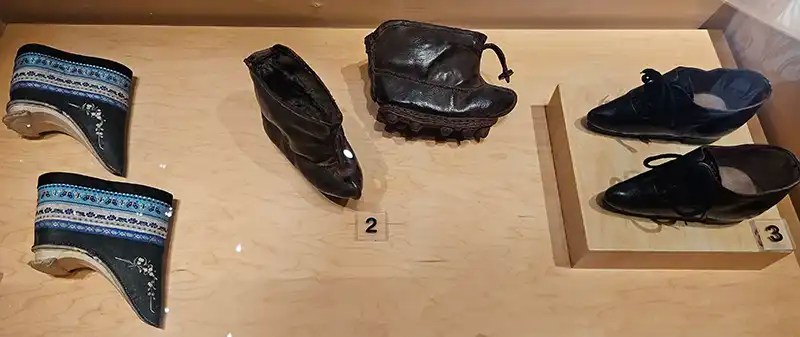
- Special shoes were worn by Chinese women who achieved the ideal size of san cun. How big was that? A mere 7.6 cm or 3 inches long! To achieve that size women’s feet were bound as children, making them a unique shape that required special shoes. Feet that met san cun were called jin lian or golden lotuses.
And these are just a sampling of the unique shoes we’ve worn through the ages!
Fast Fact: The permanent collection of the Bata Shoe Museum contains artifacts from virtually every culture in the world.
What’s in the Bata Shoe Museum?
The Bata Shoe Museum in Toronto has four galleries. One of these is the permanent All About Shoes gallery I loved. The other three galleries feature changing exhibitions. Around a thousand shoes and related artifacts are on display at any given time.
However, the museum collection has 14,000 shoes altogether! This makes it a great Toronto attraction to visit, as there are always new things to see and learn.
Fast Fact: The Bata Shoe Museum exterior was designed to resemble a shoe box lid being lifted.
Occupying four-storeys, the museum is approximately 39,000 sq. ft (3,600 sq. m). Exhibitions are on three levels, along with a conservation lab, education room, collection storage and offices.

Canadian architect, Raymond Moriyama, designed the building that’s a landmark in the University of Toronto / Annex neighborhood.
How did the Bata Museum get started? Sonja Bata, a Swiss-born Canadian businesswoman, married Thomas J. Bata, heir to the global Bata Shoe Company. She began collecting shoes in her global travels, amassing a giant private collection.
In 1979, the Bata family established the Bata Shoe Museum Foundation that continued her work. The Bata Shoe Museum opened on May 6, 1995.
The main objective of the Bata Shoe Museum Foundation is to establish an international centre for footwear research.
Linda’s Road Trip Tips
I took the Toronto subway to the museum, getting off at Union Station to start my day of exploring.
You’ll find several other great museums just 5 to 10 minute walks away from the Bata Museum. They include: Royal Ontario Museum (ROM), Gardiner Museum (ceramics and pottery), and Textile Museum of Canada.

After visiting the museum, I stopped at the Pi Co. Pizza at 180 Bloor Street West. It was just a two-minute walk away, so very convenient. I picked a super-delicious goat cheese, honey and walnut pizza.
Who Should Visit the Bata Shoe Museum?
The Bata Shoe Museum appeals to museum goers who love quirky, often unexpected subjects. However, the 4,500 years curated by the museum also provide lots of insights for history lovers.
Whether young or old, everyone interested in design and fashion will find lots of insights going through the collection. From the history of footwear to the shoes worn by celebrities, there’s a ton of variety!
There are also interactive displays to keep children’s attention, making the museum a fun family destination, too.
The Bata Shoe Museum is fully accessible for visitors with mobility needs. Elevators are available on every floor and there are wide hallways for wheelchairs and baby strollers. Service animals are also allowed.

How Do You Visit the Bata Shoe Museum?
The Bata Shoe Museum is situated in downtown Toronto.
Getting to the Museum & Parking: Take Line 1 (Yonge-University) or Line 2 (Bloor-Danforth) on the subway system to St. George Station. The museum is across the street. Public parking for motor vehicles is available close by at Kimpton St. George Garage at 284 Bloor St. W; Carpark 205; or 300 Bloor Street West Lot.
Check days open and admission costs at the Bata Shoe Museum website.
Keep up to date with what’s happening with the Bata Shoe Museum Facebook page.
Take virtual tours of the Bata Shoe Museum with their YouTube channel.
Plan your visit with Google maps.

Read More Ontario Museum Reviews
Check out all these museum reviews for the Canadian province of Ontario!
Explore More Specialty Museums
- Texas Ranger Hall of Fame and Museum: Waco, Texas
- MOPOP in Seattle: Unparalled Look at Pop Culture

- Astonishing Evolution of Shoes: Bata Shoe Museum in Toronto
- Toronto Police Museum & Discovery Centre: Two Centuries of Law Enforcement History

- Missouri State Penitentiary Museum: Jefferson City, Missouri
- Butch Cassidy Bank Robbery Museum: Montpelier, Idaho
- Frontier Prison Museum: Rawlins, Wyoming

- Toronto’s First Post Office Museum & National Historic Site: Ontario

- Gone With the Wind Museum: Memorabilia in Jefferson, Texas





 guide2museums.com