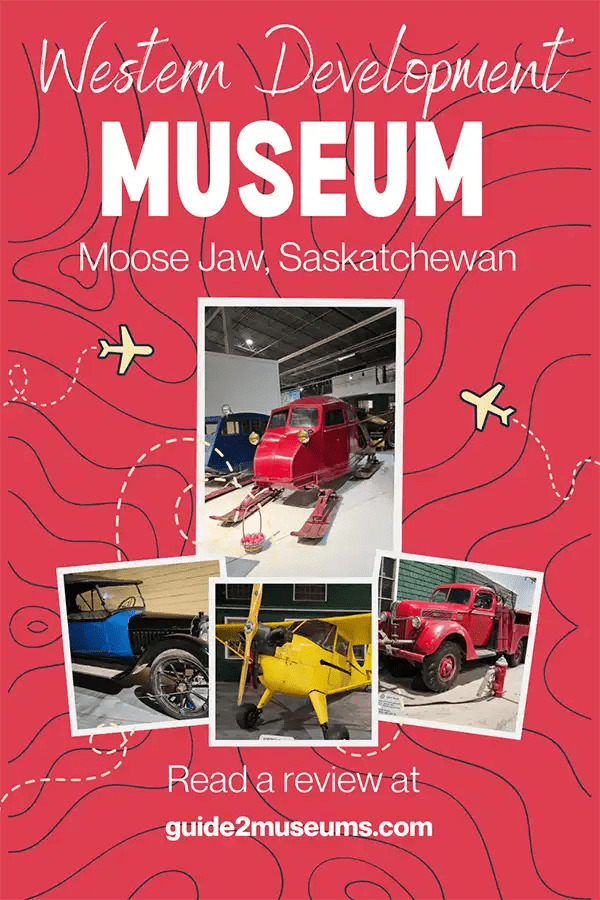
Saskatchewan is home to four Western Development Museums (WDM), with the one in Moose Jaw focused on transportation. It covers the province’s amazing history of travel across land, air, water, and rail.

Linda’s Pick of the Exhibits
I’ll be the first to say that I discovered many fascinating stories unfamiliar to me at the WDM in Moose Jaw! After researching and writing the nonfiction picture book, L is for Land of Living Skies, a Saskatchewan Alphabet, I thought I knew a lot.
It turns out there was a lot of transportation history I’d missed.
So…I tossed a coin and came up with the Vickers Vedette Airplane as my pick for favorite. This airplane was, wait for it, basically a flying boat!
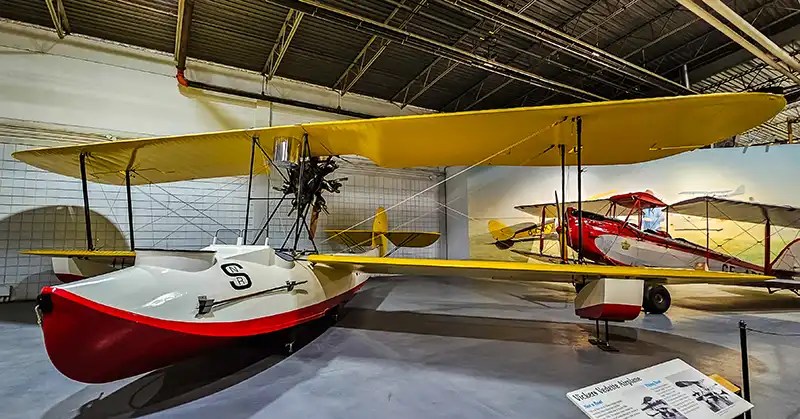
The Vickers Vedette airplane was built by Canadian Vickers, a boat-building company in Montreal, in 1924. This type of machine was needed by the Royal Canadian Air Force (RCAF) for aerial mapping and forest fire patrols in Northern Canada.
Looking more like a boat with wings than a biplane, it had a wooden hull and open cockpit. Effective at short take-offs and water-landings, 60 more planes in five versions were manufactured until 1930.
Most people think of Saskatchewan as flat prairie, so why did the province need a plane that could land on water? Because Saskatchewan has 100,000+ lakes, mostly in its north. Indeed, all of the northern part of the province is in the Canadian Shield region.
Fast Fact: The RCAF set up a base at Ladder Lake, near Big River, in 1927. The base was equipped with four Vickers Vedettes and one Vickers Varuna.
All five planes being used by the RCAF were purchased by the province of Saskatchewan for $1 in 1930. Why 1930? Because that’s when Saskatchewan got control of its natural resources from the Federal Government.
The airplanes fought fires and took aerial photos until 1936. Then, a Vickers Vedette CF-SAE crashed on Delaronde Lake. The plane burned, taking the life of the passenger. This opened a Court of Inquiry that grounded all Vedettes until safety belts could be installed. However, none ever flew Saskatchewan’s northern skies again.
What’s at the Western Development Museum Moose Jaw?
The Moose Jaw Western Development Museum is a spacious facility. With over 100,000 square ft of space, its extensive collection is easy to see.
There are 10 galleries and exhibits, ranging from the Aircraft Gallery to Winter Travel to the Rail Gallery.
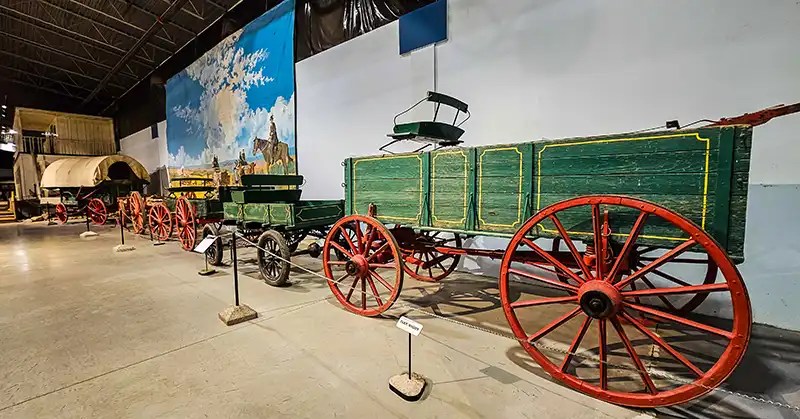
Here are some of the highlights of machines at the museum.
- During World War II there were twenty flying training air units in Saskatchewan, spread across fourteen communities. Trainees included 33,142 aircrew graduates.
- Saskatchewan had the first publicly-funded air ambulance service in North America. The air ambulance flew its first mission on February 3, 1946, using two Norseman airplanes, CF-SAH and CF-SAM. The museum has a Cessna 195 Airplane once used as an Air Ambulance.
- The Prairie Farm Rehabilitation Administration (PFRA) turned a 1959 IHC Travelall station wagon for use as an ambulance. It was used during The South Saskatchewan River Project building of a dam on the South Saskatchewan. The ambulance’s first trip was November 3, 1960. Now, it’s in the museum.
- The Buchinski Caboose in the museum was a horse-drawn, enclosed cutter. Buchinski patented the caboose in 1934 and built 200+ cutter gears and complete cutters on his farm.
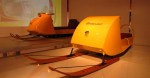
- Robert Fudge built and sold about 400 “snow sedans” or Fudge snowplanes from 1929 to 1956. The museum has a 1949 Fudge Snowplane.
More Exhibits
As well as the more standard range of machines, the museum is also home to “Blowtorch.”
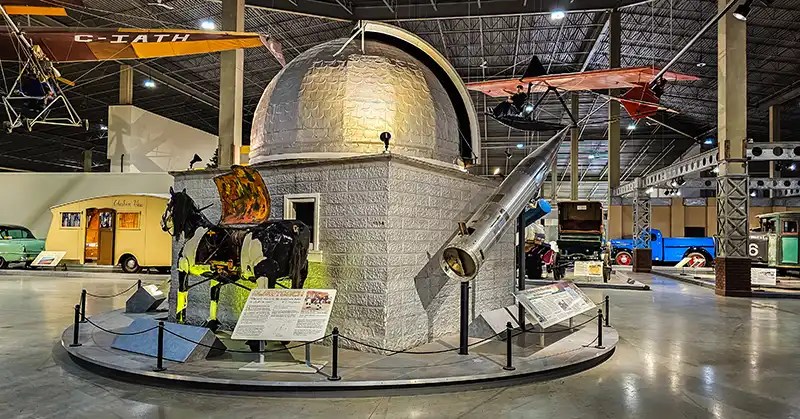
Blowtorch was, according to its inventor, W.J. McIntyre, “The only horse in the world you have to choke to start…!” Indeed, the mechanical steed and its inventor appeared across Canada in various parades and exhibitions.
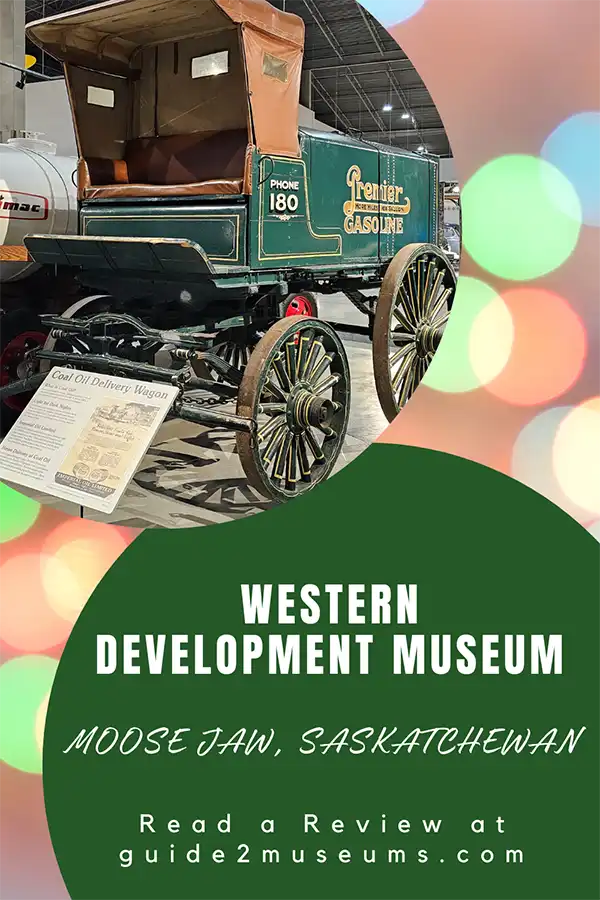
Fast Fact: Coal Oil is a thin oil distilled from coal. It was the most common fuel in North America in the late 1800s. In 1909, Imperial Oil opened a store in Saskatoon that used a team of horses hitched to a four-wheeled tank as a coal delivery wagon. A Coal Oil wagon is part of the museum's collection
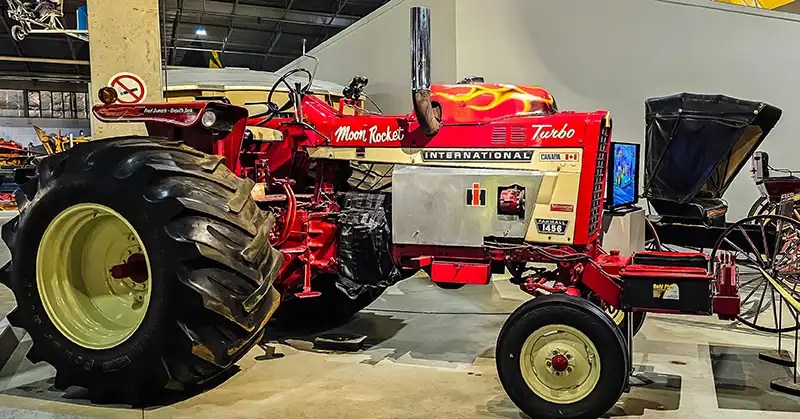
Tractor pulls gained popularity in Saskatchewan with the National Tractor Pullers Association‘s first event in Saskatoon in 1972. Moon Rocket, a tractor used in competition by Fred Summach, is in the museum.
It’s a modified International turbo diesel that competed in the Super Stock class.
The museums’ water transportation exhibits are interesting. While the majority of Saskatchewan’s water bodies are in the North, the South Saskatchewan River flows through Saskatoon.
Fast Fact: Saskatchewan's worst marine disaster occurred in Saskatooon in 1907, when the SS City of Medicine Hat boat was swept into the concrete piers of the 19th Street bridge. You'll see the lifeboat anchor and photos in the museum.
Linda’s Road Trip Tips
Moose Jaw is a great destination for visitors to Saskatchewan. Situated on the Trans-Canada Highway, it has many attractions that keep locals like me — and visitors — coming back.
I’ve got a few favorite spots!
If you’re looking for a relaxing, pampered stay, book a night or two at the Temple Gardens Hotel & Mineral Spa.
Its geothermal mineral pools keep my writers’ group returning on a regular basis.
The mineral waters come from an ancient seabed and contain sodium, potassium, magnesium, and various other elements.
Water comes into the well-head at about 45°C (113°F)!
After your soak, treat yourself to dinner at Hopkins Dining Parlour, one of Saskatchewan’s most unique restaurants.
This Victorian era, three-story house converted to a restaurant, is all about the experience. Rumors are there may even be a ghost or two around — not that I’ve ever seen one there.
To complete your adventures, be sure to check out the Tunnels of Moose Jaw. What are they? Three interactive underground experiences:
- The Chicago Connection – learn the ropes of becoming a bootlegger with Al Capone (and all about the gangster’s connection to Moose Jaw).
- Passage to Fortune – learn the story of early Chinese immigration to Canada.
- Bunker 24 – go back to 1958 and Canada’s Cold War experience.
Who Should Visit the Moose Jaw Western Development Museum?
The Moose Jaw Western Development Museum is a great stop for families. Kids will love all the space to roam around — and the machines. It’s a spot locals return to on a regular basis.
While museums all archive history, some tell stories of the past that bring history to life. The Moose Jaw WDM is one of them.
Every piece of machinery is identified, many with fascinating tales to go with them.
So, it can take a few hours to get just an overview of the collection.
For visitors passing through Saskatchewan, there’s a lot to learn about the province by looking at transportation over the past century and a half.
You can even ride the K+S Potash Canada Short Line 101 over its 400 m track during the summer!
It’s the only operating steam locomotive in Saskatchewan.
The museum is all on a single floor, so accessible for wheel chairs and strollers. Outside, you’ll even find picnic tables for a relaxing road trip stop.
How Do You Visit the Western Development Museum Moose Jaw?
The Moose Jaw Western Development Museum is located right off of the Trans-Canada #1 Highway in Moose Jaw, Saskatchewan.
Parking: There's lots of free parking in front of the museum.
Street location: 50 Diefenbaker Dr. at the junction of Highways #1 and #2, Moose Jaw, Saskatchewan.
The museum is open year-round. Check days and times at the Moose Jaw Western Development Museum website.
Keep up-to-date with what’s happening with the WDM Moose Jaw Facebook page.
Take a virtual tour with SaskTel on YouTube.
Plan your visit now with Google Maps.
More Places to See in Saskatchewan
Check out all of guide2museum.com’s reviews of museums in Saskatchewan.
Read More Reviews of Transportation Museums
- Canada Aviation and Space Museum: Iconic Civil & Military Airplanes
- Little Known Saskatchewan Transportation History: Moose Jaw WDM Museum

- EAA Aviation Museum in Oshkosh, Wisconsin: Airplanes from All Eras
- Yukon Transportation Museum: Whitehorse, Yukon
- Oklahoma Route 66 Museum: Clinton, Oklahoma, Exploring the Mother Road History

- Museum of the Yellowstone: 150 Years of Travel In Yellowstone National Park
- Pioneer Auto Show Museum: Cars & More in Murdo, South Dakota
- Frontier Auto Museum: Classic Cars & Collectibles in Gillette, Wyoming
- Polaris Experience Center: Polaris Snowmobile Museum in Roseau, Minnesota
- Museum of Ingenuity: Ski-Doo Snowmobile Museum in Valcourt, Quebec
- Legends Motorcycle Museum: Harleys to Merkels in Springville, Utah
- Top of the Lake Snowmobile Museum: Naubinway, Michigan





 guide2museums.com