The Diefenbunker may be Canada’s most interesting — and historically important — museum. The bunker isn’t, as anyone who was born after the Cold War might imagine, a thing of science fiction.
Rather, the Diefenbunker was Canada’s central Emergency Government Headquarters (EGHQ) location during the Cold War. Operating as Canadian Forces Station Carp between 1961 and 1994, the bunker was designed to house 535 people. In the event of a nuclear attack, that would have included the Prime Minister, senior cabinet, and military command for up to 30 days.
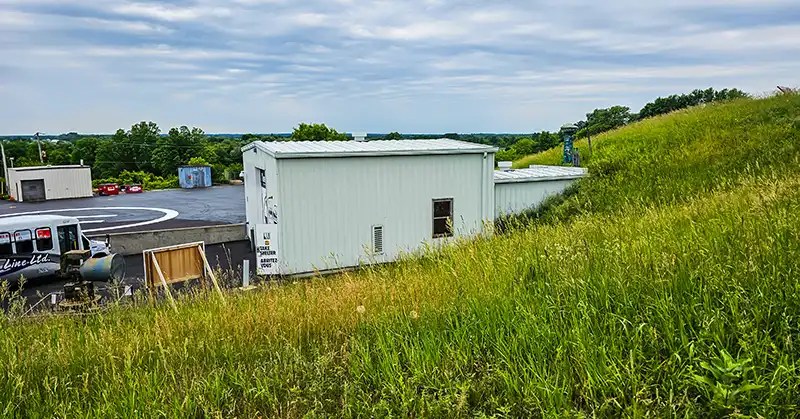
Fast Fact: While the Military and Government officials were ready for a nuclear attack on Canada in 1961, Canadians weren't. A Toronto Telegram newspaper in the museum from Friday, October 5, 1961, indicated: "36 Shelters -- Lots of Bars -- that's the way Canadians prefer to go underground in the nuclear age, and in Ottawa it has the government worried." Builders in all major Canadian cities were ready to build shelters. However, few residents, none in some cities, applied for permits in the early 1960s.
Linda’s Pick of the Functional Zones
The Diefenbunker is organized into core functional zones by level.
My favorite? The entrance and decontamination areas.
A curved blast tunnel extends from the outside entrance to the bunker. The cold shivers I felt weren’t just from the temperature inside the Diefenbunker!
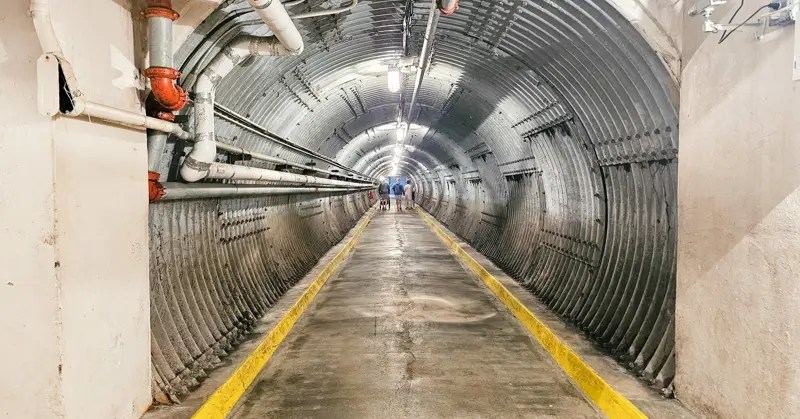
A lover of science fiction, the 378-foot-long tunnel reminded me of Stargate SG-1’s Cheyenne Mountain entrance, or going further back in tv time, The Time Tunnel.
The tunnel was designed to reduce the impact of a nuclear blast on the two massive steel blast doors. Each door weighs several tons and seals the bunker. Indeed, the tunnel is a shockwave diffuser. It forces incoming air pressure, heat, and radiation to be redirected and dissipated before reaching the main blast doors.
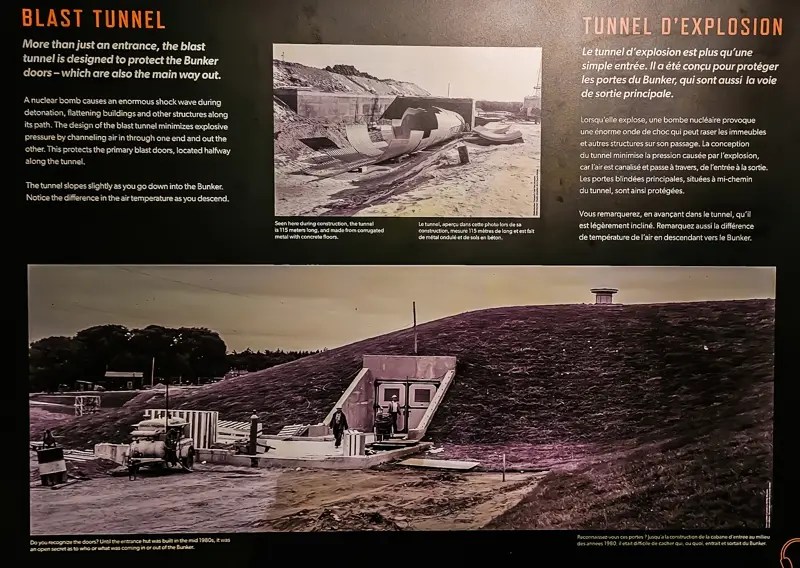
It was the first line of protection against a 5 megaton blast from as close as 1.8 km (1.1 miles).
In case of a blast, people coming in went through a decontamination area. It’s located near the entrance on the 400 (or top) level. The zone includes showers and radiation monitoring equipment.
And of course, there were also two escape hatches.
Fast Fact: Each 9-metre emergency escape hatch was filled with 13 metric tons of pea gravel. Why? To prevent surface radioactive particles from penetrating the bunker after a nuclear blast. Outside radioactivity would have been monitored using the "Rad Sniffer." If the escape hatches were needed, a lever released the pea gravel into a pit. The sudden suction would break the plexiglas surface cover, so people could climb out one at a time.
What’s in the Diefenbunker Museum?
The Diefenbunker was built to serve as the Central Emergency Government Headquarters (CEGHQ) for Canada during the Cold War. It was commissioned in 1959 by — you guessed it — Prime Minister John Diefenbaker. And this bunker, outside Ottawa at Carp, was just one of several that were completed across Canada.
Why did Canada need facilities like the Diefenbunker during the Cold War?
The Cold War had two main combatants. They were the Western Bloc, or the United States and its allies, and the Eastern Bloc, the Soviet Union and its allies. Canada’s airspace would have been the easiest path for attacks between the two.
So, the Canadian military built bunkers on a smaller scale to the Diefenbunker at the now-defunct Canadian Forces Base Penhold in Springbrook, Alta., CFB Shilo east of Brandon, Man., CFB Borden west of Barrie, Ont., CFB Valcartier north of Quebec City, and the Nanaimo Military Camp on Vancouver Island (CTV News, 2019).
In addition to the bunkers, the U.S. and Canada constructed three main northern lines of defense.
- Pinetree Line: It was built roughly along the 50th parallel (the U.S. / Canada border is the 49th parallel) in the early 1950s. The line included long-range radar stations providing initial air surveillance. Its drawback was a limited warning time.
- Mid-Canada Line (MCL): This line was further north, along the 55th parallel. It became operational by 1958 using unmanned sites and sector control stations with Doppler (bistatic) radar to detect enemy aircraft. Its limitations resulted in it being shut down in the 1960s due to technological advances and high operational costs.
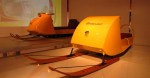
- Distant Early Warning (DEW) Line: The DEW Cold War radar system line was built around the 70th parallel, along the Arctic and far-north coast extending from Alaska across Canada to Greenland and Iceland. Its 60 manned radar stations provided early warning of incoming Soviet bombers, allowing time for defense mobilization from 1957. The DEW Line was the most critical part of continental defense. Learn more about the Cold War Sno-Train for the DEW line at the Yukon Transportation Museum.
Made of 32,000 yards of hand-poured concrete and 5,000 tons of steel, it’s hard to believe the Diefenbunker was built as a top-secret building. The 75-foot underground bunker was just 30 km (18.6 miles) west of downtown Ottawa, the country’s capital city and home of parliament, in the town of Carp.
Its four underground levels are divided into main functions.
- 400 Level (Top Floor / Entrance Level). This area includes the blast tunnel and doors, decontamination chamber, building systems control room, administrative offices, medical centre, isolation rooms, telecommunications maintenance, and the Prime Minister’s Suite.
- 300 Level (Government Operations). Office spaces and work areas for government officials and senior staff fill this area.
- 200 Level (Living and Support Facilities). This level contains the sleeping quarters, cafeteria, laundry, and mechanical systems required to support daily life for those living in the bunker. This area doubled as a recreation zone with pool table, darts, shuffleboard, etc.
- 100 Level (Lowest Level with Mechanical and Power Systems).

The Diefenbunker operated as a military base from 1962 to 1994. It was staffed 24 hours a day by approximately 100 military and civilian personnel. So, all of the levels were utilized for 32 years.
In 1994, the bunker was decommissioned. It was transformed into a museum that opened in 1998.
Communications Inside Diefenbunker
The Diefenbunker was all about communications on a local, national, and global basis. Relevant areas ranged from the War Room to the CBC broadcasting room to the computer centre and other support areas.
The computer room, as you’d expect, had the most advanced computing and communications technology of the time. In the 1960s, that was the STRAD supercomputer system.
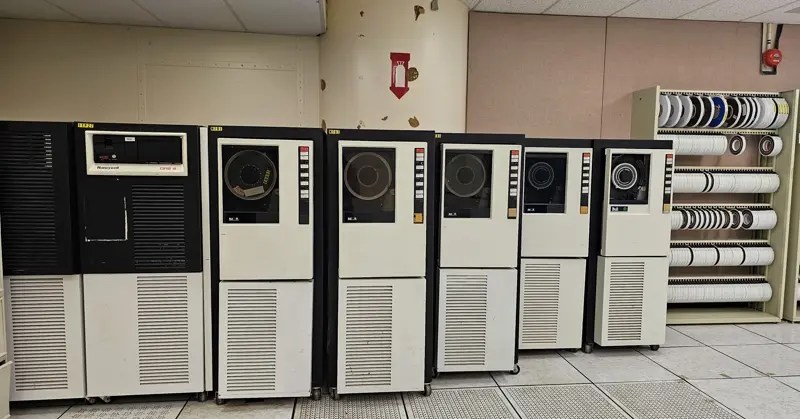
What did it do?
STRAD used magnetic drum storage and magnetic tape systems inside storage cabinets. The system processed up to 9,000 messages per day with a maximum capacity of up to 83,000 words a minute!
By 1981, the newer Ottawa Semi-Automatic Exchange (OSAX) used in the bunker surpassed STRAD’s capabilities.
Fast Fact: Disk drives used by OSAX are on display in the museum. "Each drive contained four such disks that stored 20 megabytes (Mb) of data. OSAX also included Data General mini computers which used 32 kilobyte (Kb) core memory cards. It would take 200 of the disks or 62,500 of the 32 Kb memory cards to store one gigabyte - a typical amount of data storage found in most cellphones today (Diefenbunker information sheet)."
The War Cabinet Room is one of the most popular areas inside the Diefenbunker. It was, of course, where a crisis would have been discussed and handled. “A legitimate emergency government in Canada had to have at least five people: the governor general and four ministers, one of which would likely be the prime minister (Diefenbunker signage).”
Only one sitting Canadian prime minster ever visited the Bunker while it was operational. Who do you think it was?
While the Diefenbunker was commissioned by Prime Minister John Diefenbaker, he never visited it. Prime Minister Pierre Elliot Trudeau visited the Diefenbunker in 1976.
And the CBC broadcast area? The CBC was responsible for control of the Emergency Broadcasting System. Messages during a nuclear war would have come from the Diefenbunker studio. It was connected to all affiliated CBC public radio stations via regional “black box” devices.
Some Important Exhibits
The Diefenbunker continues to develop exhibits that let visitors understand the Cold War and its impact on the world. Here are some of the important ones.
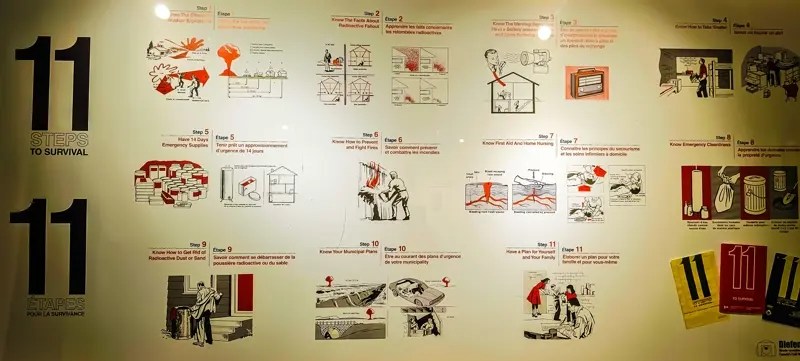
- 11 Steps to Survival. The exhibit shows a home fallouot shelter space. It’s based on the 1961 government manual by the same name.
- Lost Nuke Exhibit. This exhibit revolves around the first atomic aircraft accident.
- Whose Side? Propaganda and the Cold War. These are two permanent exhibitions new in 2025 that display immersive imagery and interactive elements.
- Hidden Heroes. Here, visitors learn more about the overlooked roles of staff who operated the bunker.
- Original Scale Model of the Diefenbunker. This centerpiece exhibit showcases the engineering feat of building this massive nuclear fallout shelter.
- Outdoor Exhibits. Do take time to walk the Interpretive Trail that leads up the hill covering the bunker. You’ll see the tops of the emergency escape hatches, the 55-metre radio tower, active intake and exhaust for the bunker ventilation, and a view of the landscape.
- Various Interactive Options. You’ll find interactive activities including audio and video content, along with a special escape room group experience (by booking), plus there are virtual tours with clickable points for remote exploration of the bunker.
Linda’s Road Trip Tips
When you visit the Diefenbunker, take some time to visit Carp. It’s just a minute or so drive, or a 10 minute walk (700 m).
The town of Carp celebrates its agricultural focal point with the Agricultural Society Fairgrounds. Each fall they have the “best little fair in Canada.”

Take a few minutes to check out the Carp Fair mural painted by master muralist, Pierre Hardy. Capturing 150 years of history, the mural was completed in 2013.
On my visit, I also enjoyed lunch at Alice’s Village Cafe, located right on Carp Road that takes you to the Diefenbunker. It’s a good lunch spot with everything from a full breakfast to sandwiches to quick bites.

My choice? The daily special of Chorzo meat soup (spicy) with cherry crumble (tart cherries) for dessert.
Who Should Visit the Diefenbunker?
In my opinion, everyone should visit the Diefenbunker. If you remember bits and pieces of the era from growing up, the displays will answer any questions you might still have. If you don’t remember the Cold War, the Diefenbunker makes it only too clear what happens when countries can’t get along peacefully.

I spent half a day at the Diefenbunker, but would gladly have stayed the whole day except for needing to catch a 5 pm flight in Ottawa.
You can take a guided tour or go through the exhibits yourself, which gives you time to read a lot of material that’s on display.
Canada’s Cold War Museum is committed to providing accessibility to all visitors. The building is wheelchair accessible with ramps and elevators providing full access to the underground floors.
Support services are available to assist visitors with mobility, visual, or hearing impairments. You can also contact the museum ahead of a visit to arrange for specific needs.
How Do You Visit the Diefenbunker Museum?
The Diefenbunker Museum is located in a rural community just outside Canada’s capital city, Ottawa, Ontario.
Getting There & Parking: There's lots of free parking available at the Diefenbunker if you arrive by car. If you're visiting Ottawa and don't have a car, you can take an Uber at your convenience. Or, if you're visiting during peak season, the Diefenbunker offers a free shuttle service starting in summer 2025.
Location: 3929 Carp Road, Ottawa, Ontario
Hours: The museum is open year-round. Check the website for days and times you can visit.
Keep up-to-date with what’s happening at the museum with the Diefenbunker Facebook page.
Take a quick virtual tour of the Diefenbunker on YouTube.
Plan your visit to the Diefenbunker with Google maps.
Read More Ontario Museum Reviews
Check out all these museum reviews for the Canadian province of Ontario!
Explore More Military & War Museums
- Canada Aviation and Space Museum: Iconic Civil & Military Airplanes
- Plains of Abraham Museum & Battlefield Park: Quebec City
- Canada’s Little-Known Cold War Museum: the Diefenbunker
- U.S. Army Museum of Hawaii Artillery Battery in Honolulu

- USS Lexington Museum: WWII Aircraft Carrier in Corpus Christi, Texas

- Regional Military Museum: Artifacts from all US Wars in Houma, Lousiana
- Strategic Air Command & Aerospace Museum: Ashland, Nebraska
- Vancouver Island Military Museum: Nanaimo, British Columbia

- National Museum of the Pacific War: Fredericksburg, Texas

- Hill Aerospace Museum: Military Aircraft at Hill AFB, Utah

- Battleship Memorial Park: 1942 Battleship & 1941 Submarine in Mobile, Alabama

- Fagen Fighters WWII Museum: Granite Falls, Minnesota

- Manhattan Project National Historical Park: WWII History in Hanford, Washington
- National World War II Museum: New Orleans, Louisiana

Acknowledgment
The city of Ottawa provided me with complimentary museum admissions and a Hop On Hop Off bus ticket. This type of sponsorship makes it possible for me to provide museum reviews.







 guide2museums.com