A vibrant, multicultural city, Montreal, Quebec, has lots of great things to do. But for many visitors, the distinctive Biosphere museum tops their list of attractions. It’s an amazing destination to learn more about this type of dome architecture along with exploring the environments of many living things on earth.
Linda’s Pick of the Exhibits
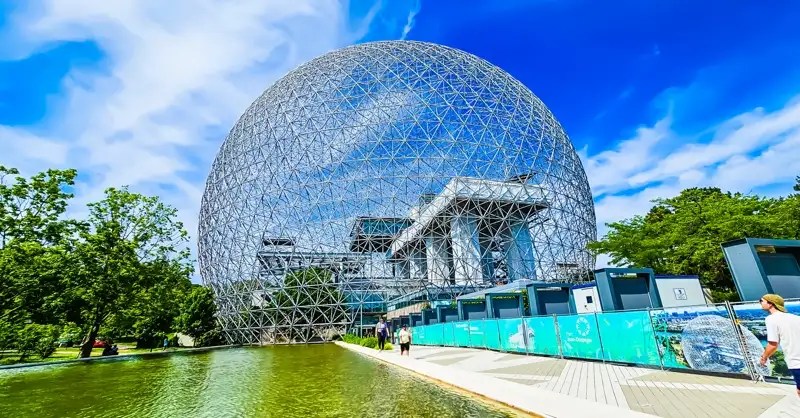
When it comes to museums, the Biosphere stands out for locals and visitors alike before they even get inside. The reason? Its unique geodesic dome. And while shape isn’t really an exhibit, it’s the iconic feature of the Biosphere that drew me to put it at the top of my must-see museums in Montreal.
What’s a Geodesic Dome?
When I first saw the term, geodesic, I thought it was a typo. Surely, the term should be a geodisc or geodisk not a geodesic. Bad guess. Both geodisc and geodisk are simply misspellings of the word, geodesic.
A geodesic is the shortest line between two points on a curved surface. Think orange or planet Earth. The term also, as you’ve likely already figured out, can refer to a geodesic dome.
Likewise, a geodisic is the shortest distance between two points on a map. Why? They’re simply a segment of the great circle of planet Earth.
Wondering about Earth floating out there in space with all the other planets orbiting the sun? If so, you’ll be happy to learn that the path of a planet orbiting a star like the sun is also a geodesic.
But back to the Biosphere. Why does its shape fit its purpose of a museum dedicated to socio-environmental issues? Well, the geodesic dome is made up of a network of triangles that make it strong enough to withstand Montreal’s winter winds and snow due to a high strength-to-weight ratio. They also create a large interior space with minimal surface area perfect for the museum.
According to the Oregon Dome Co., the net annual energy savings for a dome owner is 30% less than normal rectilinear buildings.
As well as its shape, I found the Biosphere’s history fascinating. The dome came to Canada, like the Alaska Highway, as a gift from the United States when its purpose was served.
What was the original purpose of the Biosphere dome? It was built as the United States pavilion for Expo 67. This expo was the World’s Fair held in Montreal in 1967 to celebrate Canada’s 100th birthday. I remember seeing tv coverage of the event as a child and really wished I could have gone!
Fast Fact: Expo 67 is widely considered to be the most successful World's Fair in the past century, with more than 90 pavilions from 62 nations, record-breaking attendance, as well as lasting innovation and cultural impact. It marked the first time that the U.S. and U.S.S.R. were both in attendance during the Cold War.
When the first visitors entered the dome on April 27, 1967, they must have felt like they’d ended up in the Jetsons cartoon that was popular in that era.
A 41 m (135 ft) unsupported escalator — the longest in the world in 1967 — took visitors to exhibit platforms. The Apollo AS-202 capsule hung from the ceiling. Everything from guitars of famous musicians to a hat collection represented the “American Spirit.” A Minirail monorail ran through the pavilion.
Now, the Biosphere features seven stories of themed platforms connected by stairs and elevators. As I went ever higher, I was amazed at the scientific displays, models, animations and more.
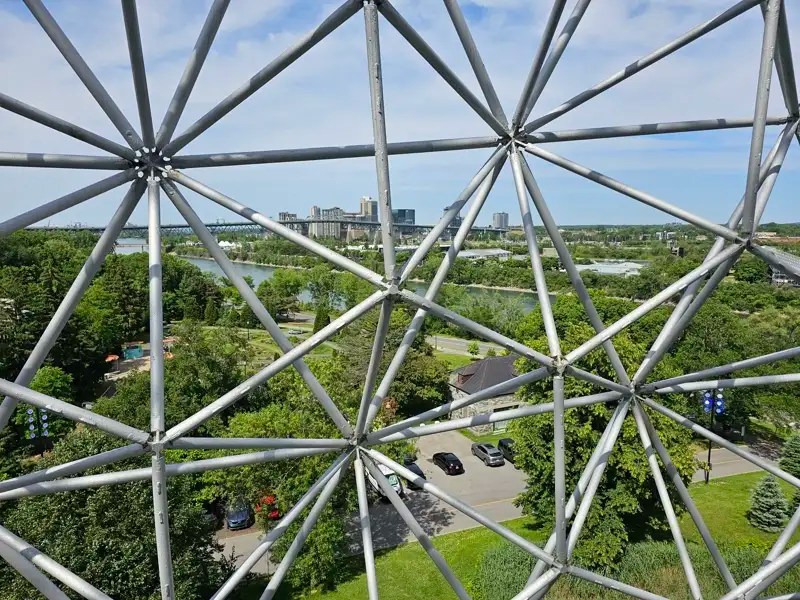
But the pièce de résistance was the 360-degree views of downtown Montreal, St. Lawrence River, and natural landscapes from the Observation Deck.
What’s in the Biosphere?
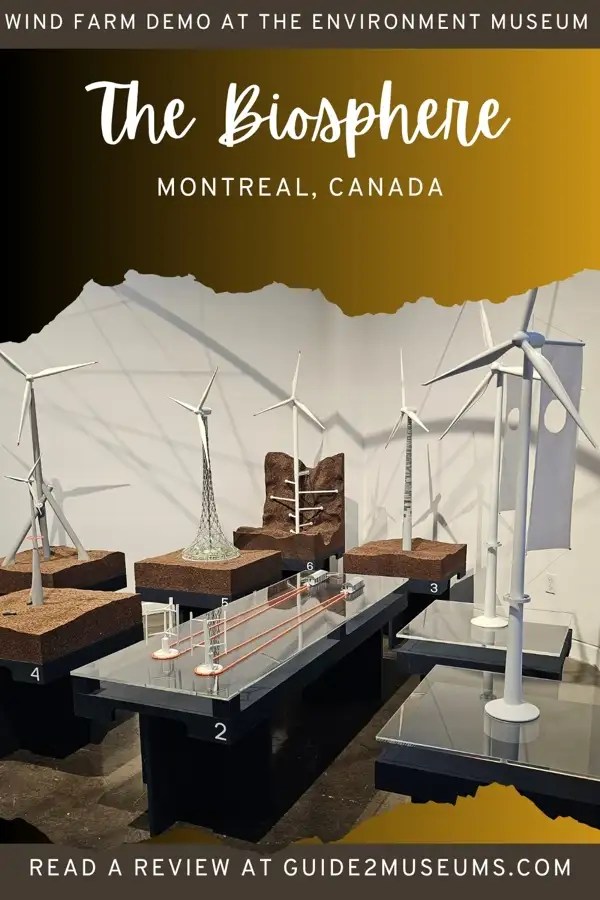
Exhibits in the Biosphere focus on critical environmental issues and sustainable living. They occupy approximately 3,250 sq. m (35,000 sq. ft) of exhibit space.
Fast Fact: In 2021, after nearly 25 years as a federal institution, the Biosphere integrated its activities into Space for Life, Canada's largest natural science museum complex. Led by the city of Montreal, Space for Life brings together the Biodome, Insectarium, Jardin botanique and Planetarium Rio Tinto Alcan. ~ The Biosphere
The main exhibits include:
- Environmental Issues: You can engage with animations, illustrations, models, even hands-on activities like adjusting a water use schedule at home to change shower duration and how fast water flows from the faucet.
- The Ecological House: Interested in eco-friendly houses and energy-efficient living? See innovative examples from the world that you can apply to your home.
- Public Engagement and Citizen Science: See global initiatives highlighting how individuals and communities are working together to protect the environment.
- The Insectarium: Hate insects? This dedicated space showing their importance in ecosystems may change your mind.
Some Key Exhibits
I enjoyed The River: Rushing Waters. It reminds visitors that since Montreal is on an island, all roads lead to the river. Near the city, the St. Lawrence is freshwater. However, as it flows towards the ocean, the water becomes saltier.
How many species of fish do you think live in the St. Lawrence River?
According to Biosphere information, there are over 80 species of fish in the St. Lawrence River. Learn more about fishing in the river with the Angler’s Atlas.
My favorite single artifact in the museum was the Kinetic Energy Dress. What was it? A dress that harnessed human energy!
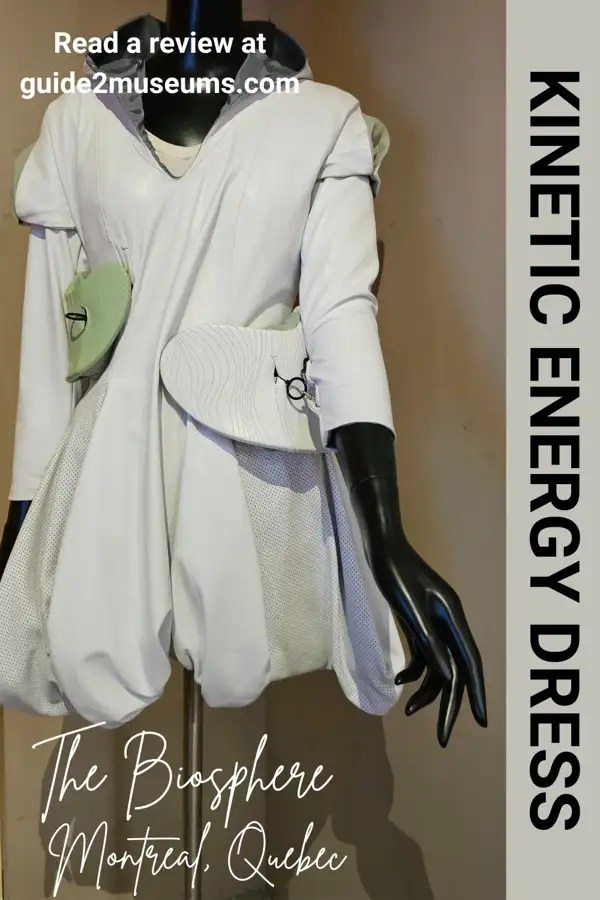
The Kinetic Energy Dress in the museum was developed by Joanna Berzowska and XS Labs, at Concordia University in 2008.
It used inductive generators to convert kinetic energy from the body’s movements into electric energy.
The electricity stored in an integrated battery illuminated the pockets.
XS Labs is a design research studio focused on innovation in electronic textiles and reactive clothing.
When it comes to solar energy, I found the museum’s history trivia fascinating. I hadn’t realized the long history of solar houses. Indeed, the first ones were built primarily for testing purposes after WWII. The Dover Sun House was featured as the world’s first solar house in Life Magazine in 1949.
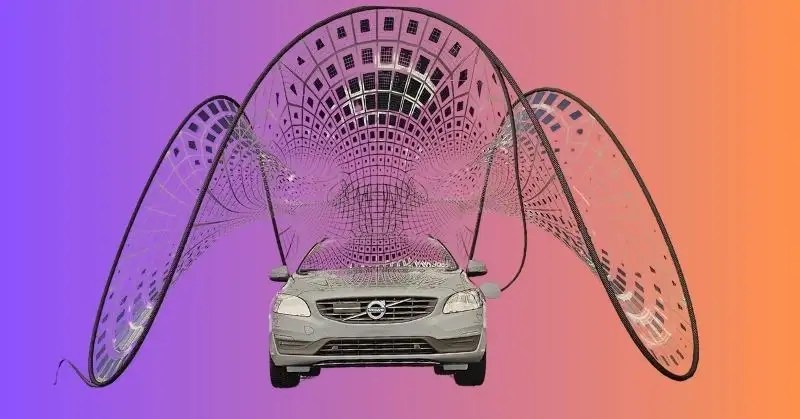
And the mobile charger above literally blew me away!
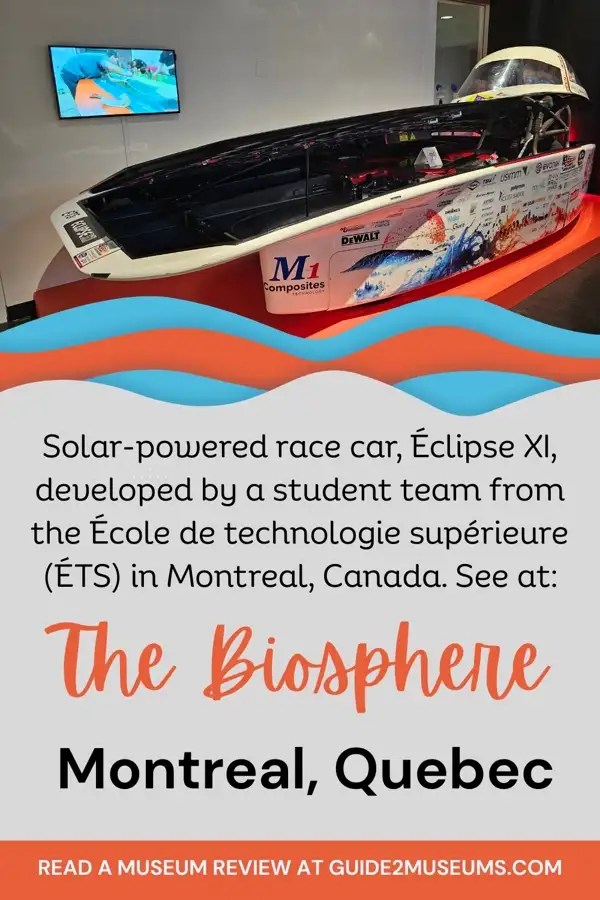
When it comes to solar-powered cars, in 1955, General Motors unveiled its Sunmobile. It was a miniature model of a Corvette powered by 12 photoelectric cells driving a small electric motor. ~ Biosphere
Linda’s Road Trip Tips
The Biosphere is located in Parc Jean-Drapeau. The park is comprised of two islands in the middle of the St. Lawrence River that were developed for the World’s Fair.
Montreal itself is on an island, so to host the World’s Fair in 1967, the city developed an additional island, Saint Helen’s.
However, it took about 25 million tons of earth, rock, and materials to expand it to the current size. The city also constructed a new, artificial island called Île Notre-Dame specifically for the event.
Today, Parc Jean-Drapeau is home to many of Montreal’s most important attractions, including The Biosphere. So when you visit the Biosphere, you’ll find lots to do from Montreal’s premier amusement park, La Ronde, to the Parc Jean-Drapeau Gardens botanical gardens and walking trails.
If you’re spending the day in the Parc, you’ll find the most dining options at Casino Montreal. It’s nearby on Île Notre-Dame. Depending on the season, you’ll find various snack bars and food trucks near La Ronde and The Biosphere. Visitors to the Parc can also bring their own food and relax in designated picnic zones.
Who Should Visit The Biosphere?
The Biosphere has great general appeal for museum-goers. With its wide range of interactives and hands-on activities, it’s popular with families and schools. The museum even offers a family admission rate, which varies by season and special promotions.
With its broad coverage of the environment, the museum is ideal for anyone wanting to learn more about ecological innovation.
I spent a couple of hours going through The Biosphere.
However, I only spent in-depth time at exhibits that I found particularly intriguing.
So, you could certainly spend longer.
The museum is generally accessible with stairs and elevators. Wheelchairs are available for visitors upon request, just ask at the Insectarium reception area.
For those with sensory sensitivities, the museum also offers sensory-friendly afternoons, providing a sensory kit for visitors to borrow.
How Do You Visit The Biosphere?
I took the Montreal Metro (underground) to The Biosphere. Just hop on or connect at the Green Line (Line 1) of the Montreal Metro and get off at the Jean-Drapeau station. When you emerge from the station, you’ll be able to see the Biosphere. It just takes a few minutes of walking to get there.
Parking: You can take a car or ride-sharing service like Uber to visit the Biosphere. Parking lots P10 and P11 are the closest ones. Be prepared for a hefty price tag, though, as parking space on the island comes at a premium.
Street Address: The Biosphere is located at 160 Tour-de-l’Isle Road. Montreal, Quebec.
The Biosphere is open year-round. You can check days, hours, and admission costs at The Biosphere website.
Take a virtual tour of The Biosphere with this YouTube video by The Guy From Montreal.
Plan your visit with Google Maps.
Read More Quebec Museum Reviews
Check out all these museum reviews for the Canadian province of Quebec!
Explore More Science Museums
- Tour The Biosphere: Montreal’s Environment Museum

- Discover the Amazing Canada Science and Technology Museum

- Fort Worth Museum of Science & History: Museum School™

- Lafayette Science Museum: From Dinosaurs to the Space Age in Louisiana

- McCormick Bridgehouse & Chicago River Museum: Chicago, Illinois

- Moody Gardens: Resort & Fun Attractions with Pyramids in Galveston, Texas
- Museum Of Illusions Toronto: Mind-Bending Exhibits

- Field Museum: Natural History Museum in Chicago, Illinois

- Audubon Insectarium: Natural Science Museum in New Orleans, Louisiana

- Glendive Dinosaur & Fossil Museum: 25+ Dinosaur Skeletons in Glendive, Montana











 guide2museums.com