Situated in the UNESCO World Heritage Site, Vieux‑Québec (Old Québec), the Musée de la civilisation is a key attraction in Quebec City. The modern complex integrates heritage buildings to blend into the area. It’s a great place to visit to develop an understanding of the city–and the province’s–history.

Linda’s Pick of the Exhibits
My favorite part of the Musée de la civilisation was called “On the Homefront.” While the introduction to the exhibit described a home the same as it was in Saskatchewan — kitchen, living room, bedroom and more. However, although the things in the home might have had the same purpose as artifacts from my past, they were often quite different.
The kitchen appliances really stood out. While the fridge looked like the old one in my garage–the stove was so different! As you can see from the photo below the controls for the burners are underneath them. The oven looking more like a little hotel fridge, was attached to the side of a metal framework.
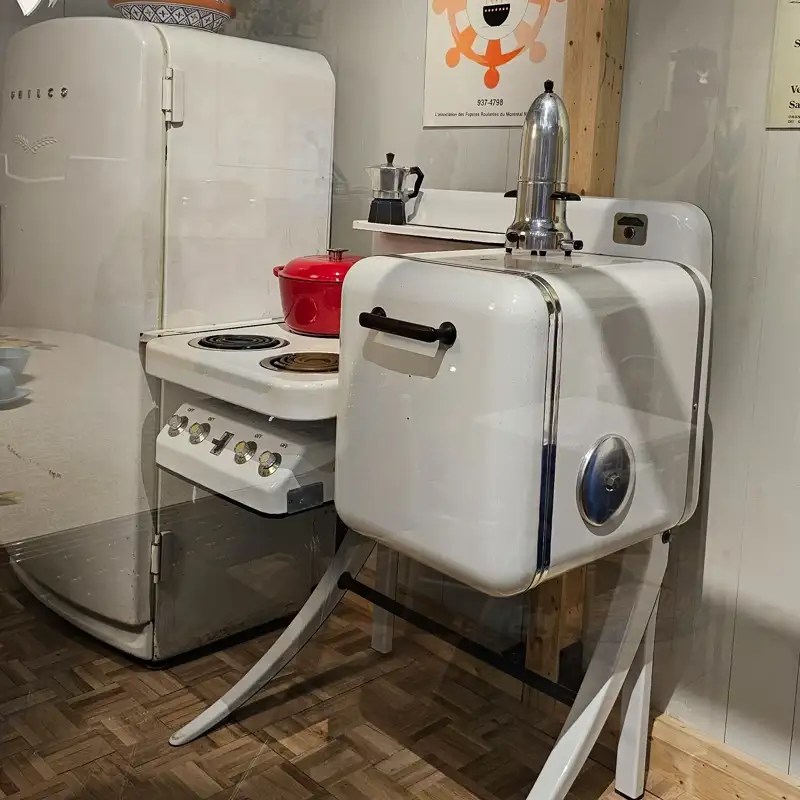
How old is it? The stove is an Electrochef Stove dating to about 1930. It’s made of enameled and chrome-plated steel, Bakelite, and ceramic. It was produced in Detroit, Michigan.
Wonder what that metal object is on top of the oven? At first glance, I thought it was a model rocket. Wrong. It’s a vintage Sunbeam Rocket Baby Bottle Warmer dating from the 1930s or 1940s.
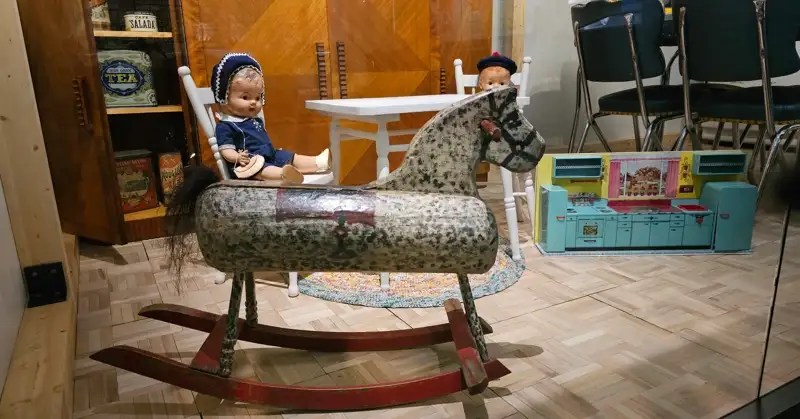
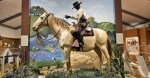
I just loved the rocking horse above, but it sure didn’t look like the ones I was familiar with. The difference, I guess, was that prairie rocking horses were patterned after cowboy history. These historic lovingly hand-carved horses continued French-Canadian artisanal practices from Normandy.
The rocking horse was displayed right next to the kitchen table, where children likely spent a lot of time so mom could see them. The kids’ mini-kitchen also let kids play at cooking while mom worked.
What’s in the Musée de la civilisation?
The Musée de la civilisation is around 20,000 square meters (about 215,000 square feet) total floor area. occupying a full city block in Québec City’s historic Lower Town. It also incorporates the St. Lawrence River into its design and history. Indeed, visitors can view the original 18th-century shoreline, uncovered during construction, in the Grand Hall.
Is the Grand Hall really grand?It is, indeed! In fact, it holds 1000 people. You enter the Grand Hall via the museum’s central foyer or concourse.
There are three levels for visitors to enjoy. They include:
- Level 0: My Place with lots of family fun
- Level 1: Green Light (considering personal and collective change); crowds of humans in interactions; special exhibits
- Level 2: In Other Words (significant events of Quebec history); This is Our Story (First Nations and Inuit of the 21st Century – 11 Indigenous Peoples); Finding Refuge (life of a Rohingya refugee); Strange Objects, Amazing Science (largest collection of scientific instruments in North America); Teens, Creative Minds.
When it comes to artifacts, the museum collection is over 225,000 objects. Now that’s a lot! Many, of course, are in storage. However, many different temporary exhibits rotate to showcase the collection.
The museum also oversees other Quebec heritage properties such as the Musée de l’Amérique francophone and the Séminaire de Québec collections, including UNESCO‑recognized archives.
Horse-Drawn Tramway
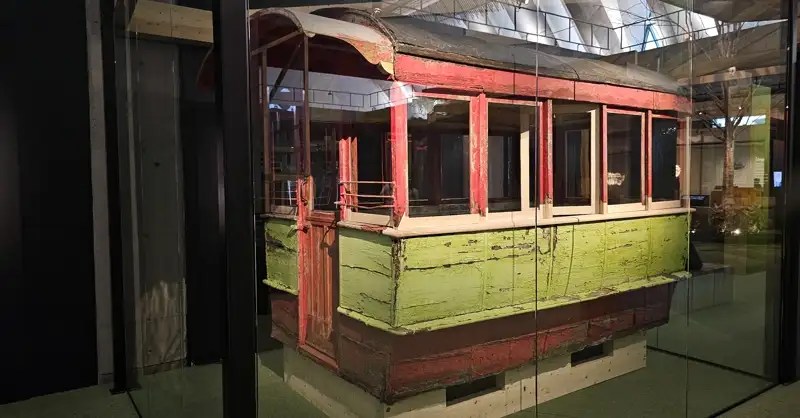
With my background growing up on a horse ranch, I have to mention the horse-drawn tramway. It was the first form of organized, affordable public transport in the city. This one is from 1860. It was made of wood, metal, and iron.
The first Quebec Street Railway opened on August 7, 1865. Its first line served the commercial arteries of Saint-Pierre, Saint-Paul, Saint-Joseph, and Saint-Vallier.
This is Our Story Exhibition
This is Our Story is a permanent exhibition developed with the First peoples in Quebec. What makes the exhibition most significant, though, is the level of cooperation and consultation done in creating the exhibit.
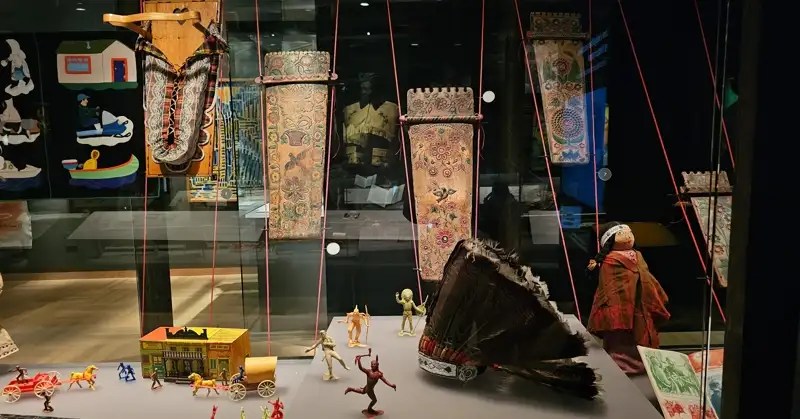
Quebec’s 11 Indigenous Nations, in partnership with La Boîte Rouge VIF, an organization that promotes Indigenous cultures, were co-creators. They drew on the experiences and design of more than 800 people.
You’ll find five distinct sections exploring the history of centuries. Starting with 12,500 years ago and curating to Aboriginal Peoples today, a lot of contemporary topics are covered.
Linda’s Road Trip Tips
I visited the Musée de la civilisation while attending a conference in Quebec City. My museum visits were packed in around sessions, so were more rushed than I’d have liked.
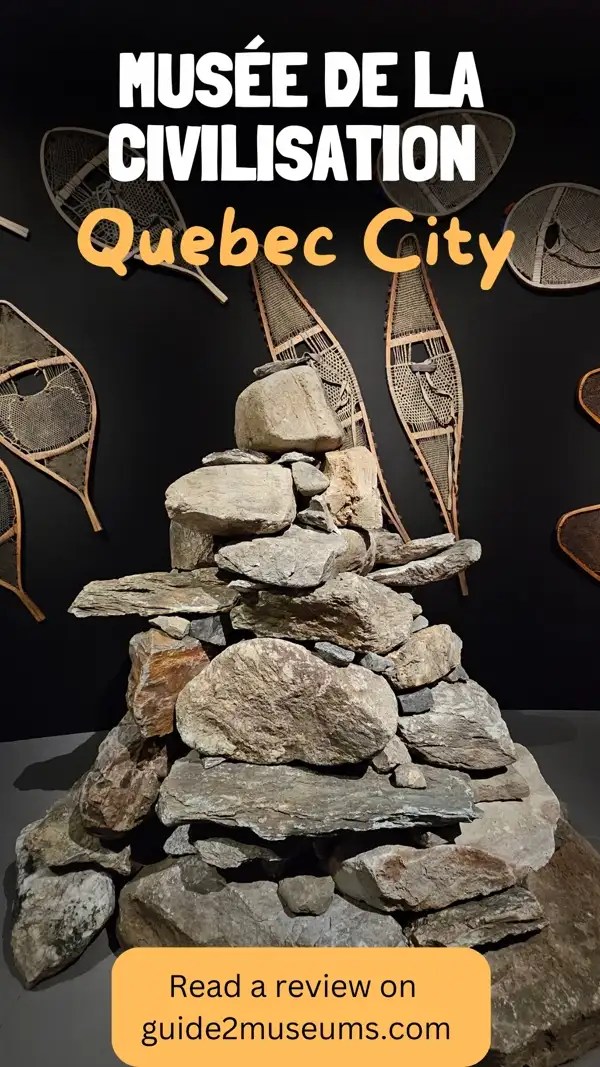
Of course, once you’re already in the UNESCO World Heritage Site, Vieux‑Québec (Old Québec), visiting the museum, you have to spend some time walking around inside the walls.
Old Québec is the only city in North America that still has its historic walls — they’re known as the Fortifications of Québec.
So how old are the city’s stone walls? The oldest parts are around 280 years old (built in 1745), while some restored parts range from 204 to 336 years old.
Now that’s old!
The UNESCO designated area is in both the Upper Town and Lower Town sectors of Quebec City. If you’re looking for great exercise, you can walk up the steep streets between the two.
Or, you can take a fun ride on the Old Quebec Funicular that connects them!
Who Should Visit the Museum of Civilization?
If you’re in Quebec City, the Musée de la civilisation, or Museum of Civilization, is a must-see stop. Getting there will take you through Old Quebec and the fortification walls, as these are also important to see on a visit.
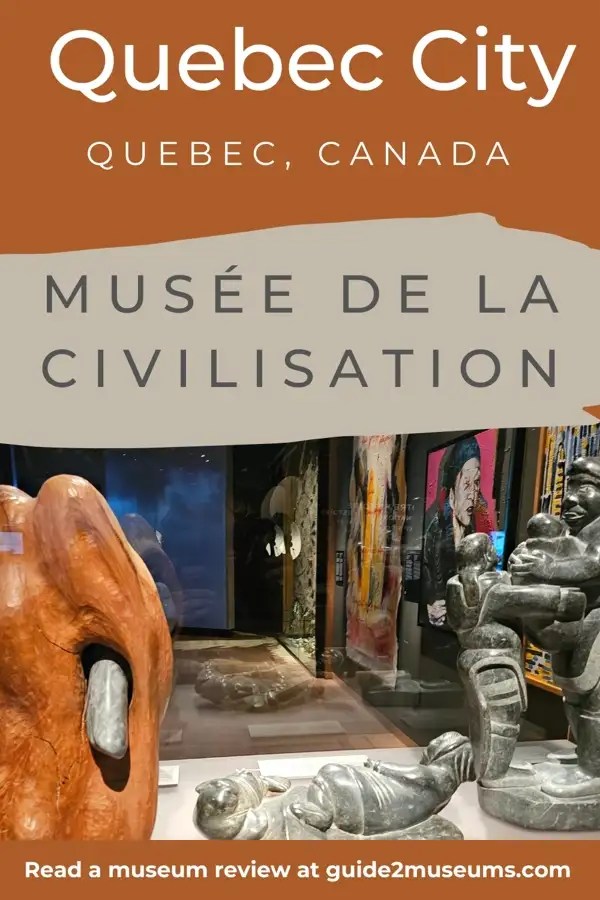
The museum develops a broad perspective of the history and culture of Quebec, with a significant Indigenous collection.
So, it’s a must-see for anyone exploring First Nations and Inuit culture in Canada.
What about taking kids to the museum? There’s lots for children, such as My Place (Ma Maison), an interactive house for kids up to eight-years-old. Children will also enjoy things like interactive maps and other hands-on exhibits.
The Musée de la civilisation prioritizes accessibility. So, it implements a wide range of physical, sensory, and policy measures for visitors. All floors are accessible by elevator and there’s ample room between exhibits so anyone with mobility needs, or pushing strollers, will find the visit comfortable.
If the kids, or someone with limited mobility, get tired, they have you covered with free loans of wheelchairs and strollers. There are also several baby-changing stations and a dining area with a microwave for heating baby bottles.
How Do You Visit the Museum of Civilization?
The museum is located in the Lower Town historic district of Quebec City.
Parking: There's no on-site parking, so you'll need to locate a public parking option. The nearest is Terrasses du Vieux-Port (76 rue Dalhousie). If you have a disabled parking permit, you'll find reserved parking on rue de la Barricade.

Visiting without a vehicle? The Quebec City Hop-On Hop-Off Bus Tour has the museum as one of its stops.
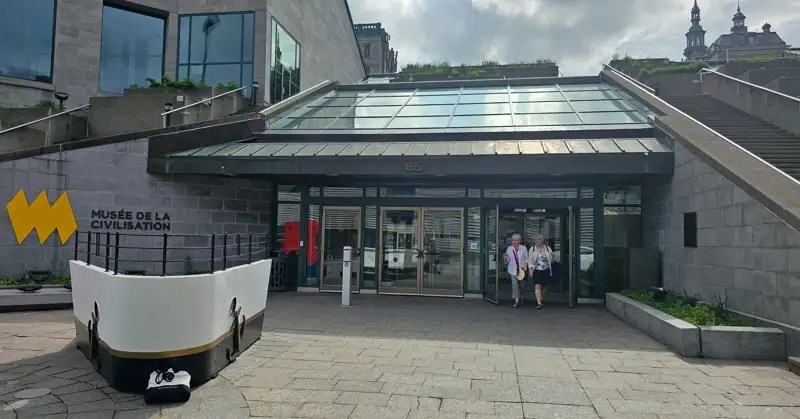
Street Address: 85, rue Dalhousie, Québec (Québec)
The museum is open year-round. You can check specific days and hours on the Musée de la civilisation website. You can also purchase advance tickets online.
Keep up on the latest news at the Musée de la civilisation Facebook page.
Visit the museum virtually with Slowmadic Journeys on YouTube.
Plan your visit with Google Maps.
Read More Quebec Museum Reviews
Check out all these museum reviews for the Canadian province of Quebec!
Explore More History Museums
- Musée de la civilisation: Quebec’s Museum of Civilization
- Inside the Cattle Raisers Museum: Fort Worth, Texas

- Plains of Abraham Museum & Battlefield Park: Quebec City
- Royal Ontario Museum in Toronto Review
- Amazing Giant Bison, Beaver, Mammoths & More: Yukon Beringia Museum in Whitehorse

- Royal Saskatchewan Museum & World’s Largest T-Rex Dinosaur

- Fick Fossil & History Museum: Buffalo Bill to Prehistoric Fish in Oakley, Kansas
- Ronald Reagan Presidential Library & Museum: Simi Valley, California

- Morro Bay Maritime Museum: Morro Bay, California

- National Cowgirl Museum & Hall of Fame: Cowgirl history in Fort Worth, Texas
- Bell Barn Museum: Historic Round Barn in Indian Head, Sskatchewan

- Naranjo Museum: Dinosaurs & Fossils in Lufkin, Texas

- Texas Seaport Museum: Gulf Coast History in Galveston, Texas
- Levine Museum of the New South: Charlotte, North Carolina

- Jefferson Historical Museum in Big Cypress Bayou: Jefferson, Texas
- Museum of the Fur Trade: Chadron, Nebraska

- Mystic Seaport Museum: Historic Seafaring Village in Mystic, Connecticut





 guide2museums.com