Learn the story of Quebec and its people through the Musée national des beaux-arts du Québec. More than just an art museum, it’s a “living memory” that aims to bring people together through art. With its programs and innovations, the museum creates a dynamic social space rather than a static art repository.
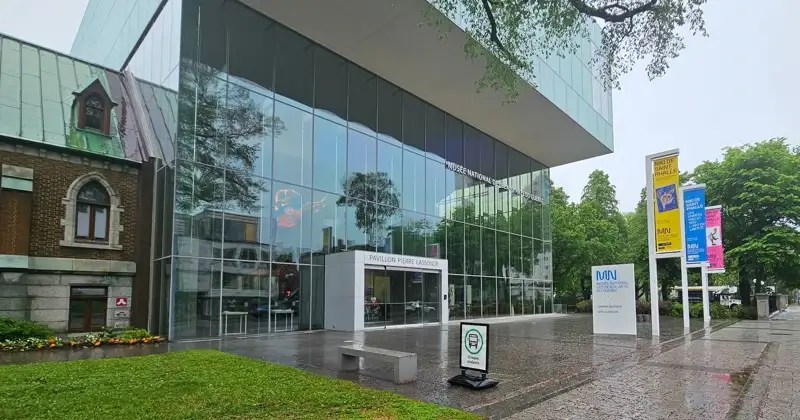
Linda’s Pick of the Exhibits
When it comes to art, my favorite things are the pieces that surprise. The surprise may be an artistic form or interpretation, but it should give me an “aha” moment. In the Musée national des beaux-arts du Québec that surprise was titled Lost in Nature (The Car).
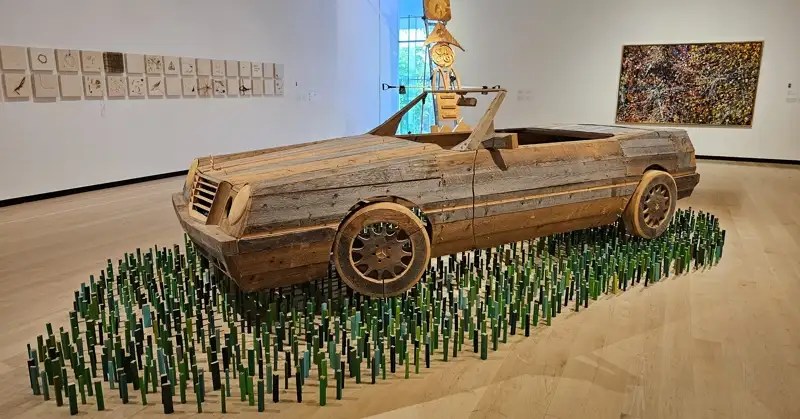
Lost in Nature uses mixed media to create a Mercedes convertible parked on a lush green lawn. The artistic purpose? It uses hyper-realistic mimicry to satirize suburban excess and consumer culture.
Made entirely of salvaged barn wood, the piece truly becomes a piece of living history. The rough, mismatched planks show weathering, knots, and handmade assembly, all part of the area’s past. The materials revive traditional wood sculpture techniques to create a luxury Mercedes car, amplifying the piece’s satire on materialism.
The Mercedes is, after all, about prestige and status. It’s more than a car–it’s a cultural emblem of financial achievement.
And the grass, what’s it made of? It uses everything from construction waste to discarded pallets to wooden debris. If you’re like me, you’re wondering how on earth the sculptors got hundreds of small wooden sticks to balance on the floor. Apparently, there isn’t even any glue or mat!
The trio of artists who created Lost in Nature used the name BGL Collective: Jasmin Bilodeau, Sébastien Giguère, and Nicolas Laverdière. It’s a permanent installation in the Pierre Lassonde Pavilion on the first floor.
What’s in the Musée national des beaux-arts du Québec?
The Musée national des beaux-arts du Québec (MNBAQ) has been collecting and displaying Quebec art for a century. Initially, it had multiple roles, but became dedicated to art in 1979. In 1981, the museum was reorganized as a crown corporation under the National Museums Act.
With a collection of 42,000+ works from the 17th century to today, there’s always something new to see in the museum galleries. Of course, there are several must-see pavilions.
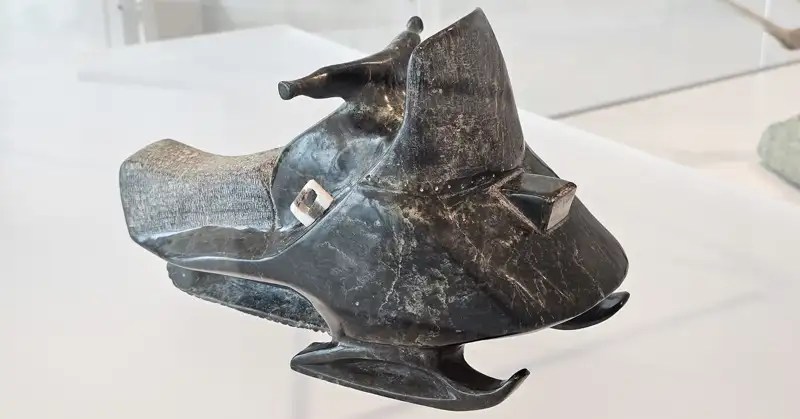
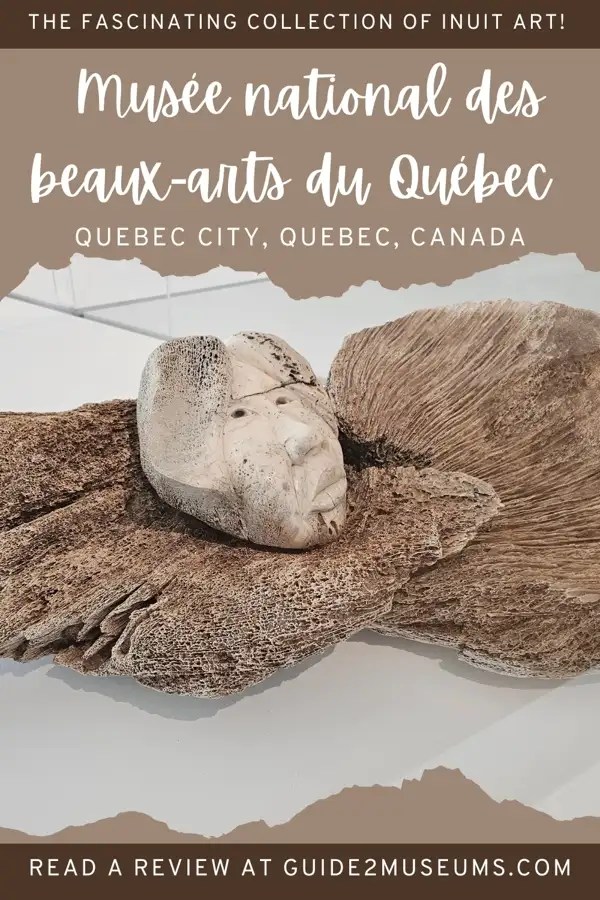
The Inuit art collection really stands out with its sculptures, prints, and drawings. Indeed, the museum is considered to have one of the most important collections in the world. The Brousseau collection of about 3000 pieces is particularly important. It includes sculptures from Alaska, Siberia, Northern Europe, and Greenland.
Fast Fact: Raymond Brousseau was a Québec City-based art collector, filmmaker, painter, and dealer renowned for elevating Inuit art. He donated the Inuit works to the Musée national des beaux-arts du Québec in 2005.
These are the galleries spread over four pavilions:
- 0 – Auditorium and Salon Desjardins
- 1 – Entrance and Grand Hall – Galleries 1 & 2 that rotate
- 2 – Gallery 3 Contemporary Art & Gallery 4 – Us
- 3 – Gallery 5 Inuit Art & Gallery 6 Decorative Arts and Design in Quebec
Altogether, the museum spans about 31,590 m² (340,000 sq ft). Its area had doubled with the addition of the Pierre Lassonde Pavilion in 2016. Exhibits are done in French and English, so information is accessible to all.
While not a display, the spiral staircase of 79 cantilevered concrete steps in the Pierre Lassonde Pavilion are a piece of art themselves. In addition, there’s an exterior pop-out-staircase with 40 steps.
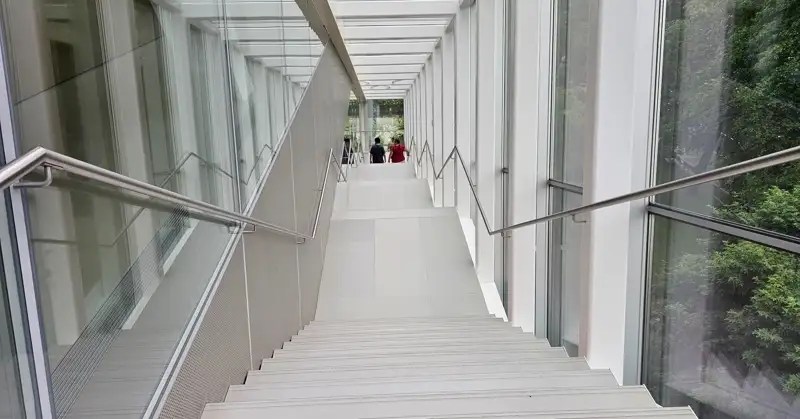
From the interior stairs, you get sweeping views of Battlefields Park, Saint-Dominique Church, and the Quebec City skyline. It’s a fabulous view!
In addition to rotating pieces from the museum’s permanent collection, there are also international pieces and temporary shows.
Linda’s Road Trip Tips
The MNBAQ is adjacent to the Plains of Abraham Museum in Battlefords Park. The day I visited the museum, I left my hotel, the Hotel Chateau Laurier (not the Fairmont), and walked along the Plains of Abraham until I reached the museum.
To start my walk, the Plains of Abraham Museum was a must-see. From uniforms to law and order, there’s a lot to learn about 1700s and 1800s history of Quebec City.
Fast Fact: The Martello Towers were built by the British between 1808 and 1812 to defend against invasion threats from the Americans.
Leaving the Plains of Abraham Museum, I took extra time to walk through the Joan of Arc Garden. The flowers were gorgeous!
Of course, I also enjoyed seeing the statue of Joan of Arc. As well, the Martello Towers, four, two-story cylindrical stone fortifications, were also interesting.
Before you get to the MNBAQ on your walk, stop for an Instagram shot of Église Saint-Dominique (Saint-Dominique Church).
Around a century-old, it’s a beautiful stone church. Made of local stone, it features turrets and stained-glass windows.
How long is the walk? About 10 minutes if you don’t spend too much time on stops along the path!
If you work up an appetite with your walk and tour, check out the menu at the Café Québecor in the museum. You’ll be able to enjoy the great outdoors while dining or having a drink, as the restaurant is entirely enclosed in class.
Who Should Visit the Musée national des beaux-arts du Québec?
The ideal visitor to the Musée national des beaux-arts du Québec is an art lover. But the museum’s appeal doesn’t stop there. Anyone interested in the province’s culture, as interpreted through the eyes of artists, will also enjoy a visit.
Families will find the interactive zones and workshops keep the kids interested during a visit.
With a spacious layout, those using mobility aids or pushing a stroller will find it easy to get around.
While the staircase is a must-see, there are elevators in all of the pavilions.
Free loaner wheelchairs are available, and there are ramps at all entrances.
The museum provides tactile maps and audio guides for anyone with visual impairments.
There are also quiet rooms provided as sensory aids.
Time required? My hour-long visit wasn’t nearly enough, but I was trying to pack a lot into the time I had!
How Do You Visit the Musée national des beaux-arts du Québec?
The Musée national des beaux-arts du Québec is located in the city’s Montcalm neighborhood within the National Battlefields Park (Plains of Abraham).
Parking: MNBAQ provides two paid on-site parking lots. They also offer free accessible parking for Québec-issued disabled placard holders in both on-site lots.
Street Location: 179 Grande Allée Ouest, Quebec City, Quebec, Canada.
The museum is open year-round. Check days and hours on the Musée national des beaux-arts du Québec website.
Keep up-to-date with what’s happening at the museum with their Facebook page.
Take a virtual tour of the museum with Slomadic Journeys on YouTube.
Plan your visit with Google maps.
Read More Quebec Museum Reviews
Check out all these museum reviews for the Canadian province of Quebec!
Explore More Art Museums
- Musée national des beaux-arts du Québec: Art & People
- TD Gallery of Indigenous Art: Free Toronto Museum
- Maple Creek’s Intriguing Jasper Cultural & Historical Centre

- See 100 Miles Across Nebraska From Scotts Bluff National Monument

- Art Gallery of Ontario: Art Museum in Toronto, Ontario

- Fort Cody Trading Post: Miniature Wild West Show in North Platte, Nebraska

- Museum of Northern British Columbia: Indigenous Art & History in Prince Rupert, British Columbia
- The Enchanted Highway: Giant Metal Sculptures in North Dakota




 guide2museums.com