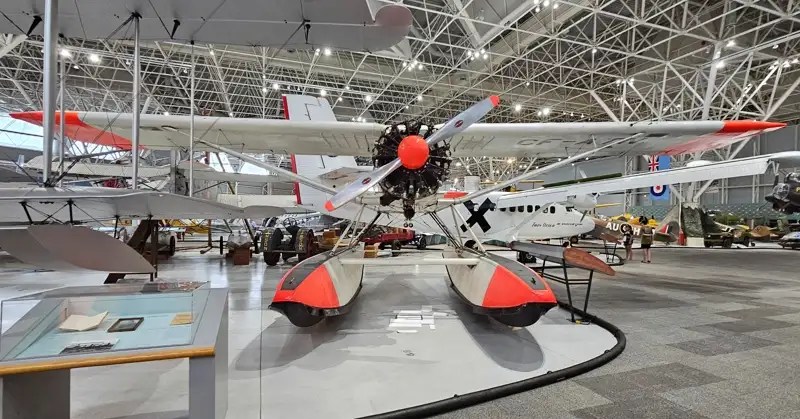
Canada Aviation and Space Museum (CASM) is located in Ottawa, Canada. One of the country’s nine national museums, CASM takes visitors flying through Canada’s stars and skies. Museum visitors see airplanes ranging from the largest surviving nose section of the Cold War jet interceptor prototype, Avro Arrow, to the CF-BSC luxury bush plane.
Linda’s Pick of the Exhibits
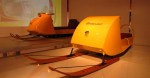
My favorite exhibit? Being a diehard BRP Ski-Doo snowmobile owner, I had to pick the Bombardier Challenger 604 prototype. Its importance in the museum? This airplane is one of the great successes of the Canadian aerospace industry.
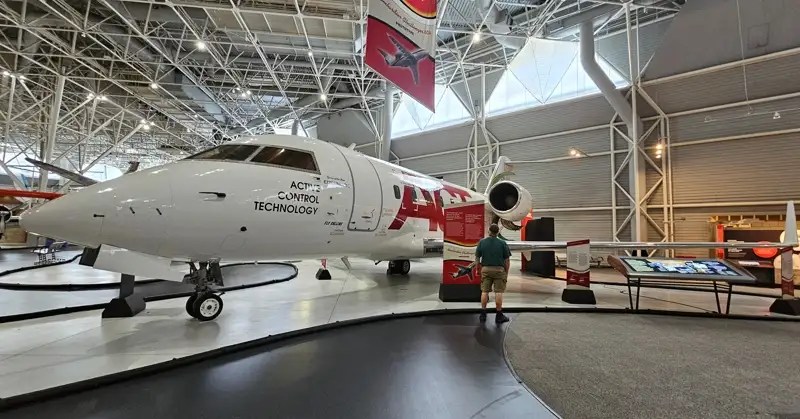
Indeed, the Canadair CL-600 Challenger achieved international success. Why? It was the world’s first wide-body business jet. The spacious stand-up cabin and long range made it a #1 choice for individuals and companies who own their own jets.
Canadair pioneered aircraft building in Canada starting in 1944. The company was a government-created spinoff from Canadian Vickers that was nationalized in 1976. Bombardier then acquired Canadair when it had financial problems a decade later in 1986.
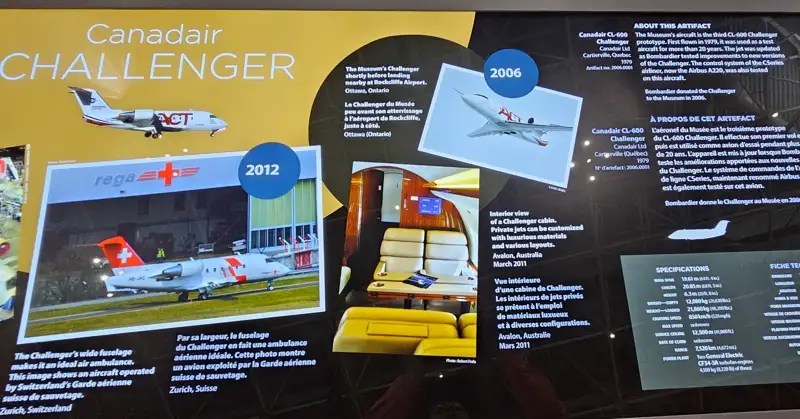
Bombardier went on to expand the Challenger line to include regional airliners and ultra-long-range jets.
Fast Fact: The Challenger 604 can be configured to fly 12 passengers. Five of the seats can be made into beds mid-flight, making it ideal for night flights. When it comes to flying, the 604 is able to make steep approaches relative to its size. This allows it to fly in and out of various sized airports.
What’s in Canada’s Aviation and Space Museum?
The Canada Aviation and Space Museum opened in 1960 as one of three separate collections of air exhibits owned by the government. They were combined into one museum in 1964 under the control of the Crown corporation, Ingenium.
Fast Fact: Canada's first air shows took place in 1910! Where? Major cities like Toronto and Montreal. By 1912, air shows were common, often coinciding with local fairs.
Now, the museum is located in two hangars. The main hangar has a fascinating history of its own. Why? It’s a triangular steel structure built in 1940 at RCAF Station Rockcliffe, which now forms part of the museum property.
What’s the history of RCAF Station Rockcliffe?
RCAF Station Rockcliffe was a key Royal Canadian Air Force base in Ottawa. The base opened in 1920 as the Ottawa Air Station and became RCAF Station Rockcliffe in 1940 during WWII.
The Ottawa Air Station was on 930 acres alongside the Ottawa River. It was Canada’s first combined land and seaplane base. In addition, the base supported aerial mapping, transport, and testing. Paved runways were added in 1939.
Flight testing, initially done at Station Rockcliffe, was moved in 1957. Flying ended in 1964. It was used for admin purposes until 1965.
Most key exhibits are located in the main hangar. A second hangar, also open to the public, was opened in 2006 for aircraft storage. It provides off-site storage for 100+ aircraft. Visitors can explore this part of the museum by taking a tour from the museum admission desk.
What’s in the Museum’s Galleries?
I found the galleries contained tons of information in addition to the airplanes and other artifacts.
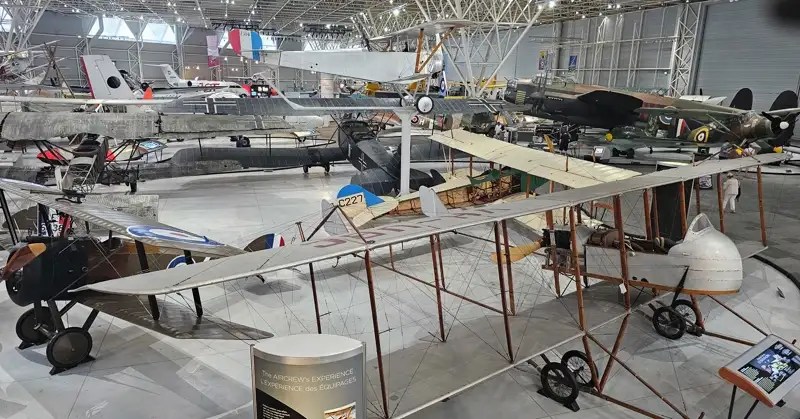
They included:
- Main Hall with the history of flight
- Engines: The Power to Fly Gallery with around a dozen historic aircraft egnines with specs, histories, and powered aircraft examples
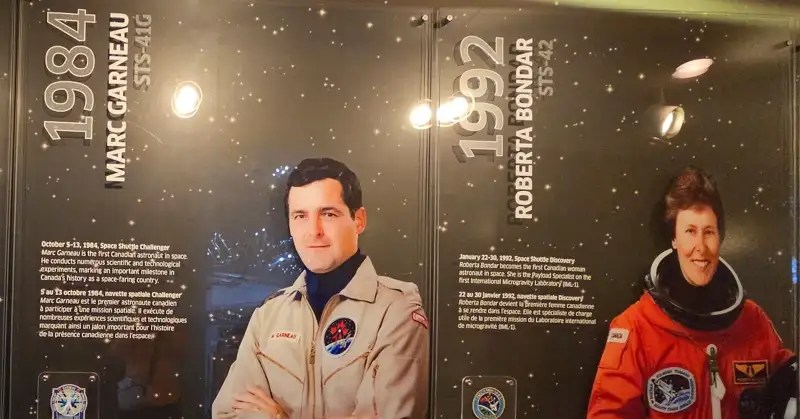
- Space Exploration featuring the Canadarm and biographical information of all of the Canadians who’ve been astronauts
- WWII display including RCAF contributions, British Commonwealth Air Training Plan, and iconic fighter planes such as the Supermarine Spitfire
- Cold War history in Canada including a replica basement fallout shelter (stocking for 2 weeks), digital DEW Line radar station tour, and decoding challenge
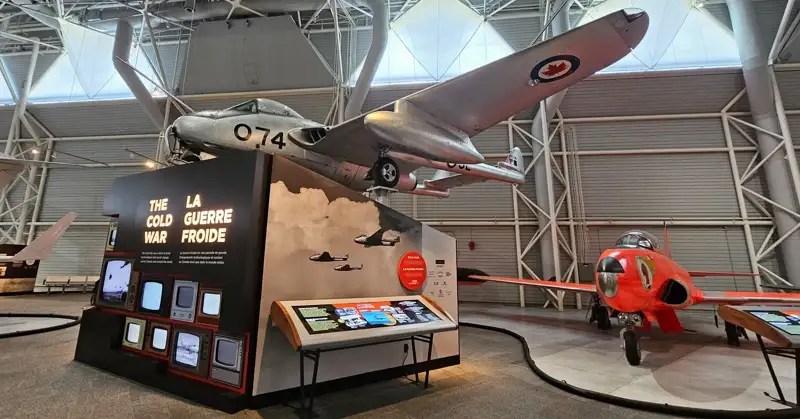
When it comes to galleries, I learned a lot of new things about Canada’s participation in space exploration. The Cold War history also had lots of interesting facts and artifacts.
Interactive Exhibits at CASM
The Canada Aviation and Space Museum provides many interactive exhibits. Flight simulators, of course, usually jump to the top of the popularity list, especially for families. Never wanted to fly?
Try the Eyes in the Skies that lets you direct multiple lanes as an air traffic controller instead.
Fast Fact: Roberta Bondar was the first Canadian woman astronaut in space. She was the Payload Specialist on the first International Microgravity Laboratory on the Space Shuttle Discovery, January 22-30, 1992.
Linda’s Road Trip Tips
I visited CASM using the Hop On Hop Off bus. The bus ride gave me many views of the historic Rideau Canal, as well as access to most of the national museums. The tour also takes you around a number of embassies in Canada’s capital city.
If you’re hungry or thirsty during your visit, the Savour Express from Bytown Catering has you covered.
They provide various grab and go options from sandwiches to baked goods. Food isn’t allowed in the museum, so be sure to rest your feet at one of the provided tables while you snack.
On a budget? You can save money visiting Ottawa’s museums by purchasing a one or three-day Ottawa Museums Pass.
I found Ottawa an easy city to get around without renting a car–always a plus for me.
While I didn’t get time, visiting Parliament Hill is an important stop for many visitors. There are three different free guided tours, so be sure to book one!
Who Should Visit the Canada Aviation and Space Museum?
The Canada Aviation and Space Museum galleries will appeal to a wide variety of visitors. While museums are all about history, the CASM exhibits have a heavy focus on storytelling. This storytelling broadens the appeal to younger generations.
What kinds of stories? You’ll find personal stories from RCAF espionage stories to nuclear Cold War fears to bomber aircrew accounts.
With 130+ aircraft, the museum is a must-see for anyone interested in aviation. A number are very rare, such as the Heinkel H 162A-1 Volksjägers (WWII “people’s fighter”) captured in Leck, Germany, in 1945. This plane was never flown in combat.
CASM is fully accessible and barrier-free, with a Rick Hansen Foundation Accessibility Certified™ rating for its design. This includes mobility, sensory, and visibility disabilities.
Free admission is provided for one support person. Service animals are welcome. Parking is free is designated accessible parking spots with a vaild accessible parking permit.
I spent an hour-and-a-half, but would recommend longer.
How Do You Visit the Canada Aviation and Space Museum?
The Canada Aviation and Space Museum is located on the grounds of the former RCAF Station Rockcliffe, now Ottawa/Rockcliffe Airport.
Parking: A paid parking lot is located right beside the museum. For those also visiting the Canada Agriculture and Food Museum and Canada Science and Technology Museum on the same day, a daily maximum parking ticket is valid in all three locations.
There are public transportation stops at the museum.
Street Address: 11 Aviation Parkway, Ottawa, Ontario
The museum is open year-round. Some times and days have free admission for various groups, so be sure to check the museum days/hours open on the CASM website for more information.
Check the Canada Aviation and Space Museum Facebook page to keep up-to-date with what’s happening at the museum.
Take a short virtual tour with Ottawa Things on YouTube.
Plan your visit with Google maps.
Read More Ontario Museum Reviews
Check out all these museum reviews for the Canadian province of Ontario!
Explore More Military & War Museums
- Canada Aviation and Space Museum: Iconic Civil & Military Airplanes
- Plains of Abraham Museum & Battlefield Park: Quebec City
- Canada’s Little-Known Cold War Museum: the Diefenbunker
- U.S. Army Museum of Hawaii Artillery Battery in Honolulu

- USS Lexington Museum: WWII Aircraft Carrier in Corpus Christi, Texas

- Regional Military Museum: Artifacts from all US Wars in Houma, Lousiana
- Strategic Air Command & Aerospace Museum: Ashland, Nebraska
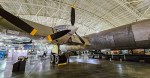
- Vancouver Island Military Museum: Nanaimo, British Columbia

- National Museum of the Pacific War: Fredericksburg, Texas

- Hill Aerospace Museum: Military Aircraft at Hill AFB, Utah

- Battleship Memorial Park: 1942 Battleship & 1941 Submarine in Mobile, Alabama

- Fagen Fighters WWII Museum: Granite Falls, Minnesota

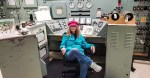
- Manhattan Project National Historical Park: WWII History in Hanford, Washington
- National World War II Museum: New Orleans, Louisiana

Acknowledgment
During my visit to Ottawa, Ontario, I received a national museum pass, and hop on, hop off bus pass, from Ottawa Tourism. I appreciate their support as it helps me provide this blog content free for everyone to read.



 guide2museums.com