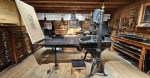
Whether you’re looking for traditional Asian cuisine, the constant bustle of shoppers, or late-evening fun, Chinatown is the perfect destination. Only steps away from Old Montreal and downtown, this historic Quebec Chinatown adds an interesting dimension to a visit to Montreal.
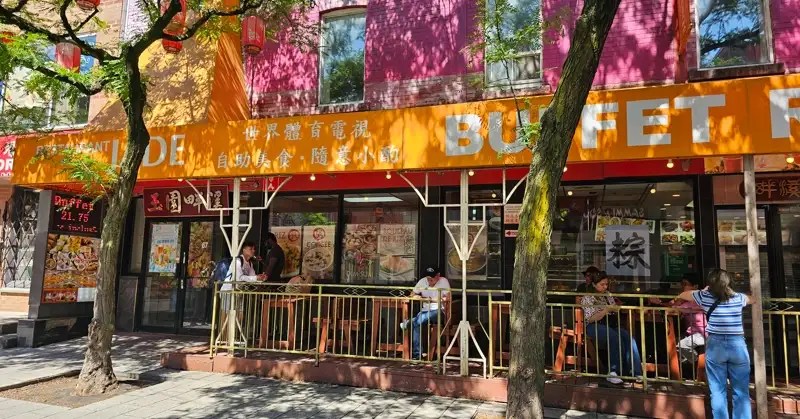
Linda’s Pick in Chinatown
I love the bright colors of Chinatown — but love the tastes of Chinatown even more! Of course, I was lucky on this visit to be with an Asian friend, Ruby, who could guide me through the amazing range of choices in bakeries and restaurants from various parts of Asia.
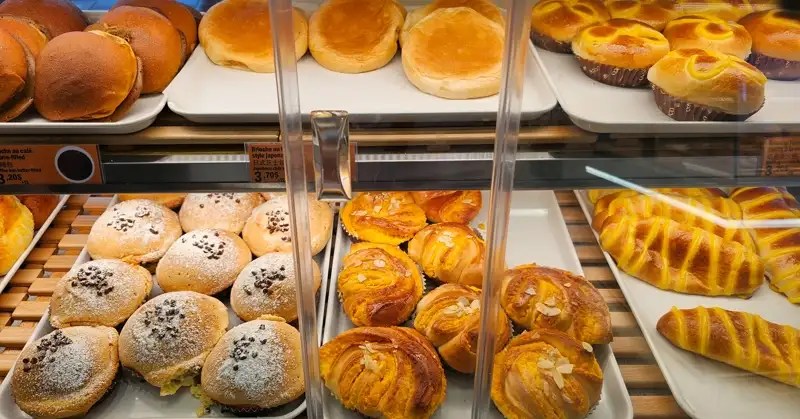
We started by going through a bakery. From buns to tarts, there were literally dozens of things I’d have bought if I hadn’t been leaving the city in the morning. So, I could only imagine the tastes!
When it came to lunch though, Ruby picked out a restaurant she assured me I just had to eat at — Sammi & Dumpling.
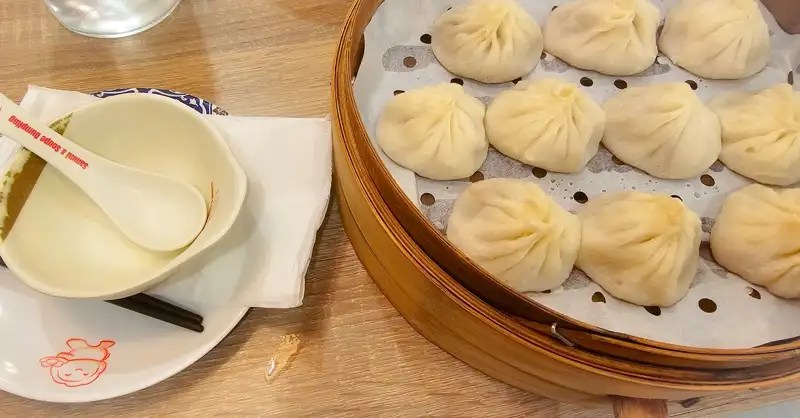
Their specialty was Xiao Long Bao. What’s that? A steamed dumpling filled with savory broth and meat, or soup dumpling. Yum!
What’s the history of Xiao Long Bao?
Let’s start by breaking down the name. Xiao means small or little, long means a basket, and bao is a bun.
In the dish, the bao, or bun, isn’t what you’d expect. I, of course, first thought of bread, but that wasn’t quite right. The bao is a thin-skinned steamed dumpling with the wrapper, or outside, made of unleavened wheat dough like a very thin bun skin. Traditionally, the bao is stuffed with ground pork and pork aspic jelly. However, modern versions use everything from crab to chicken.
And what about the basket? It’s the steamer used to make the soup dumplings.
The steamer is made of bamboo. To make the utensil, bamboo skin is peeled off, soaked and softened, then bent into a ring. The rings are then finished with nails or rattan. And finally, a base and tight-fitting lid are added to finish the cooking utensil.
Steam cooking utensils date back to Neolithic China. They evolved into today’s forms by the time of the Han dynasty in southern China. During the last 2000 years, the steamer has become a standard utensil for buns and dumplings.
Why? Bamboo absorbs some moisture as well as letting excess steam escape through the woven lid. That’s important as it keeps dumpling wrappers from becoming soggy.
In xiao long bao, the dumplings sit on something such as parchment inside the basket. Then, the basket is steamed over boiling water so the wrappers cook. The basket goes directly to the table, keeping the soup dumplings steaming hot.
At first, I thought eating the dumpling without losing the broth would be difficult, as I don’t use chopsticks. However, I managed quite well with the spoon.
I give the dumplings an A+, so do try them the next time you’re in Chinatown.
What’s in Montreal’s Chinatown?
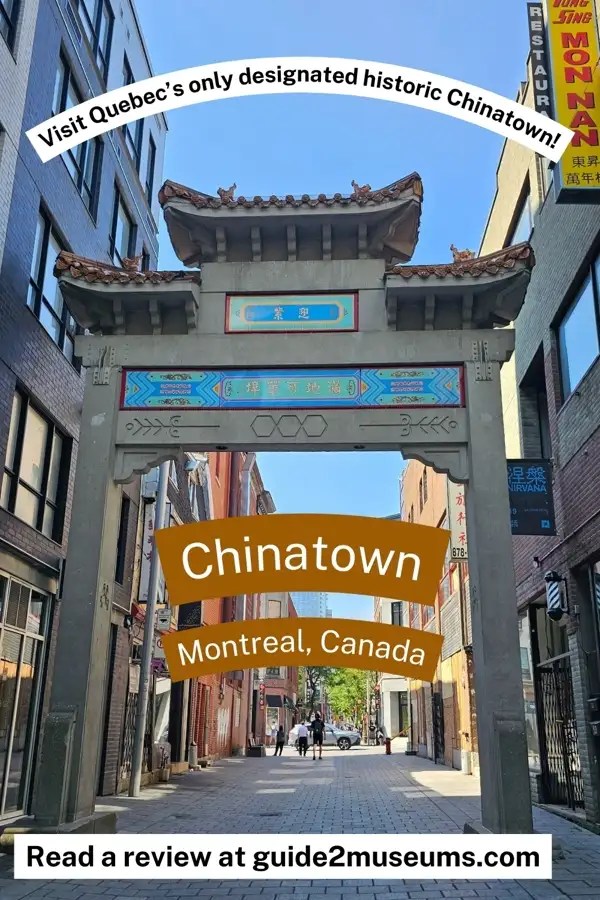
Entrances into Chinatown in Montreal are marked by four paifang gates. What’s that? Arches with various styles of decorations. While gates are common into Chinatown areas in many cities, Montreal’s four gates stand out as the city has the most paifang gates of any Chinatown in Canada.
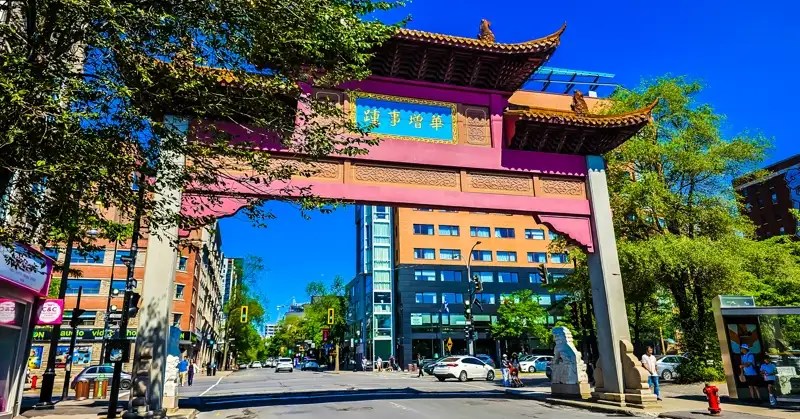
Chinatown covers an area about the size of a city block, although it’s on several streets: La Gauchetière Street and around Saint Urbain Street and Saint Lawrence Boulevard (boul. Saint-Laurent).
Montreal’s Chinatown dates back to the late 1880s. Why? That’s when Chinese immigrants who had first worked on the Canadian Pacific Railway began to build communities of their own.
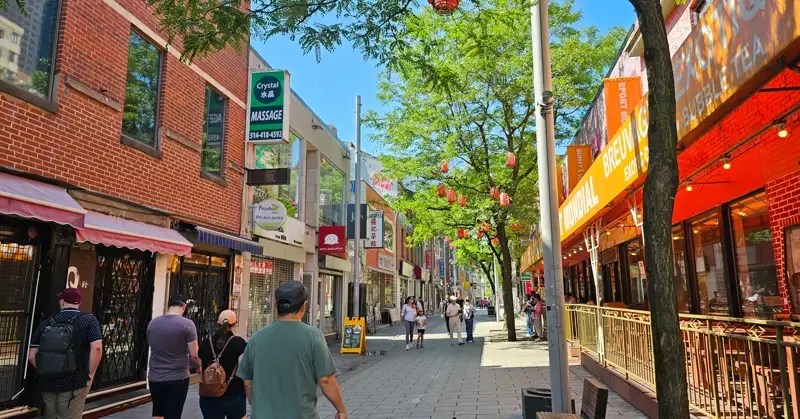
As the city grew, more and more Chinese opened businesses in the area. In 1902, this part of Montreal became officially known as Chinatown, leading to continued growth.
When urban renewal and gentrification started to threaten Chinatown, a group of activists lobbied to have Chinatown named a heritage site. The Quebec Government signed a notice of historic classification for it on July 20, 2023, retroactive to January 24, 2022.
Fast Fact: Montreal's Chinatown has a unique linguistic and cultural mix. Indeed, it's the only French speaking Chinatown in North America.
Ten buildings and 14 lots were named in the classification. They include the historic Wings Building and the Place Sun Yat Sen.
The buildings reflect different periods of community life including religion, industry, education, and social organization.
Fast Fact: Montreal's Chinatown began to be a tourist attraction during Expo 67 in Montreal. Pagoda Park was built to symbolize peace and harmony and to identify the Chinese community.
Together they make Montreal’s Chinatown a leading example of “living heritage” where social history is as important as the bricks and stones of the architecture.
Linda’s Road Trip Tips

I got to Chinatown using Montreal’s Metro. Indeed, Chinatown sits right beside two major metro stations: Orange Line (Place-d-Armes) and Green Line (Saint-Laurent). The Orange Line is the closest and most commonly used.

Together, this access makes Chinatown incredibly central to the city, even though it’s a small area.
Outside the boundaries of Chinatown, you’ll find entertainment venues, offices and courthouses.
Inside Chinatown, you’ll find a cultural hub that’s a place where Montrealers and visitors gather.
Chinatown also sits directly above sections of Montreal’s Underground City (Montreal’s RÉSO network). You can access the Underground City at the Place-d-Armes metro station.
Who Should Visit Montreal’s Chinatown?
Chinatown is a great place to enjoy traditional Asian foods from dim sum to bubble tea to soup dumplings.
Indeed, its close proximity to Old Montreal means many visitors can readily explore the area as an easy stop to grab a meal.
Traditional Chinese culture and architecture is everywhere within the boundaries of the four gates, so visitors interested in cultural exploration will find this well-preserved area fascinating.
And if you’re looking for selfies and bright photos, you’ll find lots of backdrops!
The core of Chinatown has a central pedestrian mall that runs about 300 to 400 metres (328 to 437 yards) or over a quarter of the area.
All of this make Montreal Chinatown an easy visit for walking, sightseeing, eating, and shopping!
How Do You Visit Montreal’s Chinatown?
Chinatown is in the Ville-Marie Borough. The location is central to Montreal, near Old Montreal and the downtown core.
Parking: There's very limited metered street parking in Chinatown. For those taking a car, parking garages outside Chinatown are the best option. You may want to pre-book to be sure you get a spot.
Learn more about Chinatown on the city of Montreal’s official website.
Take a virtual tour of Montreal’s Historic Chinatown with Discover Montreal on YouTube.
Learn more about what’s happening in Montreal’s Chinatown with their unofficial Facebook page.
Plan your trip to Montreal Chinatown with Google maps.
Read More Quebec Museum Reviews
Check out all these museum reviews for the Canadian province of Quebec!
Explore More Historic Sites
- North Pacific Cannery National Historic Site – BC’s Mighty Salmon Runs

- Legendary Stories of Fort Totten Historic Site: North Dakota
- Chinatown in Montreal: A Fascinating Historic Site

- Canada’s Little-Known Cold War Museum: the Diefenbunker
- Discover the Mormon Handcart Historic Site & Devil’s Gate in Wyoming

- Historic Home of 1800s Governor in Lafayette, LA: Alexandre Mouton

- See 100 Miles Across Nebraska From Scotts Bluff National Monument

- Bishop’s Palace in Galveston, Texas: Victorian Era Castle

- Rip Van Winkle Gardens & Historic Mansion: Jefferson Island, Louisiana

- Robinson Roadhouse & Robinson Flag Station: Yukon Ghost Town

- USS Lexington Museum: WWII Aircraft Carrier in Corpus Christi, Texas

- Watson Lake Sign Post Forest Historic Site: Watson Lake, Yukon

- Medalta Museum: Ceramic Arts in Medicine Hat, Alberta
- Claybank Brick Plant National Historic Site: Claybank, Saskatchewan

- The Sheriff’s House Museum & Historic Site: A Hidden Gem in Devils Lake, North Dakota

- Soo Line Historical Museum & Historic Site: Weyburn, Saskatchewan

- Texas Seaport Museum: Gulf Coast History in Galveston, Texas

- Fred Light Museum: Battleford, Saskatchewan

- Frontier Prison Museum: Rawlins, Wyoming

- Toronto’s First Post Office Museum & National Historic Site: Ontario

- The Bastion: Designated Historic Place, Nanaimo, British Columbia

- Hearst Castle: National Historic Landmark in San Simeon, California

- Inglis Grain Elevators National Historic Site: Agricultural History in Inglis, Manitoba