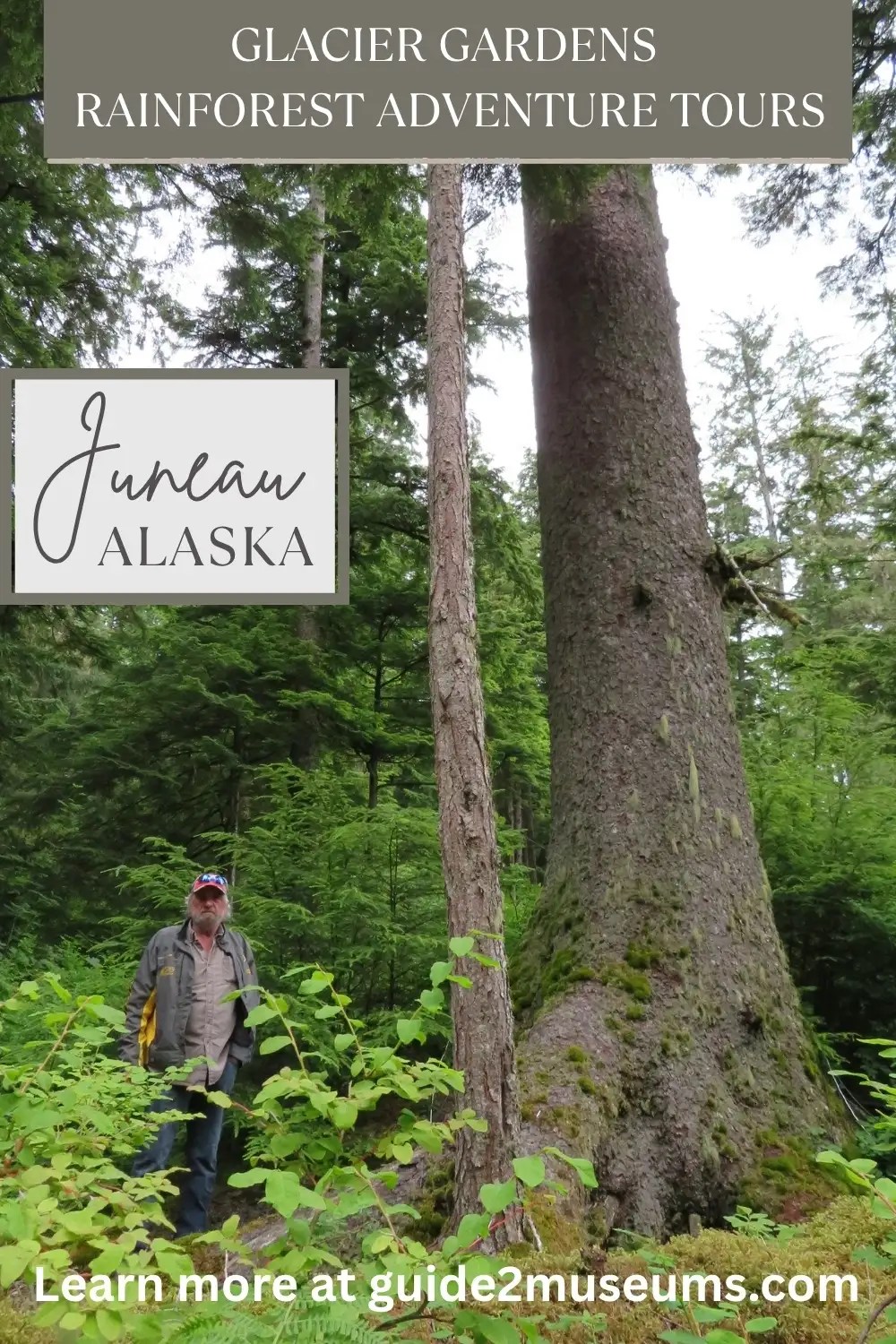
Glacier Gardens, in Juneau, Alaska, is much more than a botanical garden or living plant museum. It’s an opportunity to experience the coastal rainforest that surrounds the city. Whether visitors arrive by air, ferry, or cruise ship, it’s a must-see.
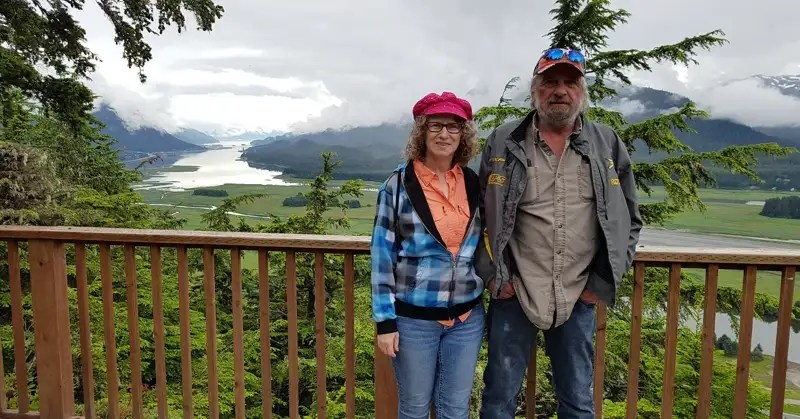
Linda’s Pick of the Exhibits
I love trees–especially big trees. Maybe I inherited the interest from my dad, who spent winters in lumber camps in Ontario back in the late 1940s. All I know is that I find places like the rainforest fascinating.
So, Juneau’s Glacier Gardens was at the top of my list of things to do during our three-day visit. And, since David doesn’t hike, I signed us up for an adventure tour ride up Thunder Mountain in a golf cart.
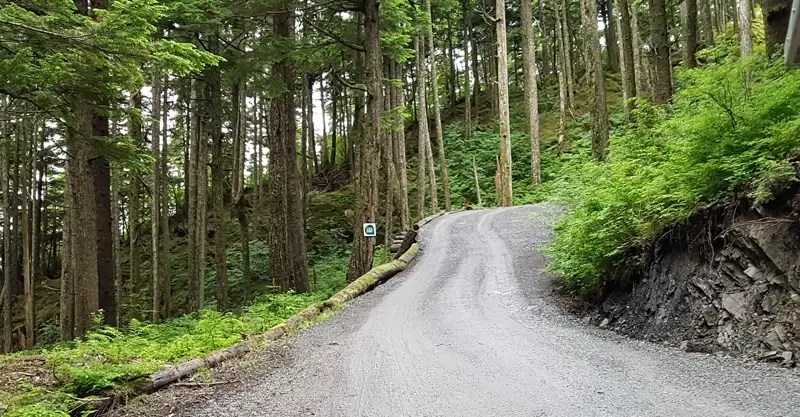
Our driver and guide was Miranda, a college student from Kansas, who’d taken intensive training on the local ecology. We found her to be very authoritative and great to listen to.
The tour begins at near sea level and climbs to about the 600 ft elevation at the Thunder Mountain viewpoint in the Tongass temperate rainforest.
However, there’s no waiting for a view. The one-way road winds up the mountain following natural corridors to protect the trees. And the trees? They’re mainly towering Sitka spruce and western hemlock trees.
How old are the trees in the Tongass temperate rainforest? How big are they?
The Tongass temperate rainforest ecosystem was shaped as the glaciers retreated around 10 to 12 thousand years ago. Its current old-growth has trees up to 700 to 1000 years old, like massive Sitka spruce and western hemlock. About 89% of Tongass old-growth is intact, with trees storing vast carbon due to their extreme age and density.
The biggest trees in the Tongass temperate rainforest are massive Sitka spruce, the state’s official tree. They reach heights of 160 – 250 feet (50 – 75 meters) and diameters up to 16-18 feet (5-5.5 meters) at the base. Western hemlocks and red cedars grow nearly as large, often 100-200 feet tall with 4-8 foot diameters.
About 70% of the Alaska’s bird species are found in the Tongass–that’s about 40% of all the bird species found in North America!
As well as trees, there are over 40 fern species living in the damp, shaded forest. Ranging from tall Northwestern lady ferns with fronds up to 5 ft long (1.5 m) to the small triangular fronds of the Western oak fern, they carpet the damp forest floor.
Our tour wound ever higher up the mountain, bringing new views over the edge of the narrow road. The most fascinating thing here? The corduroy-like road of layered logs.
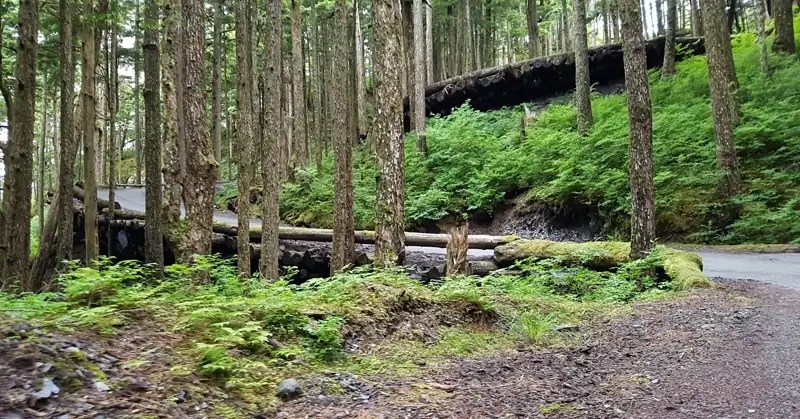
This twisting path through the old growth was built by laying felled trees side-by-side perpendicular to the path. Why? For stability against mudslides and erosion.
Fast Fact: The two-mile long road was part of a private effort to rehabilitate a 1984 landslide site. Builders used chainsaws, bulldozers, and winches to haul 8 to 12 inch diameter logs up the mountainside to build the road. It took many years of seasonal work to complete the project.
What’s in Glacier Gardens?
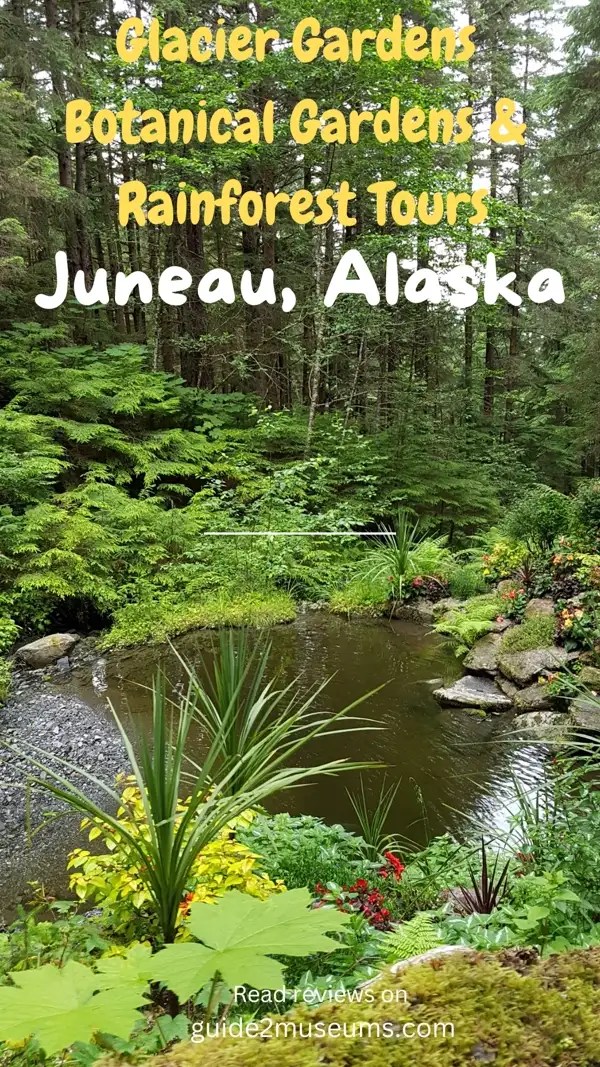
Glacier Gardens is 50-acre botanical garden that serves the nursery and landscaping needs of Juneau. Started by Steve and Cindy Bowhay in 1984 as a nursery business, they bought the additional site in 1994 for stream rehabilitation. The Rainforest Adventure opened to the public in 1998.
The gardens showcase thousands of annuals that thrive in Juneau’s cool, wet climate. However, its quirky upside-down Flower Towers are one of the garden’s key attractions.
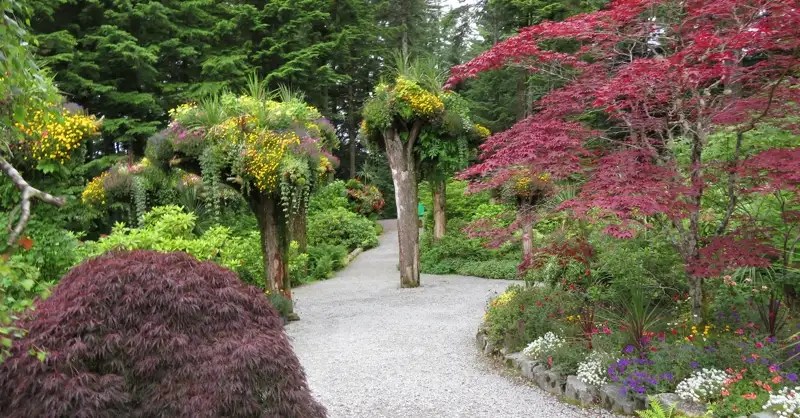
How did the Flower Towers come about? Steve Bowhay, co-owner of the gardens, was landscaping a waterfall that poured into a pond. His goal? To make a heart-shaped pond dedicated to his wife, also a co-owner.
Bowhay was using a rented excavator to move some dirt when things went wrong. He accidentally slammed into a piece of granite! The excavator, of course, got the worst of the situation. Since there wasn’t anything around for him to throw in his frustration, he used the excavator to grab a broken tree stump, flip it upside down, and slam it into the soil.
So, the roots faced the sky. This was Bowhay’s moment of inspiration! Those roots could hold baskets of flowers.
Fast Fact: There are around 100 upside-down Flower Towers in Glacier Gardens. Each flower tree has 75 to 100 plants hung on it.
In addition to the flowers and shuttle tours, Glacier Gardens also has a live eagle cam. It’s focused on a bald eagle nest with resident eagles, Liberty and Freedom. So, visitors can watch right from egg-laying to seeing the babies leave the nest in the summer.
Linda’s Road Trip Tips

We spent our first night in Juneau at the century-old Alaskan Hotel & Bar. It was, however, a little more rustic than we were looking for, so we spent the next two nights at a newer hotel near the airport.
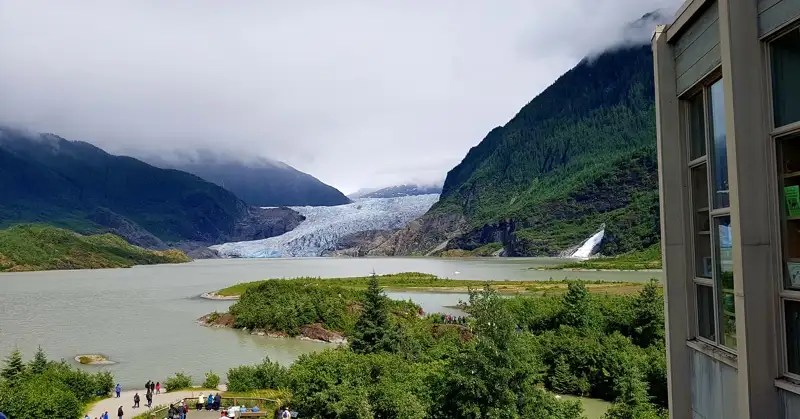
The Mendenhall Glacier is a must-see stop for everyone visiting Juneau. This 13.6 mile long river of ice is in the Tongass National Forest just 12 miles (22 km) from downtown Juneau.
It’s a super-amazing experience, as you can stand on the edge of Mendenhall Lake, and feel the icy chill of the breeze coming off the turquoise waters.
While we had a car for the 20-minute trip, there were dozens of big buses with visitors on tours from the cruise ships.
You can also get a public bus, rent a car, or get an uber during the busy season.
If you’re able, take the Nugget Falls Trail (2 miles round trip) for a close-up look of the falls.
These 377 ft (115 m) falls are fed by a nearby glacier. They plunge into Mendenhall Lake in two tiers.
If you’re lucky, you’ll even see some small icebergs!
And if you want to learn more about the history of the city and local peoples, visit the downtown Alaska State Museum.
Who Should Visit Glacier Gardens?
Glacier Gardens is the perfect place to visit to learn more about the Tongass National Forest. The gardens are in the Earth’s largest remaining temperate rainforest, which has a geological history that goes back over 400 million years.
This natural history museum is ideal for those with mobility issues who are unable to hike into a national forest.
The Rainforest Adventure ride takes you 600 feet up Thunder Mountain for a panoramic view of the Mendenhall Valley and Chilkat Mountains.
Plus, of course, you can smell the amazing earthy scent of the rainforest and feel the cool maritime breeze.
It’s the perfect destination for anyone looking for soft adventure–no risk but lots of rewards. Kids will love it!
The gardens and Rainforest Adventure are designed for all ages and abilities. There are wide paths and a summit boardwalk for added ease. Lower gardens provide access for a self-paced tour. However, some unpaved areas may not be wheelchair-friendly.
We spent a couple of hours enjoying Glacier Gardens, which included the adventure tour. The tour itself lasts about an hour.
How Do You Visit Glacier Gardens?
Juneau isn’t accessible by land. We got to Juneau using the Alaska Marine Highway System, which is a ferry that takes you and your car to various points on the west coast. Many cruise ships also stop in Juneau, plus you can fly in.
Parking: There's lots of on-site parking without additional fees beyond tour admission.
Street Address: 7600 Glacier Highway, Juneau, Alaska.
The museum is open seasonally. Check days, hours, and costs on the Glacier Gardens website.
Learn more on the Glacier Gardens Facebook page.
Take a virtual tour with this Glacier Gardens YouTube video.
Plan your visit with Google maps.
More Things to Do in Alaska
Check out all of guide2museum.com’s reviews of museums in Alaska.
Read More Natural History Museum Reviews
- Glacier Gardens: Juneau Botanical Gardens & Rainforest Tours
- Royal Ontario Museum in Toronto Review
- Amazing Giant Bison, Beaver, Mammoths & More: Yukon Beringia Museum in Whitehorse

- Royal Saskatchewan Museum & World’s Largest T-Rex Dinosaur

- Naranjo Museum: Dinosaurs & Fossils in Lufkin, Texas

- Field Museum: Natural History Museum in Chicago, Illinois