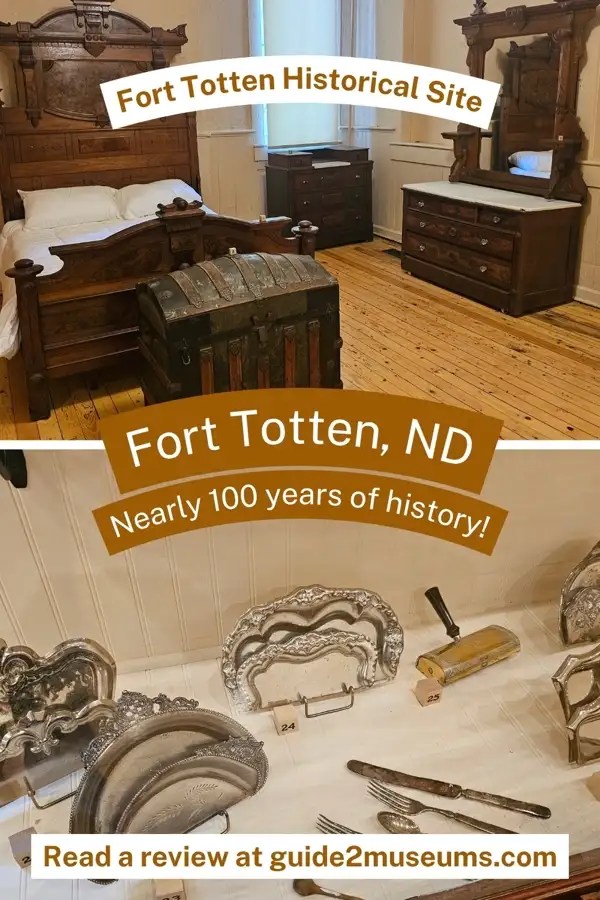
Fort Totten, North Dakota, is an historic site with a diverse history. Its well-preserved buildings, authentic artifacts, and documented stories make it one of the state’s must-see historic sites. Indeed, Fort Totten is a lot more than a quick stop on a holiday itinerary!
Linda’s Pick of the Exhibits
My favorite exhibit at Fort Totten was the gardening section. Perhaps it was the season or my return to gardening myself!
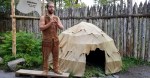
At any rate, according to Mandan history, one of the tribe’s founders was Yellow Corn Maiden. The legend goes that she saved the first corn crop from Sun Man’s burning rays and taught him that the corn should be forever safe from his attacks.
Interestingly, the Hidatsa people had a very precise method of planting their gardens. First, in early April, they planted the perimeter of the garden with sunflowers. Next came the most important crop–the corn. If the plants were touched by frost or bugs, the corn was replanted until the middle of May. Finally, they planted beans, squash, and pumpkins.
The Carrying the Corn dance was performed in the early spring. Its purpose? To sanctify the planting season and find blessing from the Great One Above to make the fields thrive.
Gardens were also important to the inhabitants of the Fort!
Fast Fact: During the fall of 1868 and the winter of 1868-69, after the supply of vegetables from the garden was exhausted, the following articles of food...were found effectual in preventing scurvy...Per 100 rations, ten pounds of dried fruit and five gallons of krout or curried cabbage twice a week; one gallon of molasses, twenty-five pounds of corn meal, and two and one-half gallons of pickles once a week.
~ Assistant Surgeon J.P. Kimball, Fort Buford, 1870 [Fort Totten display quote]
What’s at Fort Totten Historical Site?
The Fort Totten Historical Site consists of around 10 acres of land located within the boundaries of the Fort Totten Indian Reservation. It’s on the southeastern edge of the town of Fort Totten.
So, where does the site’s name come from? It’s from the Totten Trail, which was an overland route from southern Minnesota to the goldfields of Western Montana.
Fast Fact: Fort Totten became a state historic site in 1960. It was listed on the National Register of Historic Places in 1971.
Fort Totten had three distinct periods of usage before becoming an historic site. My favorite was the first, its frontier history. It’s one of the best preserved of the nearly 150 forts constructed on the western frontier.
What are the main periods in Fort Totten’s history?
The three time periods include:
- Frontier Military Post – 1867 to 1890
- Decommissioned and transferred to the Bureau of Indian Affairs in January of 1891 for use as an Indian school
- The Industrial boarding school operated until 1935. Between 1935 and 1939, the site was a tuberculosis preventorium run by the Federal Government. The preventorium provided a boarding school for children at high risk of contracting TB. It returned to being a day and boarding school until 1959.
Established in 1867, the post’s main function was to serve American Indian Policy. Soldiers enforced the peace among settlers near Devils Lake and the Dakota people living on the reservation around it.
How did Devils Lake get its name? It comes from the Dakota phrase Mni Wakan, which means Spirit Water or sacred water. Early Europeans to the area, however, didn’t get the translation quite right. They interpreted the name to be something like a bad spirit. Eventually, that turned into the name Devils Lake.
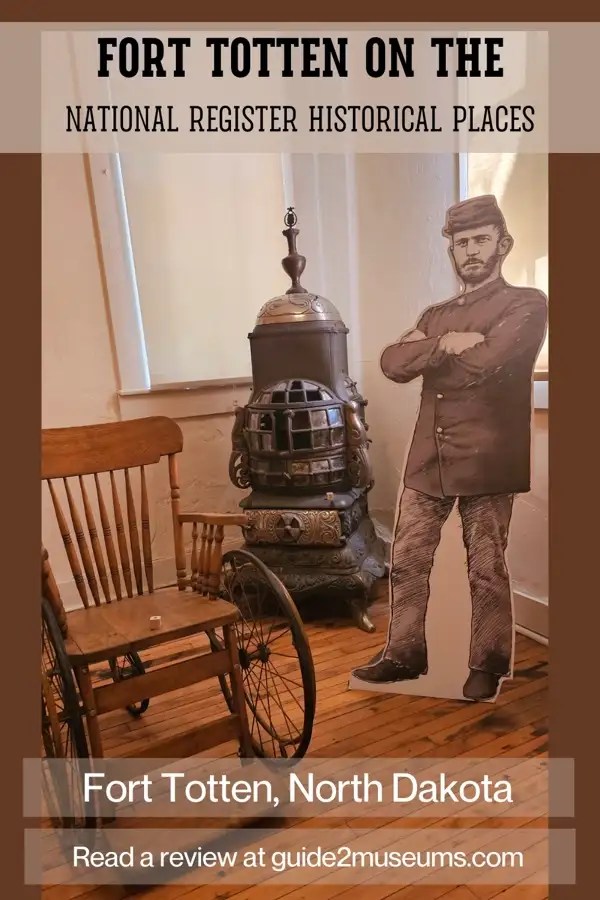
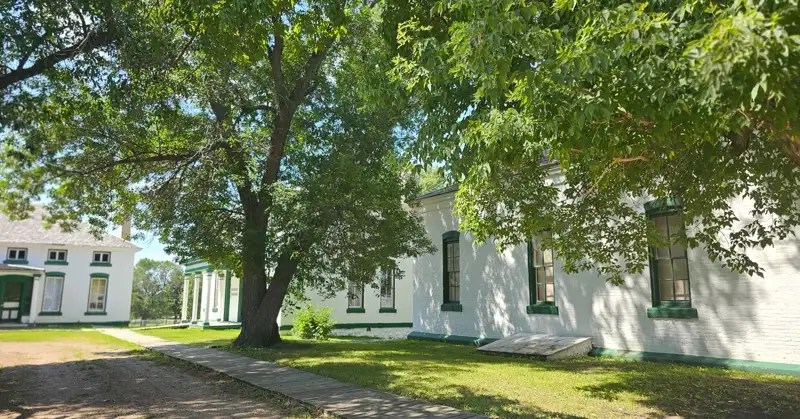
Of course, the main feature of the Fort’s frontier era is the 16 original buildings. They’ve all been well preserved and maintained, initially by the Bureau of Indian Affairs. Then, in 1959, school management became local.
The original buildings, of course, served different purposes over the 93 years before Fort Totten became a state historic site.
My favorite buildings? The Captain/1st Lieutenant Quarters with their historical furnishings.
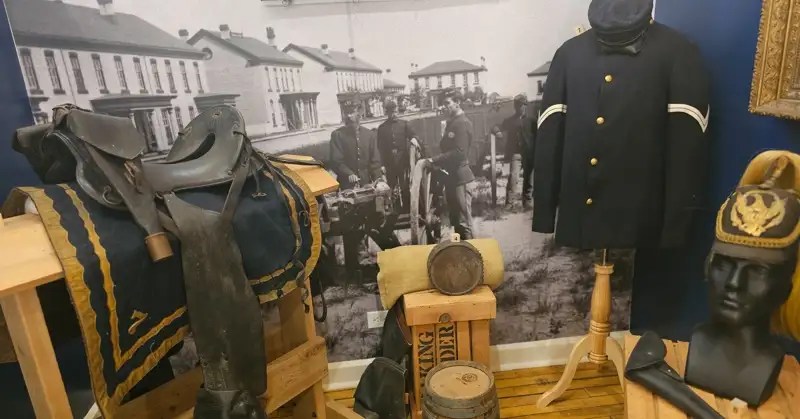
Some of the artifacts I found interesting included:
- Officer’s dress sabre belt (circa 1860s)
- 7th Cavalry horse blanket and saddle (circa 1880s)
- Wood canteen (circa 1860s)
- 7th Cavalry helmet with horse hair plume (circa 1880s)
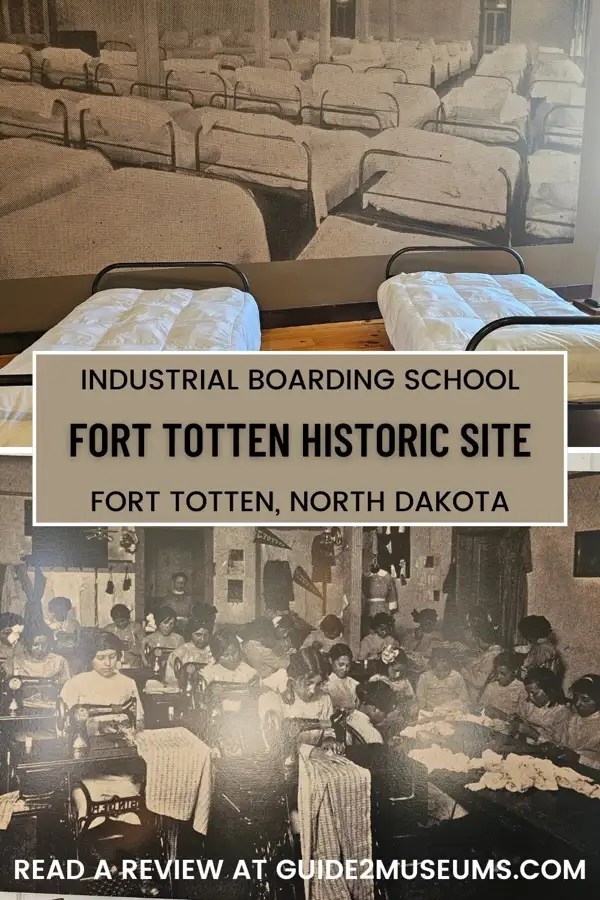
A self-guided tour takes visitors through the site with access to many of the buildings and window exhibit panels in others. Historic photos are used to bring the stories, especially of the lives of children who lived in the Industrial schools, to life.
On the tour, visitors can choose to follow a soldier, a young female Chippewa student, a teacher, or a teenage male Dakota student. The stories are based on oral histories collected from Spirit Lake tribal members and other accounts.
Student Life at Fort Totten
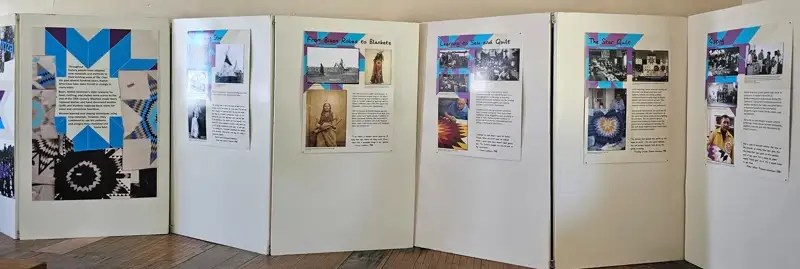
The reservation had been assigned to the Catholic Church by the Board of Commissioners of Indian Affairs. So religious education was part of daily life.
Life, as shown in the exhibits, was militant. Children wore uniforms to ensure uniformity and were required to speak English. To accomplish this, children from various tribes were often grouped together to restrict their use of their first language and birth customs.
Punishments for speaking their own language could be severe, as assimilation into the greater population was a main educational goal.
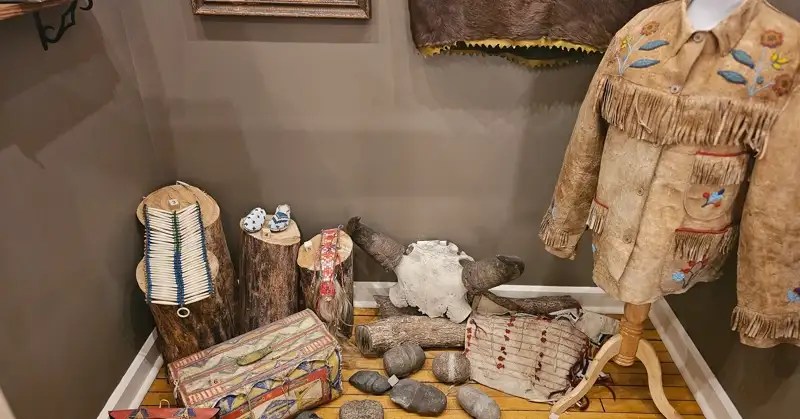
Many of the artifacts on display are from local Indigenous people.
They include such fascinating items as a deer hoof ceremonial necklace (circa 1920) and a Sioux quilled horse hair ornament.
Fast Fact: After Fort Totten became a school, the powder magazine floor was lowered and used for storing flour. Why? About 400 pounds of flour were used daily! That's a lot of flour -- roughly 1 pound of flour daily for the 400 residents.
Pioneer Daughters of the Lake Region Museum
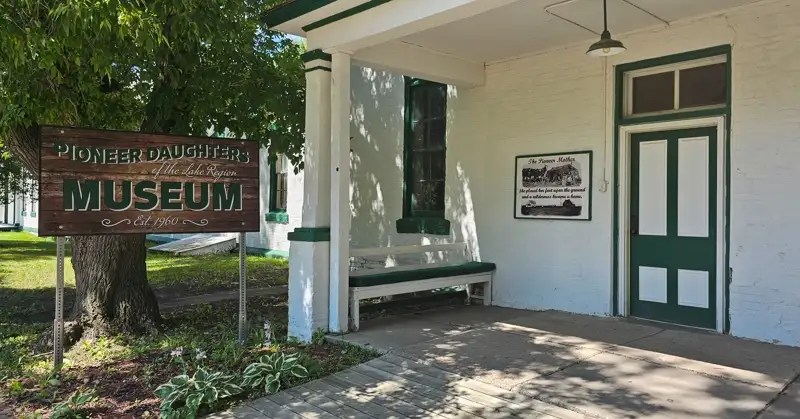
Fort Totten is also home to the Lake Region Pioneer Daughters Museum. It’s situated in the fort’s old hospital/school cafeteria building (Building 7). While the museum isn’t very large, it’s packed with interesting artifacts.
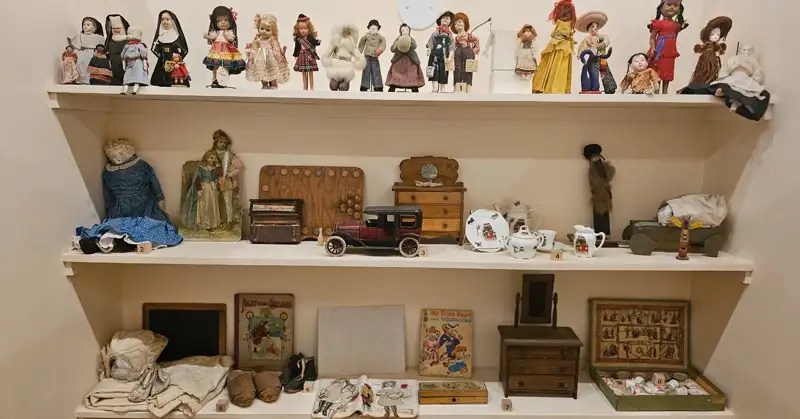
The Pioneer Daughters museum does an excellent job of displaying the collection. All of the pioneer-era household objects are identified and labelled with the names of the people who donated them. Artifacts range from the Minnie H steamboat’s anchor to silver dinnerware service to children’s toys.
There’s also an on-site Totten Trail Historic Inn. Each room has a distinctive personality and historic furnishings that let you immerse yourself in history.
Linda’s Road Trip Tips
We visited Fort Totten on a weekend getaway in Devils Lake, North Dakota. While we’d passed through the small city on many trips, we’d always been interested in learning more about both the city and the lake.
Devils Lake deserves a quick stop, even if you’re just driving through North Dakota on U.S. Highway 2.
Its Downtown Devils Lake Commercial District has 47 properties built between 1885 and 1937.
Most are brick, but there are a wide variety of architectural styles.
We enjoyed the Lake Region Heritage Center, which is housed in the historic U.S. Post Office building.
The regional history was very interesting. As well, the Sheriff’s House Museum was a great stop!
Our favorite dining spot? The Old Main Street Cafe. Prices were good and the taste was great. David enjoyed a steak dinner while I ordered the Rolette chicken fillet served on wild rice. If you don’t have time for a full meal, take a coffee break to get a peek at the pictures on the wall illustrating area history.
Who Should Visit the Fort Totten Historic Site?
Fort Totten is a great family destination for travelers. There’s lots of space for the kids to run around the lawn in the shade of aged trees.
From an historical perspective, the glance into American Indian boarding schools is particularly interesting for the whole family.
The experience can provide an opportunity for families to consider what it was like for children to grow up in an institution focused on making them forget the culture they were born into.
Since the exhibits are in various historic buildings, seeing everything may be challenging for visitors who have mobility issues.
The grounds are generally flat and walkable, with more accessible options at the on-site Pioneer Daughters Museum area.
Restrooms are generally accessible.
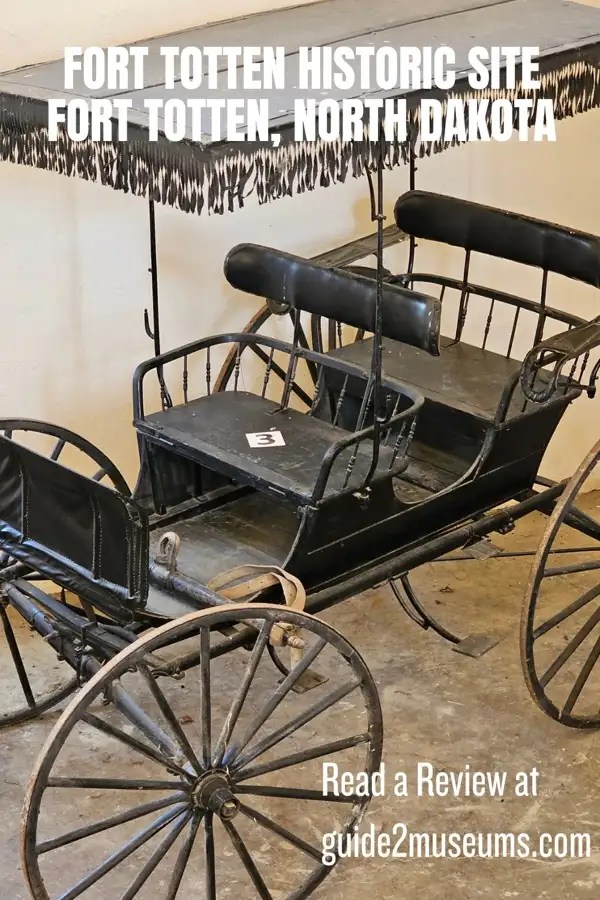
We spent about an hour and a half going through the displays and enjoying the grounds.
How Do You Visit Fort Totten?
Fort Totten is located on a peninsula on the southeastern edge of Devils Lake, about 12 miles south of the city of Devils Lake, North Dakota.
Parking: There's lots of free parking available at the site.
Street Address: 417 Cavalry Circle, Fort Totten, North Dakota
The museum is open seasonally to the general public, with the option to arrange a visit at other times of the year. Check the website for details.
Keep up to date with what’s happening on the Fort Totten State Historic Facebook page.
Learn more with this YouTube video, Forgotten Fort Totten, North Dakota -[Old West Forts] from American Old West Tales.
Plan your visit with Google maps.
Find More Museum Reviews for North Dakota
Check out more reviews of museum attractions in North Dakota on guide2museums.com.
Discover More Historic Sites
- North Pacific Cannery National Historic Site – BC’s Mighty Salmon Runs
- Legendary Stories of Fort Totten Historic Site: North Dakota
- Chinatown in Montreal: A Fascinating Historic Site

- Canada’s Little-Known Cold War Museum: the Diefenbunker

- Discover the Mormon Handcart Historic Site & Devil’s Gate in Wyoming

- Historic Home of 1800s Governor in Lafayette, LA: Alexandre Mouton

- See 100 Miles Across Nebraska From Scotts Bluff National Monument

- Bishop’s Palace in Galveston, Texas: Victorian Era Castle

- Rip Van Winkle Gardens & Historic Mansion: Jefferson Island, Louisiana

- Robinson Roadhouse & Robinson Flag Station: Yukon Ghost Town

- USS Lexington Museum: WWII Aircraft Carrier in Corpus Christi, Texas

- Watson Lake Sign Post Forest Historic Site: Watson Lake, Yukon
- Medalta Museum: Ceramic Arts in Medicine Hat, Alberta

- Claybank Brick Plant National Historic Site: Claybank, Saskatchewan

- The Sheriff’s House Museum & Historic Site: A Hidden Gem in Devils Lake, North Dakota

- Soo Line Historical Museum & Historic Site: Weyburn, Saskatchewan

- Texas Seaport Museum: Gulf Coast History in Galveston, Texas
- Fred Light Museum: Battleford, Saskatchewan

- Frontier Prison Museum: Rawlins, Wyoming

- Toronto’s First Post Office Museum & National Historic Site: Ontario

- The Bastion: Designated Historic Place, Nanaimo, British Columbia
- Hearst Castle: National Historic Landmark in San Simeon, California

- Inglis Grain Elevators National Historic Site: Agricultural History in Inglis, Manitoba

- Evergreen Plantation: National Landmark Site in Edgard, Louisiana

- Cannington Manor Provincial Historic Park: Rich Lifestyles in 1880s Saskatchewan

- Mystic Seaport Museum: Historic Seafaring Village in Mystic, Connecticut

- National Doukhobor Heritage Village: Veregin, Saskatchewan