Salmon have played a central role in the history of Prince Rupert, British Columbia, for thousands of years. Today, visitors to this Canadian province can learn about the days the rivers ran red with salmon at the North Pacific Cannery National Historic Site in nearby Port Edward.

Linda’s Pick of the Exhibits
So what part of this historic site’s exhibits was my favorite? Learning how they got the salmon into the tin!
Back in the day, the average family didn’t have access to a deep freeze. My family didn’t even have power until I was six! So, the best way to ensure a good winter supply of meat was to preserve it.

Seeing just exactly how canning worked with salmon–one of my favorite fish–is what drew me to visit the North Pacific Cannery. And the process definitely brought back a lot of memories of Mom canning chicken and deer meat.
Fast Fact: The canning production process began at the unloading dock. In the early years, a crew of men stood knee-deep in salmon, unloading them from the scow one-by-one with a long-handled, one-tined fork called a peugh.
~ North Pacific Cannery
Initially, of course, the process wasn’t highly mechanized. Preparing the salmon for processing took a whole lot of people!
Filling and packing the cans didn’t happen until the third step. In the earliest days, that meant chunks of salmon cut to size were carried to filling tables in a wicker basket. Workers filled the cans by hand and put them onto a tray that held 12 full-pound or 24 half-pound cans.
Fast Fact: The rotary fish filler was invented in 1912. It filled cans automatically at a rate of 75 - 120 tins per minute using a plunging method. An automatic salter injected a preset amount of salt into each can as it passed through.
~ North Pacific Cannery
After filling, the cans were also weighed to ensure they were full enough. Any that weren’t were topped up at the patching tables. Then, lids were placed on the full cans. A vacuum closing machine became part of the processing line in the 1920’s, replacing the need for workers to put lids on by hand.
Of course, the lids eventually needed to be firmly attached to the tins. In the early years, workers soldered them on by hand. What a lot of work! Later, workers used a manually controlled soldering machine.
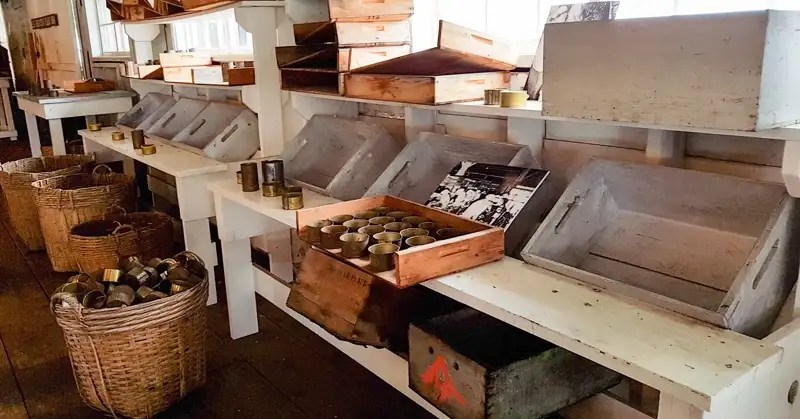
In the early 1900s, manufactured cans were used with a machine called the clincher that fit lids loosely onto the can bodies. Why didn’t they seal them? The process allowed air to escape during cooking, protecting the salmon from direct contact with the steam heat.
During Phase 4, the cans of salmon were cooked.
Initially, unsealed cans were loaded onto racks, lowered into the exhaust vat full of boiling water, and processed for 75 minutes for a first cook. This cook allowed trapped air to escape, then the lids were sealed with solder and sent for a second cook in the retorts (type of pressure cooker) for 65 minutes.

Eventually, this process changed to one with a single cook of about 90 minutes in a machine that turned on to a pressure of 116 degrees Celsius (240 degrees Fahrenheit).
What’s in the North Pacific Cannery National Historic Site?
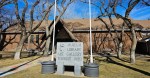
The North Pacific Cannery National Historic Site has all of the equipment in the old cannery complex used to process the salmon catch, along with the village that housed workers.
Parts of the site remain as they were when the complex’s final purpose, as a maintenance and reduction facility for the fishing fleet in Prince Rupert, ended in 1981.

Earlier, in 1968, ABC Packers, which owned and operated the site as the North Pacific Cannery, had closed down.
Is the cannery building original?
The inside timbera that run along the cannery pilings, joists, and ceiling rafters are original. The foundation and walls have been changed over time, but it’s still the same building. Original cedar shingles can still be seen on the 1889 roofline visible from the can loft. Cheaper metal roofing had been installed in the 1920s.
~ North Pacific Cannery National Historic Site
Once all operations had closed, the site was considered for demolition. Luckily, the North Coast Marine Museum Society, a community group formed in 1979 to sponsor the restoration of a cannery. The North Pacific Cannery was designated as a National Historic Site in 1985. In 1987, ownership transferred from BC Packers to the Village of Port Edward.

Cannery Areas
Cannery operations were organized into five distinct areas. They included:
- Phase 1: Catch is delivered to the cannery for processing
- Phase 2: Cleaning and slicing into can-sized pieces
- Phase 3: Fill, weigh, cap, and seal cans
- Phase 4: Sealed cans are cooked
- Phase 5: Boxing and packing for shipping and export
The museum has many historical photos of each stage that are particularly fascinating. Photos cover various decades, so you can see the changes in the machines over time. And of course, there are lots of photos of workers from many backgrounds. All photos are explained in detail, so it’s easy to see how the cannery worked.

Labels from the past century are another great display. Many brands are featured including Carnation, Premium, Silverline, Queen Charlotte and more.
Altogether, there are 25 buildings visitors can tour. The latest restorations were the historic Japanese Triplexes built in the 1960s.
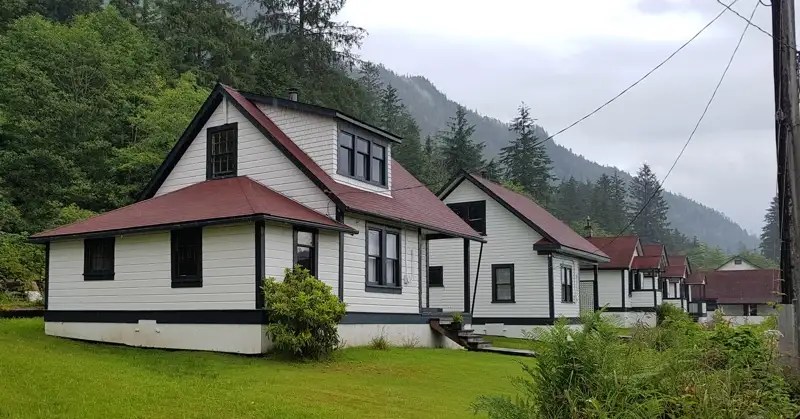
Three modern units are available for rent and a fourth is open to show an historic living space. It also features an interpretive exhibit showing the history of Japanese Canadians at the cannery.
Linda’s Road Trip Tips

We visited the North Pacific Cannery on our return home from driving the Alaska Highway.
Our journey included the Alaska Marine Highway System with a final stop in Prince Rupert. There, we, along with our car, got off the ship.
I highly recommend the Marine Highway as a relaxing way to make a lot of interesting miles along the coast!
When you’re in Prince Rupert, the Harbour Interpretive Centre is a perfect stop to get oriented.
There are some great hiking trails extending east and west from Cow Bay, if you’d like to explore nature on the coast.
Prince Rupert is also home to the very beautiful Museum of Northern British Columbia. With lots of Indigenous art, as well as being housed in a large cedar longhouse, a visit is a real treat. We certainly enjoyed it!
Who Should Visit the North Pacific Cannery?
The North Pacific Cannery is an interesting museum and historic site on many levels.
For those who love tinned salmon, it provides a fascinating history of the product.
For anyone interested in coastal industries, there’s a lot to learn through the various components of the site.
About 75% of the complete historic site is child’s stroller and wheelchair accessible, although there’s a lot of walking involved to see inside all the buildings.
While kids will likely be intrigued by the many vintage machines and tools, parents will need to keep a close watch on the youngest ones as there’s lots of easy access.

We were at the site for a couple of hours, but could certainly have spent more time as we didn’t cover all of the buildings. Unfortunately, we were on a strict timeline. The free guided tour helped ensure we made the most of our time!
How Do You Visit the North Pacific Cannery?
The museum historic site is located 24 km (15 miles) away from the city of Prince Rupert.
Parking: There's lots of free parking available at the site. Public transportation may also be available leaving from Inn on the Harbour and Bank of Montreal in Prince Rupert -- check availability for your visit here.
Street Location: 1889 Skeena Drive, Port Edward, British Columbia.
The museum is open seasonally, so check the North Pacific Cannery website for hours and admission fees.
Keep up to date with what’s happening on the North Pacific Cannery Facebook page.
Take a virtual tour of the North Pacific Cannery with Destination Adventure on YouTube.
Plan your visit with Google maps.




 guide2museums.com